In a significant ruling on the interplay between arrest procedures and narcotics law, the Gauhati High Court has held that for the purpose of Section 43(5) of the Bharatiya Nagarik Suraksha Sanhita, 2023 (BNSS), the time of arrest is determined by the point of effective detention, not the formal arrest memo. The Court dismissed the bail application of a woman accused under the NDPS Act, finding that her detention commenced before sunset, thereby negating the requirement of prior magisterial permission.
Background & Facts
The Genesis of the Case
On 22.07.2026, at approximately 3:30 P.M., reliable source information was received at Lahdoigarh Out Post that a red-coloured Maruti Bolero vehicle bearing Registration No. AS-01-DP-7060 was transporting a large quantity of narcotic drugs concealed inside sealed soap cases. The information was duly entered and registered vide Lahdoigarh O.P. GDE No. 439 dated 22.07.2026.
Pursuant to this information, a police team headed by senior police officers proceeded towards Meleng Meteli and conducted naka checking/searching. The suspected vehicle was intercepted and searched in the presence of independent witnesses after observing mandatory legal formalities.
The Seizure and Arrest
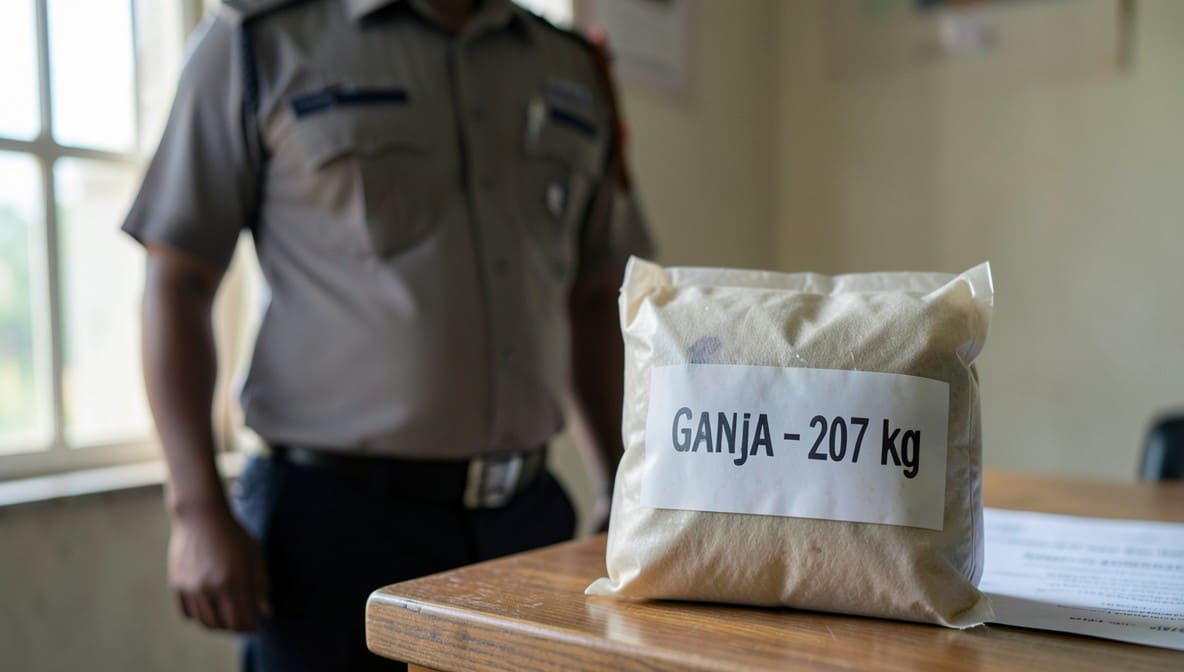
During the search, 29 (twenty-nine) soap cases were recovered from the vehicle, each containing transparent polythene packets filled with a brown-coloured powdery substance suspected to be heroin. The substance was weighed on a digital weighing machine in the presence of independent witnesses and was found to weigh 434.38 grams. The recovered contraband was duly packed, sealed, labelled and seized under a proper seizure memo. The entire search and seizure proceedings were videographed and recorded through the e-Sakshya system.
In addition to the contraband, the police also seized the vehicle and two mobile phones along with SIM cards allegedly belonging to the arrested person. The date and time of seizure was recorded in the seizure list as 22.07.2026 at 6:05 P.M.
The Petitioner's Claim
The petitioner, Asmina Begum, was brought to Teok police station on the night of 22.07.2026 and kept in the lockup throughout the night. She was shown to have been formally arrested at 11:30 A.M. on 23.07.2026 at Teok police station. The petitioner claimed that sunset at Jorhat, the place of arrest, occurred at 6:06 P.M. on 22.07.2026, whereas the time of arrest was stated as 6:30 P.M. on the same date. Thus, the stated time of arrest was after sunset, allegedly violating Section 43(5) of the BNSS.
Procedural History
- 22.07.2026: FIR lodged by WSI Baby Neog, In-charge of Lahdoigarh Out Post, before the Officer-in-Charge of Teok Police Station
- 22.07.2026: Teok P.S. Case No. 73/2026 registered under Sections 21(c)/25/27A/29(1) of the NDPS Act
- 23.07.2026: Formal arrest of the petitioner at 11:30 A.M.
- 2026: Bail application filed under Section 483 of BNSS, 2023 before Gauhati High Court
- 02.09.2026: Judgment reserved
- 09.09.2026: Judgment pronounced
Relief Sought
The petitioner sought bail in connection with Teok P.S. Case No. 73/2026 under Sections 21(c)/25/27A/29(1) of the NDPS Act, primarily on the ground that her arrest was illegal for being effected after sunset without prior permission of the magistrate.
The Legal Issue
The central question was whether the arrest of a woman after sunset without obtaining prior permission of the Judicial Magistrate of the first class, as mandated by Section 43(5) of the BNSS, renders the arrest illegal and entitles the accused to bail, particularly when the formal arrest was shown at a later time than the actual detention.
Arguments Presented
For the Petitioner
Learned Senior Counsel Mr. B. M. Choudhury submitted that the petitioner, being a lady, was arrested after sunset without obtaining the permission of the magistrate as required under Section 46(5) of the BNSS, rendering the arrest illegal and entitling her to bail. It was argued that the petitioner was brought to Teok police station on the night of 22.07.2026 and taken into police custody then itself, kept in the lockup throughout the night, and only formally arrested at 11:30 A.M. on 23.07.2026. The sunset at Jorhat occurred at 6:06 P.M. on 22.07.2026, while the time of arrest was stated as 6:30 P.M. Reference was made to the co-ordinate Bench decision in Dr. Sangeeta Dutta v. State of Assam and Anr., reported in 2025 SCC Online GAU 4847.
For the Respondent
Learned Additional P.P. Mr. P. Borthakur submitted that the provisions of Section 43(5) of the BNSS are only directory in nature and non-compliance would not render the arrest illegal. Reliance was placed on the decision of the High Court of Tripura in Anawora Begam v. State of Tripura (Bail Application No. 137 of 2025, decided on 16.03.2026), which held that non-compliance of Section 46(4) of the Cr.P.C. (corresponding to Section 43(5) of the BNSS) would not confer an indivisible right upon the accused to be released on bail in every case.
The Court's Analysis
The Court first reproduced Section 43(5) of the BNSS, which reads: "Save in exceptional circumstances, no woman shall be arrested after sunset and before sunrise, and where such exceptional circumstances exist, the woman police officer shall, by making a written report, obtain the prior permission of the Judicial Magistrate of the first class within whose local jurisdiction the offence is committed or the arrest is to be made."
The Court then examined Section 42(1)(d) of the NDPS Act, which provides for detention, search, and arrest. The Court observed that this provision contemplates two forms of detention: first, detention simpliciter, during which the petitioner is not formally arrested and no memorandum of arrest is prepared; and second, detention followed by formal arrest at a subsequent stage, after the concerned officer arrives at the requisite satisfaction.
The Court relied on the Supreme Court's decision in Niranjan Singh & Anr. v. Prabhakar Rajaram Kharote & Ors., (1980) 2 SCC 559, which held that a person under the control of the Court or in the physical hold of an officer exercising coercive authority is considered to be in custody. The Court quoted:
"When is a person in custody, within the meaning of Section 439 CrPC? When he is in duress either because he is held by the investigating agency or other police or allied authority or is under the control of the court having been remanded by judicial order, or having offered himself to the court's jurisdiction and submitted to its orders by physical presence."
The Court also considered the decisions in Directorate of Enforcement v. Subhash Sharma, 2025 SCC OnLine SC 240, and Dr. Sangeeta Dutta (supra), concluding that the crucial factor is the point of time from which the petitioner was no longer a free agent to move as she pleased. That point commences from the time the petitioner is detained by an authority with coercive powers, regardless of whether any formal arrest has been made.
The Court held that for determining whether the petitioner was arrested before or after sunset, the relevant point of time is when she was under effective detention. Since the seizure list recorded the date and time of seizure as 22.07.2026 at 6:05 P.M., the detention must have taken place sometime prior to that, as search and seizure under Section 42(1)(d) is preceded by detention. The Court concluded:
"Such detention, for the purposes of determining the commencement of the period of custody, is liable to be treated as the time of arrest within the meaning of Section 46 read with Section 43(5) of the BNSS, or Section 46(4) of the Cr.P.C., as the case may be."
The Court verified that sunset on 22.07.2026 was subsequent to 6:05/6:06 P.M., when the arrest was effected. Therefore, the petitioner was arrested before sunset, and Section 43(5) of the BNSS was not attracted.
Additionally, the Court noted that a commercial quantity of contraband drugs was recovered from the conscious possession of the petitioner, attracting the bar under Section 37 of the NDPS Act.
The Verdict
The bail application was dismissed. The Court held that the petitioner was arrested before sunset on 22.07.2026, and therefore there was no scope for application of Section 43(5) of the BNSS. The Court further held that the bar under Section 37 of the NDPS Act was clearly attracted given the recovery of a commercial quantity of contraband (434.38 grams of heroin) from the conscious possession of the petitioner. The case diary was directed to be sent back.
What This Means For Similar Cases
Effective Detention, Not Formal Arrest, Determines Arrest Time
This judgment establishes a critical principle: for the purpose of Section 43(5) of the BNSS (and Section 46(4) of the Cr.P.C.), the time of arrest is the point of effective detention, not the time recorded in the formal arrest memo. Practitioners must now scrutinize the entire sequence of events, including the time of seizure, to determine when custody actually commenced. The Court's reasoning, drawing from Niranjan Singh and Subhash Sharma, makes it clear that the moment a person's freedom of movement is curtailed by an authority with coercive powers, custody begins.
The 24-Hour Rule Under Article 22(2) Commences from Detention
The Court explicitly held that the period of 24 hours prescribed for production of the arrestee before the nearest Magistrate under Article 22(2) of the Constitution of India commences from the time of effective detention, excluding only the time necessarily required for travelling from the place of arrest to the Court. This has significant implications for computing the constitutional safeguard against illegal detention.
NDPS Act Section 37 Bar Remains a Hurdle
Even where procedural violations are alleged, the stringent conditions of Section 37 of the NDPS Act continue to apply in cases involving commercial quantities. The Court's observation that the bar under Section 37 was attracted reinforces that bail in NDPS cases requires satisfaction of both the statutory conditions and the procedural compliance arguments.
Practical Takeaways for Practitioners
- Always examine the seizure memo time, GDE entries, and other contemporaneous records to establish the actual time of detention
- The formal arrest memo time is not conclusive for determining compliance with sunset restrictions
- In NDPS cases, procedural violations must be weighed against the Section 37 bar, which requires the court to be satisfied that the accused is not guilty and is not likely to commit any offence while on bail