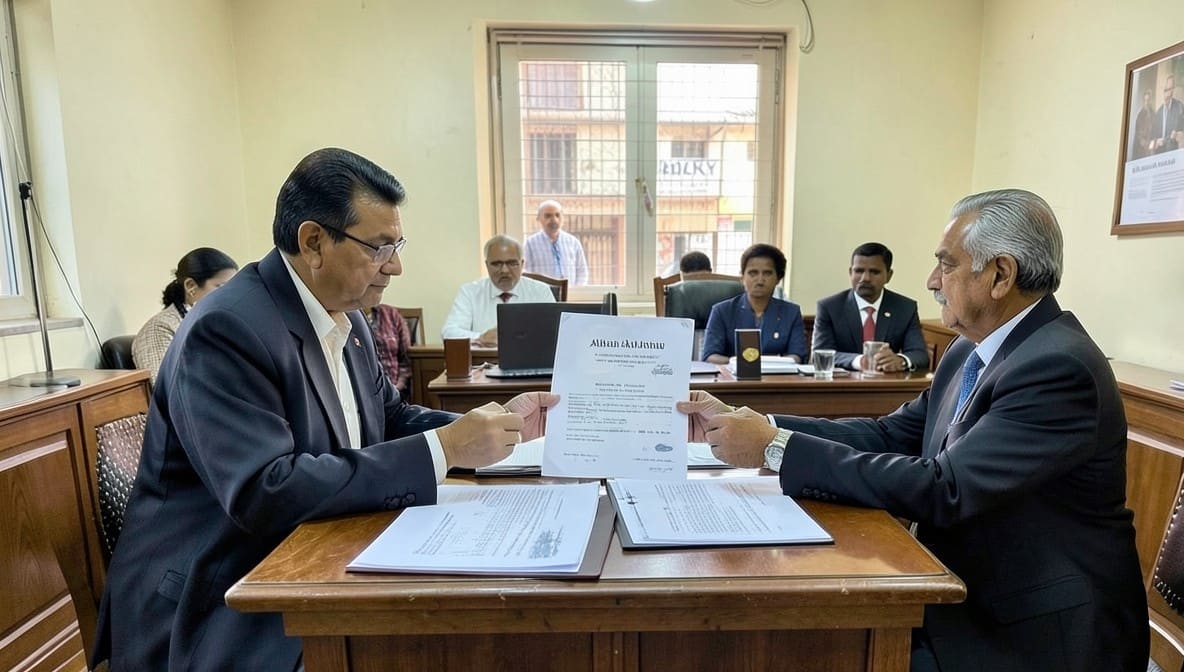
The Allahabad High Court has reaffirmed that proceedings under Section 12 of the Protection of Women from Domestic Violence Act, 2005 are entitled to strong judicial protection, and can only be quashed under Section 528 of the BNSS in cases of gross illegality or abuse of process. This ruling reinforces the legislative intent behind the DV Act as a welfare statute designed to shield women from domestic abuse.
Background & Facts
The Dispute
The applicants, Ravi and five others, sought to quash proceedings initiated under Section 12 of the Protection of Women from Domestic Violence Act, 2005, pending before the Civil Judge (Junior Division)/Family Court (Crime against Women), Auraiya, in Case No. 87 of 2024. The proceedings were instituted by opposite party no. 2, Smt. Soni, who is the wife of applicant no. 1. The remaining applicants are her in-laws.
Key Facts
- The marriage between applicant no. 1 and opposite party no. 2 was solemnized on 06.02.2022
- Opposite party no. 2 resided in the matrimonial home after marriage
- She alleged domestic violence and left the matrimonial home
- On the basis of these allegations, she filed a complaint under Section 12 of the DV Act, 2005
- Notice has been issued by the Magistrate’s court in response to the complaint
- The applicants contend that the complaint is malicious and filed solely to harass them
- No specific acts of alleged domestic violence are detailed in the application
Procedural History
- 06.02.2022: Marriage between applicant no. 1 and opposite party no. 2
- Date unknown (prior to 2024): Opposite party no. 2 left matrimonial home alleging domestic violence
- 2024: Complaint filed under Section 12 of the DV Act, 2005 before the Civil Judge (JD)/FTC (Crime against Women), Auraiya
- Case No. 87 of 2024: Proceedings initiated; notice issued
- 2026: Application filed under Section 528 of the BNSS before the Allahabad High Court seeking quashing of proceedings
The Parties' Positions
For the Applicants
- Argued that the complaint under Section 12 is malicious and fabricated
- Claimed the proceedings are an abuse of process intended to harass in-laws
- Asserted that no credible evidence of domestic violence exists
- Sought quashing of the entire proceedings under Section 528 of the BNSS (equivalent to Section 482 CrPC)
For the Respondent/State
- Opposed the quashing prayer
- Emphasized that the DV Act is a protective, welfare-oriented statute
- Highlighted that the complainant is the wife of applicant no. 1 and has a right to seek relief under the Act
- Did not contest the factual allegations but argued that the court must not interfere at this preliminary stage
Relief Sought
The applicants sought quashing of Case No. 87 of 2024 under Section 12 of the DV Act, 2005, and termination of all proceedings pending before the Magistrate’s court.
The Legal Issue
Can proceedings initiated under Section 12 of the Protection of Women from Domestic Violence Act, 2005, be quashed under Section 528 of the BNSS merely on the assertion that the complaint is malicious or filed with mala fide intent?
Arguments Presented
For the Appellant/Petitioner
The applicants relied on the general principle that courts may quash proceedings under Section 528 BNSS where the complaint is frivolous, vexatious, or an abuse of process. They argued that since the complaint was filed after the wife had left the matrimonial home and no corroborative evidence of violence was presented, the proceedings were an instrument of harassment. They contended that the in-laws, who are not spouses, should not be dragged into proceedings without prima facie evidence of their involvement in domestic violence.
For the Respondent/State
The State, through the Additional Government Advocate, opposed the application by invoking the protective character of the DV Act. It emphasized that the Act was enacted to provide a civil remedy to women facing domestic violence, and that the threshold for initiating proceedings under Section 12 is intentionally low to ensure accessibility. The State argued that allegations of malice are not sufficient to justify quashing at the threshold stage, especially when the complainant is the aggrieved person under the Act.
The Court's Analysis
The Court undertook a detailed examination of the Supreme Court’s recent judgment in Shaurabh Kumar Tripathi v. Vidhi Rawal (2025 SCC OnLine SC 1158), which directly addressed the maintainability of quashing petitions under Section 482 CrPC (now Section 528 BNSS) against proceedings under Section 12 of the DV Act.
"When it comes to exercise of power under Section 482 of the CrPC in relation to application under Section 12(1), the High Court has to keep in mind the fact that the DV Act, 2005 is a welfare legislation specially enacted to give justice to those women who suffer from domestic violence and for preventing acts of domestic violence. Therefore, while exercising jurisdiction under Section 482 of the CrPC for quashing proceedings under Section 12(1), the High Court should be very slow and circumspect."
The Court noted that the Supreme Court had explicitly held that interference under Section 482 BNSS is permissible only in cases of "gross illegality or gross abuse of the process of law." The Court further emphasized that the DV Act creates a unique procedural regime where the complainant is not required to prove her case at the stage of initiating proceedings. The issuance of notice under Section 12 is not a determination of guilt but a mechanism to afford the aggrieved person an opportunity to be heard.
The Court observed that the applicants have an efficacious alternative remedy: they may file a detailed counter-affidavit before the Magistrate’s court, contest the allegations, and present evidence. Moreover, any adverse order passed by the Magistrate is appealable under Section 29 of the DV Act to the Court of Session.
The Court rejected the applicants’ submission that the complaint’s malice alone warranted quashing. It held that allegations of mala fide intent cannot be adjudicated at the quashing stage without a full evidentiary record. The Court reiterated that the DV Act’s welfare objectives demand judicial restraint, and that premature interference risks undermining the very purpose for which the law was enacted.
The Verdict
The application under Section 528 BNSS was dismissed. The Court declined to quash the proceedings under Section 12 of the DV Act, 2005. However, it directed that if the applicants file a counter-affidavit or objection before the concerned Magistrate’s court within two months, the same shall be decided expeditiously in accordance with law.
What This Means For Similar Cases
Quashing Under BNSS Section 528 Is Exceptional in DV Cases
- Practitioners must not file quashing petitions under Section 528 BNSS merely on grounds of malice or lack of corroboration in DV Act complaints
- Courts will not entertain such petitions unless there is a clear case of abuse of process, such as fabricated evidence, collusion, or use of the Act for extraneous purposes
- The burden to demonstrate gross illegality rests squarely on the applicant
Alternative Remedies Are Sufficient and Must Be Exhausted
- Applicants must first file a detailed counter-affidavit before the Magistrate
- Any adverse order is appealable under Section 29 of the DV Act to the Court of Session
- Quashing petitions under Section 528 BNSS are not a substitute for trial or appellate remedies
- Delay in filing objections may be viewed as acquiescence
DV Act Proceedings Are Not Subject to Early Dismissal
- The issuance of notice under Section 12 does not imply a prima facie finding of guilt
- The Act’s low threshold for initiating proceedings is intentional and constitutionally valid
- Courts must not apply civil litigation standards to quasi-criminal welfare proceedings
- Legal aid and procedural flexibility under the DV Act must be preserved