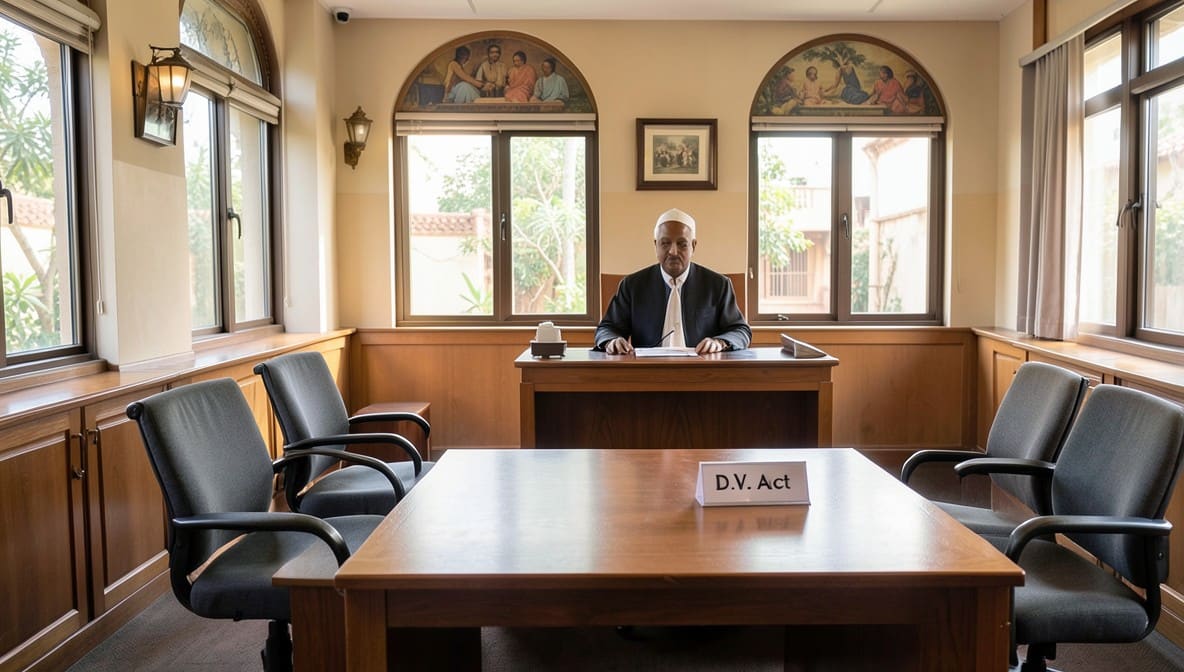
The Madhya Pradesh High Court has reaffirmed that proceedings under the Protection of Women from Domestic Violence Act, 2005 must be heard at the place where the aggrieved woman resides, rejecting attempts by accused parties to shift jurisdiction on grounds of personal inconvenience. This ruling reinforces the statutory intent of providing immediate, accessible, and safe legal recourse to victims of domestic violence.
Background & Facts
The Dispute
The petitioners - Abdul Hussain, Ruksana, and Islam Khan - sought transfer of Case No. 879/2025 (M.J.C.R.), pending before the Judicial Magistrate First Class, Bhind, to the Judicial Magistrate First Class, Morena. The case arises from an application filed by the respondent, Smt. Nasrin Neelofar, wife of Petitioner No. 1, under Section 12 of the Protection of Women from Domestic Violence Act, 2005 (PWDVA). The respondent alleges sustained physical and mental cruelty, unlawful dowry demands, and harassment by the petitioners, compelling her to leave the matrimonial home and reside with her parents in Bhind.
Key Facts
- The respondent filed her application under Section 12 of PWDVA on an undisclosed date in 2025, before the Judicial Magistrate First Class, Bhind
- The respondent is currently residing in Bhind, where the alleged acts of domestic violence occurred
- Petitioner No. 1 had previously filed a petition for restitution of conjugal rights before the Family Court, Morena, which was allowed by order dated 20.01.2020
- Despite the restitution order, the respondent did not resume cohabitation, citing continued abuse
- Petitioner No. 1 claims to be suffering from cancer and undergoing continuous medical treatment
- Petitioners No. 2 and 3 are elderly, infirm, and dependent on Petitioner No. 1 for care
- No medical records dated 2025 or later were submitted by Petitioners No. 2 and 3; records submitted for Petitioner No. 1 were from 2024
- The respondent is employed and solely responsible for the upbringing and maintenance of her minor children
Procedural History
- 20.01.2020: Family Court, Morena, granted restitution of conjugal rights in favor of Petitioner No. 1
- 2025: Respondent filed application under Section 12 PWDVA before Judicial Magistrate First Class, Bhind (Case No. 879/2025)
- 17.03.2026: Petitioners filed M.C.R.C. No. 59499/2025 before the High Court of Madhya Pradesh at Gwalior seeking transfer of proceedings to Morena
The Parties' Positions
Petitioners' Claim: The respondent is willfully neglecting marital obligations; the petitioners are physically unable to travel to Bhind due to illness and advanced age; transfer to Morena is necessary for fair participation.
Respondent's Claim: The petitioners are attempting to delay and frustrate proceedings; the respondent’s residence in Bhind is a result of safety concerns; the PWDVA mandates that proceedings be held where the aggrieved woman lives; medical claims are unsubstantiated and insufficient.
Relief Sought
The petitioners sought transfer of Case No. 879/2025 from the Court of Judicial Magistrate First Class, Bhind, to the Court of Judicial Magistrate First Class, Morena.
The Legal Issue
The central question was whether the convenience of the accused, including alleged illness and advanced age, can justify transfer of proceedings under the Protection of Women from Domestic Violence Act, 2005, from the jurisdiction where the aggrieved woman resides and where the cause of action arose.
Arguments Presented
For the Petitioner
The petitioners argued that Petitioner No. 1’s cancer and ongoing treatment make frequent travel to Bhind medically unfeasible. They further contended that Petitioners No. 2 and 3, being elderly and infirm, are entirely dependent on Petitioner No. 1 and cannot attend proceedings in Bhind. They submitted that the Family Court’s restitution order demonstrated the respondent’s non-cooperation, implying bad faith in initiating the PWDVA case. They asserted that the transfer would ensure equitable access to justice for the accused.
For the Respondent
The respondent countered that the PWDVA is a protective statute designed to ensure immediate and accessible relief to women facing domestic violence. She emphasized that she resides in Bhind due to fear of further abuse and that the cause of action arose there. She argued that the petitioners’ medical claims were inadequately documented and that legal remedies such as exemption from personal appearance were available. She further alleged suppression of facts regarding domestic violence and characterized the petition as an abuse of process to delay justice.
The Court's Analysis
The Court examined the legislative intent behind the Protection of Women from Domestic Violence Act, 2005, particularly Section 28, which provides that proceedings may be instituted in the jurisdiction where the aggrieved person resides, carries on business, is employed, or is present. The Court held that the Act’s primary objective is to ensure the safety, dignity, and convenience of the aggrieved woman.
"The proceedings under the Protection of Women from Domestic Violence Act, 2005 are intended to provide expeditious and efficacious relief to an aggrieved woman, and the convenience and safety of the aggrieved party are of paramount consideration."
The Court rejected the petitioners’ reliance on personal hardship, noting that mere inconvenience to one party cannot override the statutory rights of the aggrieved. It observed that the petitioners had not demonstrated any exceptional circumstances warranting transfer, and that their medical documentation was outdated and incomplete, particularly for Petitioners No. 2 and 3.
The Court further noted that the law provides alternative remedies for accused persons unable to attend court, including representation through counsel and applications for exemption from personal appearance under Section 27 of the PWDVA and Section 317 CrPC. These remedies, the Court held, render the plea of transfer unnecessary and unjustified.
The Court also emphasized that the petitioners’ conduct, including the alleged suppression of facts regarding domestic violence, indicated a lack of clean hands, disqualifying them from invoking the Court’s equitable jurisdiction.
The Verdict
The petition was dismissed. The Court held that Case No. 879/2025 must remain pending before the Judicial Magistrate First Class, Bhind, as the respondent resides there and the cause of action arose within that jurisdiction. No transfer was ordered. The Court further observed that the petition was an attempt to delay proceedings and was therefore not maintainable.
What This Means For Similar Cases
Convenience of the Accused Is Not a Ground for Transfer
- Practitioners must not rely on personal hardship, illness, or age of the accused to seek transfer of PWDVA proceedings
- Courts will prioritize the safety and convenience of the aggrieved woman over logistical difficulties faced by the accused
- Applications for exemption from personal appearance under Section 317 CrPC or Section 27 PWDVA are the proper legal remedies
Jurisdiction Is Determined by the Victim’s Residence
- The place where the aggrieved woman resides at the time of filing is the decisive jurisdictional factor under Section 28 PWDVA
- Even if the matrimonial home was elsewhere, proceedings may be filed where the woman is currently living due to fear of violence
- Courts will not entertain attempts to shift jurisdiction to a location more favorable to the accused
Suppression of Material Facts Bars Equitable Relief
- Petitioners who suppress allegations of domestic violence or misrepresent facts risk dismissal on grounds of unclean hands
- Courts will scrutinize the conduct of petitioners seeking transfer in PWDVA matters with heightened vigilance
- Any attempt to use procedural mechanisms to delay justice will be viewed as abuse of process