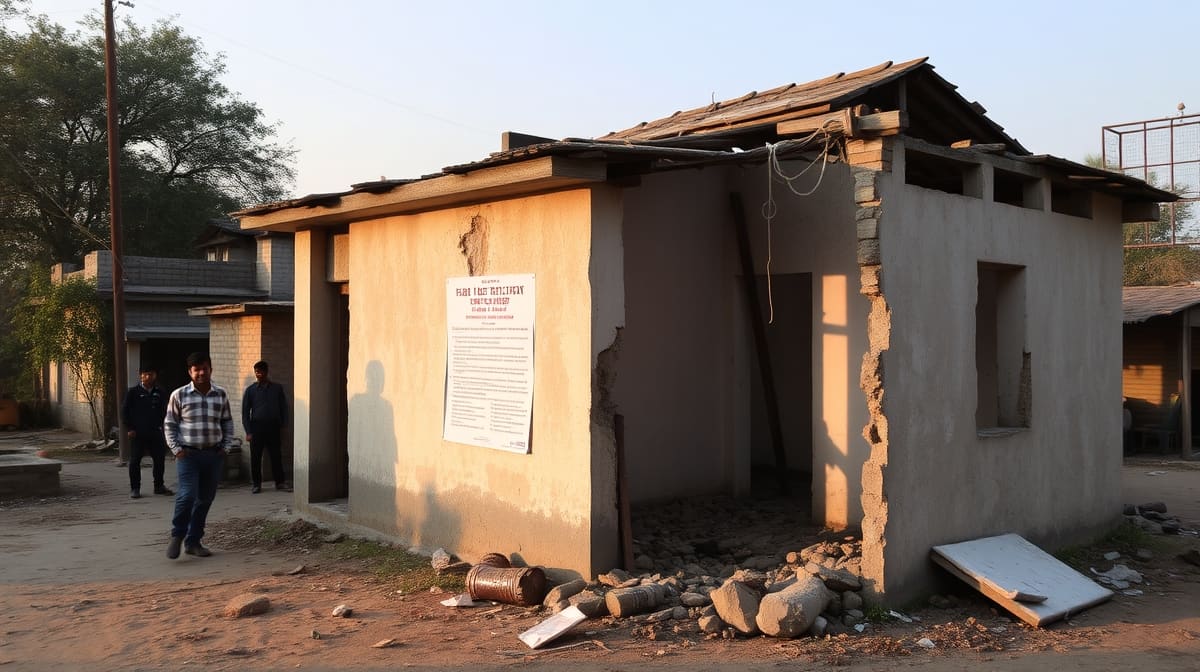
The Allahabad High Court has reaffirmed that the state cannot proceed with demolition of private property without completing all statutory and procedural safeguards. In a decisive order, the Court stayed enforcement of a demolition notice pending final determination of legal rights, emphasizing that due process is non-negotiable under Article 21.
Background & Facts
The Dispute
The petitioner, Smt. Qamar Jahan, owns a residential structure and/or commercial shop located in Uttar Pradesh. On 15.04.2026, respondent no. 5, a municipal or urban development authority, issued a demolition notice alleging unauthorized construction. The notice directed immediate removal of the structure without providing the petitioner an opportunity to be heard or to present documentation of compliance with building regulations.
Key Facts
- The petitioner has been in continuous possession of the property since at least 2018
- The structure was constructed in 2020 following verbal guidance from local authorities
- No formal notice of violation, show-cause notice, or hearing was issued prior to the demolition notice dated 15.04.2026
- The petitioner had not received any prior order of illegal construction under the Uttar Pradesh Urban Planning and Development Act, 1973
- The demolition notice was issued while the petitioner’s writ petition was pending before this Court
Procedural History
- 15.04.2026: Demolition notice issued by respondent no. 5
- 12.05.2026: Writ Petition (Writ-C No. 18513 of 2026) filed before the Allahabad High Court
- 06.05.2026: Respondent no. 5 produced inspection report and instruction memo (taken on record)
- 07.05.2026: Judgment delivered in Syed Abbas Murtaza Shamsi v. State of U.P. (Writ-C No. 16633 of 2026), holding that demolition without due process violates Article 21
- 12.05.2026: Hearing in the present petition; counsel for petitioner relied on the Shamsi judgment
- 12.05.2026: Respondents did not dispute the applicability of the Shamsi precedent
The Parties' Positions
Petitioner: Argued that the demolition notice was issued in violation of natural justice, without any prior inquiry, opportunity of hearing, or compliance with Section 15 of the UP Urban Planning Act. Asserted that the structure was built in good faith based on prior administrative acquiescence.
Respondents: Did not contest the petitioner’s reliance on the Shamsi judgment. Did not file a counter-affidavit or dispute the factual assertions regarding lack of procedural compliance.
Relief Sought
The petitioner sought:
- Quashing of the demolition notice dated 15.04.2026
- A writ of mandamus restraining respondents from demolishing the structure without acquiring the property
- A writ restraining respondents from forcing the petitioner to remove or demolish the construction
The Legal Issue
The central question was whether the state can issue and enforce a demolition notice against private property without first providing a reasonable opportunity of hearing and completing statutory inquiry under the Uttar Pradesh Urban Planning and Development Act, 1973, and whether such action violates Article 21 of the Constitution.
Arguments Presented
For the Petitioner
The petitioner’s counsel relied on the recent judgment in Syed Abbas Murtaza Shamsi v. State of U.P., which held that demolition without a prior show-cause notice, opportunity of hearing, and adjudication of legality constitutes a violation of natural justice and procedural due process under Article 21. It was submitted that the state cannot act as judge in its own cause and that the petitioner’s right to livelihood and shelter cannot be extinguished summarily.
For the Respondent
The respondents did not dispute the petitioner’s submissions or the applicability of the Shamsi precedent. No counter-arguments were presented on the merits of due process or statutory compliance.
The Court's Analysis
The Court observed that the respondents did not contest the petitioner’s reliance on the Shamsi judgment, which had already laid down the binding principle that demolition of property without adherence to procedural safeguards is unconstitutional. The Court noted that the demolition notice dated 15.04.2026 was issued during the pendency of this writ petition, raising serious concerns about abuse of power and mala fide intent.
"The right to life under Article 21 includes the right to shelter and livelihood. A demolition notice issued without any prior inquiry, hearing, or adjudication cannot be countenanced under any rule of law."
The Court emphasized that the state’s power to demolish illegal constructions is not absolute. It must be exercised in accordance with the principles of fairness, reasonableness, and proportionality. The absence of any record of prior notice, opportunity to explain, or determination by a competent authority rendered the impugned notice legally unsustainable.
The Court further held that the Shamsi judgment, delivered just five days prior, was directly on point and binding on the present bench. Since the respondents did not seek to distinguish the case or challenge its reasoning, the Court had no basis to depart from its precedent.
The Verdict
The writ petition was disposed of in terms of the judgment in Syed Abbas Murtaza Shamsi v. State of U.P. The Court directed all respondents to maintain the status quo as on 12.05.2026 with respect to the petitioner’s house or shop. No demolition, forced removal, or interference with the structure shall be permitted until completion of all statutory procedures, including issuance of a show-cause notice, opportunity of hearing, and adjudication by a competent authority. The order is effective immediately.
What This Means For Similar Cases
Due Process Is Non-Negotiable in Demolition Cases
- Practitioners must now insist on proof of prior notice, hearing, and adjudication in all demolition-related writ petitions
- Any demolition notice issued without these steps is void ab initio under Shamsi and this judgment
- The burden shifts to the state to prove compliance with procedural safeguards
Status Quo Is the Default Remedy
- Courts will routinely grant status quo orders in demolition cases where procedural violations are alleged
- The mere pendency of a writ petition creates a de facto injunction against enforcement
- Petitioners should immediately seek interim stay upon filing, even if the notice is imminent
Precedent Binding Even Without Full Hearing
- When respondents do not contest a binding precedent, courts may dispose of matters summarily on that basis
- This reinforces the importance of citing recent, directly applicable judgments in urgent matters
- Counsel must track and cite recent High Court rulings on similar facts to secure swift relief