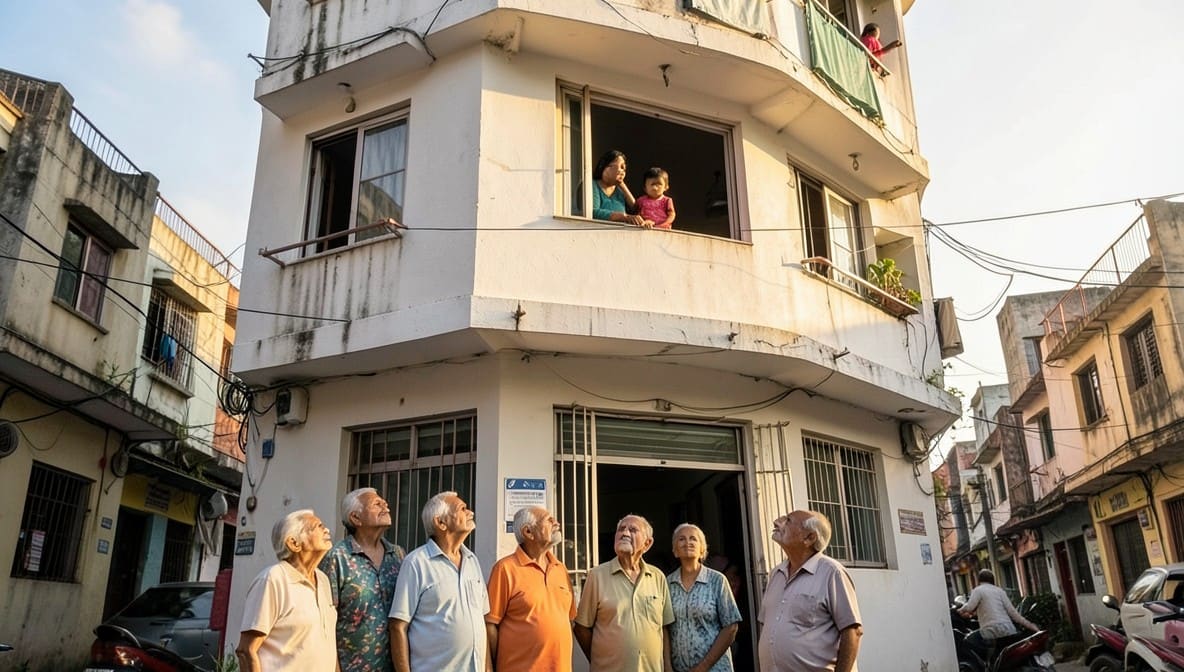
The Bombay High Court has affirmed that the right to residence under the Protection of Women From Domestic Violence Act, 2005 is not merely theoretical but enforceable through immediate, coercive measures when necessary. In a decisive order, the Court directed the forcible takeover of a shared marital flat by a court receiver, reinforcing that the Act’s protective mechanisms must be implemented without delay to ensure substantive justice.
Background & Facts
The Dispute
The applicant, a wife, sought relief under the Protection of Women From Domestic Violence Act, 2005 against her husband and other family members, alleging sustained domestic violence, emotional abuse, and unlawful denial of access to the shared household. The marital residence, Flat No.905, A Wing, Kedy Tower, Nagpada, Mumbai, was jointly occupied but effectively locked to her by the respondent-husband.
Procedural History
- 11 May 2022: Applicant filed Domestic Violence petition before Metropolitan Magistrate, Dadar, Mumbai.
- 3 May 2023: Magistrate granted interim maintenance of Rs.25,000 per month and residence order.
- 29 November 2023: Additional Sessions Judge, Mumbai, set aside the residence order, holding that possession could not be forcibly transferred without civil suit.
- 2025: Applicant filed Criminal Revision Application before Bombay High Court challenging the Sessions Judge’s order.
Relief Sought
The applicant sought: (1) enforcement of her right to reside in the shared household under Section 19 of the PWDVA; (2) maintenance arrears from the date of petition; (3) a protection order under Section 18; and (4) appointment of a court receiver to secure possession of the flat.
The Legal Issue
The central question was whether a court, under Section 19 of the Protection of Women From Domestic Violence Act, 2005, may direct immediate physical possession of a shared household by appointing a court receiver and authorizing forcible entry, even in the absence of a prior civil decree.
Arguments Presented
For the Petitioner
Counsel for the applicant relied on S. R. Batra v. Taruna Batra and D. Velusamy v. D. Patchaiammal to argue that the right to residence under Section 19 is a statutory right independent of ownership or title. He emphasized that the Act’s purpose is remedial and protective, and that delay in enforcement defeats its very object. He cited Rajesh Sharma v. State of U.P. to underscore that courts must adopt a liberal interpretation to ensure effective relief.
For the Respondent
The respondent contended that the High Court lacked jurisdiction to grant possession without a civil suit under the Transfer of Property Act. He argued that forcible eviction of a co-owner, even in domestic violence cases, violates property rights and requires adjudication under civil procedure. He further claimed that the Magistrate’s order was already set aside on valid grounds of jurisdictional overreach.
The Court's Analysis
The Court rejected the notion that enforcement of Section 19 requires a parallel civil proceeding. It held that the PWDVA is a special statute designed to provide swift, effective remedies to women facing domestic violence, and that its provisions override ordinary civil procedures where conflict arises.
"The right to reside in a shared household is not a privilege to be granted at the discretion of the husband, but a statutory entitlement enforceable by the court through any means necessary to ensure its efficacy."
The Court examined the legislative intent behind Section 19, noting that Parliament deliberately empowered Magistrates and High Courts to issue orders for residence, including possession, without requiring proof of title. It distinguished S. R. Batra by clarifying that while ownership is irrelevant, the definition of "shared household" under Section 2(s) includes any home where the aggrieved person lives or has lived in a domestic relationship.
The Court further held that appointment of a court receiver is a recognized procedural tool under the Bombay High Court Rules to execute orders where resistance is anticipated. It emphasized that police assistance for forcible entry is not an act of eviction but a measure to restore lawful possession to a victim of domestic violence.
The Verdict
The applicant prevailed. The High Court held that Section 19 of the Protection of Women From Domestic Violence Act, 2005 empowers courts to grant immediate possession of a shared household, including through court receivers and police-assisted forcible entry. The Magistrate’s and Sessions Judge’s orders were quashed, and the applicant was granted full residence rights, maintenance arrears, and a protection order.
What This Means For Similar Cases
Immediate Possession Is Enforceable Without Civil Suit
- Practitioners must now argue that Section 19 orders are self-executing and do not require prior civil adjudication of title.
- Courts cannot defer enforcement on grounds of property disputes; the PWDVA takes precedence.
- Applications under Section 19 should explicitly pray for court receiver appointment and police assistance.
Court Receiver as a Tool for Enforcement
- Appointment of a court receiver under High Court Rules is now a validated mechanism for executing PWDVA residence orders.
- Inventory of household goods must be conducted in the presence of both parties or their advocates to prevent disputes.
- Costs for receiver services are recoverable from the respondent and may be secured by deposit from the applicant.
Protection Orders Must Be Comprehensive
- Section 18 protection orders must explicitly prohibit not only direct violence but also indirect acts such as intimidation, isolation, or denial of access to the shared household.
- Violation of such orders constitutes contempt and attracts penal consequences under Section 31 of the PWDVA.