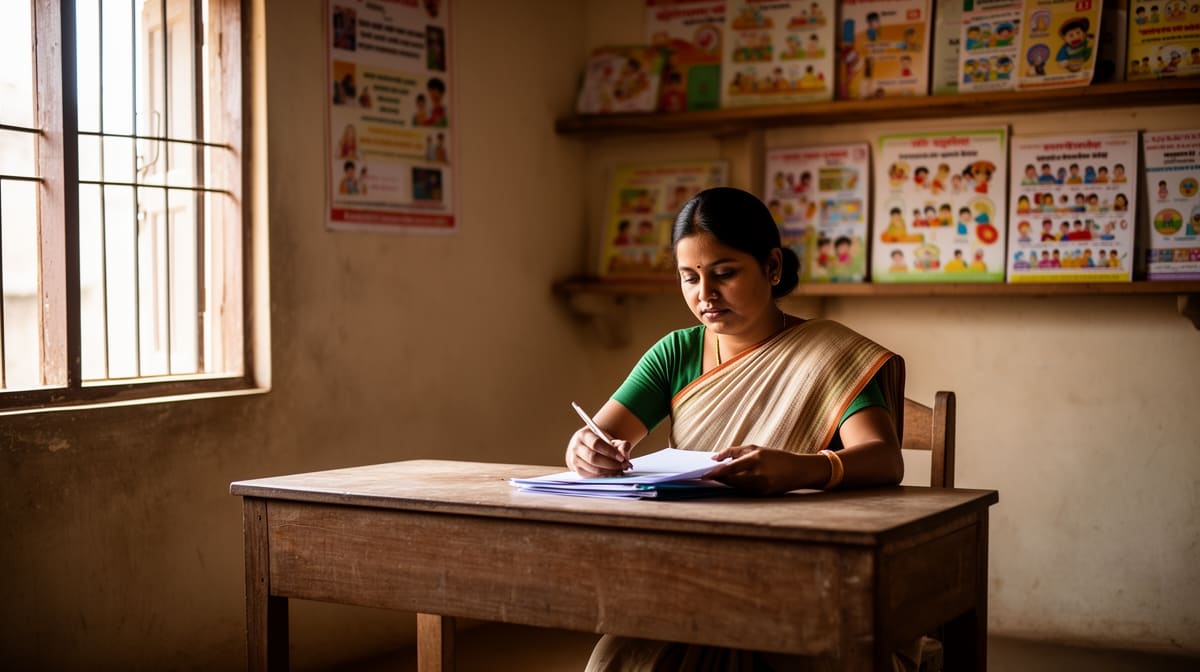
The Bombay High Court has clarified that receipt of a non-salaried honorarium does not negate a woman’s right to monetary relief under the Protection of Women from Domestic Violence Act, 2005, when she has been established as a victim of domestic violence. This ruling reinforces the compensatory, not merely maintenance-oriented, nature of relief under the Act.
Background & Facts
The Dispute
The revision petition challenged an order granting monthly monetary relief to a wife under the Protection of Women from Domestic Violence Act, 2005. The petitioner, husband and father of two sons, contested the award of Rs. 4,000 per month to the wife, arguing that she was employed as an Anganwadi Sevika and received a monthly honorarium of Rs. 13,390. He contended that her financial independence rendered the relief unnecessary and unjustified.
Procedural History
The case progressed through three levels:
- 2014: The wife filed Criminal Misc. Application No. 304 of 2014 before the J.M.F.C. Shevgaon, invoking Sections 12, 15, 17 - 20, 23, and 26 of the Domestic Violence Act.
- 2018: The J.M.F.C. granted monetary relief of Rs. 4,000 per month to the wife and Rs. 3,000 each to the two sons, effective from 01.12.2014.
- 2022: The Additional Sessions Judge, Ahmednagar, dismissed the appeal, upholding the trial court’s order.
- 2023: The husband filed Criminal Revision Application No. 45 of 2023 before the Bombay High Court, Aurangabad Bench.
Relief Sought
The revision petitioner sought quashing of the monetary relief granted to the wife, arguing that her income from the Anganwadi position rendered the award redundant. He did not challenge the relief granted to the children.
The Legal Issue
The central question was whether receipt of a non-salaried honorarium as an Anganwadi Sevika disqualifies an aggrieved person from claiming monetary relief under Section 20(1)(d) of the Protection of Women from Domestic Violence Act, 2005, when the court has already found her to be a victim of domestic violence.
Arguments Presented
For the Appellant/Petitioner
The petitioner’s counsel relied on judgments from the Madras and Kerala High Courts to argue that a woman with a steady income source cannot claim maintenance or compensation under the DV Act. He emphasized that the Rs. 13,390 received was a regular, documented payment, even if termed an honorarium, and that the relief granted under Section 20 was essentially maintenance in disguise. He contended that the lower courts ignored material evidence of her financial capacity.
For the Respondent/State
The respondent’s counsel argued that the honorarium is not a salary, lacks permanency, and is not contractual. He stressed that the relief under Section 20 is not maintenance but compensation for losses suffered due to domestic violence. He cited concurrent findings by two lower courts and argued that revision jurisdiction cannot be invoked merely to re-appreciate evidence.
The Court's Analysis
The Court examined the nature of Section 20(1)(d) of the Domestic Violence Act, distinguishing it from Section 125 CrPC. While Section 125 provides for maintenance based on financial need, Section 20 provides for monetary relief to meet expenses and losses arising from domestic violence. The Court held that the two are distinct in purpose and legal character.
"The above definition explicitly shows that, it is a monitory relief, which is different from maintenance, but it can be in addition to an order of 125 Cr.P.C. and is generally granted to meet the expenses incurred and losses suffered by the aggrieved person, as a result of domestic violence."
The Court noted that the honorarium received by the wife is not a salary, lacks job security, and is not backed by a formal appointment or contract. It is a stipend provided under a government welfare scheme, subject to termination. The Court emphasized that the relief granted was not for day-to-day sustenance but as redress for harm suffered.
The Court also reaffirmed the limited scope of revisional jurisdiction under Section 397 CrPC, citing Amit Kapoor v. Ramesh Chander. It held that where two lower courts have independently appreciated evidence and found the wife to be a victim of domestic violence, the High Court cannot interfere merely because it disagrees with the quantum of relief or because the aggrieved person has some income.
The Verdict
The revision petition was dismissed. The Court held that monetary relief under Section 20(1)(d) of the Domestic Violence Act is compensatory in nature and not contingent on the absence of any income. The receipt of an honorarium, even if substantial, does not disqualify an aggrieved person from relief when domestic violence has been established.
What This Means For Similar Cases
Honorarium Does Not Equal Financial Self-Sufficiency
- Practitioners must argue that honorariums under welfare schemes (e.g., Anganwadi, ASHA) are temporary, non-contractual, and lack social security benefits.
- Courts cannot equate such payments with regular employment income when assessing eligibility for DV Act relief.
- The focus must remain on whether the victim suffered losses due to domestic violence, not whether she has some income.
Monetary Relief Is Compensatory, Not Maintenance
- Section 20 relief is not a substitute for Section 125 CrPC maintenance; it is an independent remedy for harm.
- Evidence of emotional trauma, medical expenses, loss of livelihood, or displacement due to violence must be prioritized over income documentation.
- Petitioners cannot use a victim’s honorarium to argue against compensation - this misreads the Act’s remedial purpose.
Concurrent Findings Are Binding in Revision
- Revision under Section 397 CrPC is not an appeal; it cannot be used to re-appreciate evidence.
- Where two lower courts have independently found domestic violence, the High Court must defer unless there is patent illegality or perversity.
- Lawyers must frame revision petitions around jurisdictional or procedural errors, not factual disagreements.