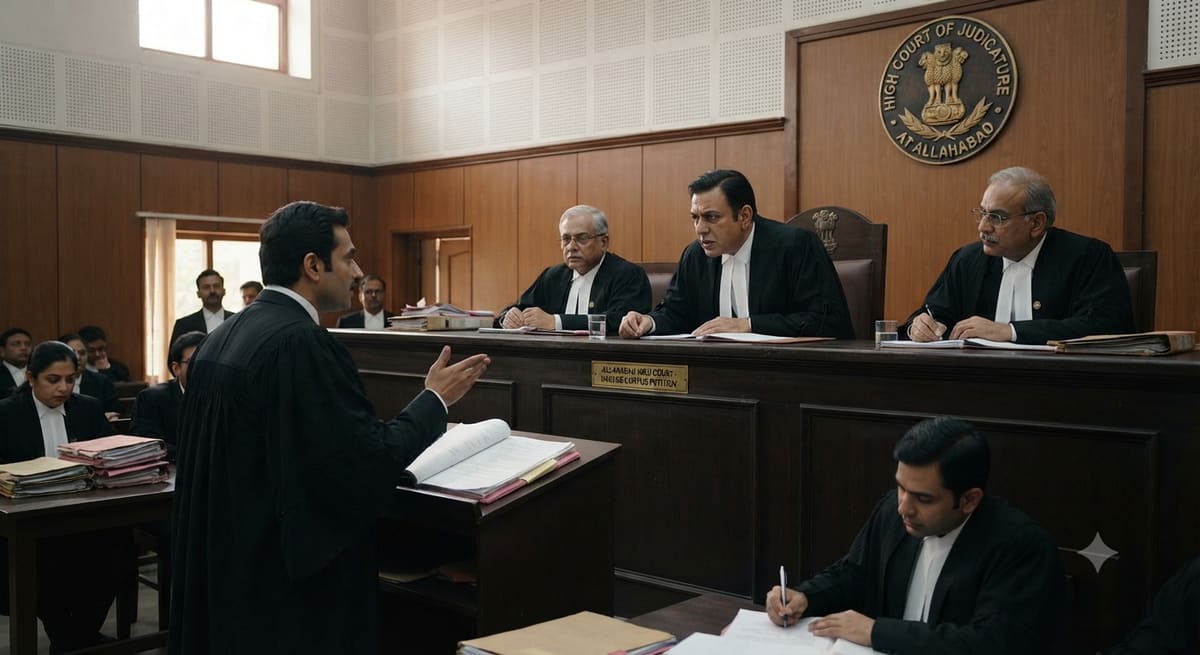
The Allahabad High Court has reaffirmed that a writ of habeas corpus is not a substitute for ordinary criminal remedies, and undue delay in filing, coupled with failure to challenge remand orders or seek bail, renders the petition unsustainable. The judgment underscores the necessity of exhausting alternative remedies and filing such petitions at the earliest possible stage.
Background & Facts
The Dispute
The petitioner, Firoj Ahmad @ Chhanga, was arrested on 31.05.2025 in connection with Crime No. 241 of 2025 registered at Police Station Bilari, District Moradabad, under sections 123, 115(2), 64(2), 333, 352 of the Bharatiya Nagarik Suraksha Sanhita, 2023 (B.N.S. 2023), and sections 3(1)(r), 3(1)(s), 3(2)(v) of the Scheduled Castes and Scheduled Tribes (Prevention of Atrocities) Act, 1989. The arrest memo and the remand order were both dated 31.05.2025. The petitioner was remanded to judicial custody on the same day by the Special Judge, SC/ST (PA) Act, Moradabad.
Key Facts
- The petitioner was arrested on 31.05.2025 without any copy of the arrest memo being furnished to him at the time of arrest.
- The remand order passed on 31.05.2025 was allegedly on a printed proforma without any independent judicial application of mind.
- No averment was made in the writ petition that the petitioner had applied for bail before any court.
- No details were provided regarding the progress of investigation, whether a charge sheet had been filed, or whether cognizance had been taken by the trial court.
- The writ petition was filed before the High Court on 22.04.2026, nearly eleven months after the arrest and remand.
- The petitioner did not challenge the remand order before the Sessions Court or file any revision or appeal against it.
Procedural History
- 31.05.2025: Arrest and remand to judicial custody by Special Judge, SC/ST (PA) Act, Moradabad.
- 22.04.2026: Habeas Corpus Writ Petition No. 673 of 2026 filed before the Allahabad High Court.
- 25.05.2026: Case reserved for judgment.
- 29.05.2026: Judgment delivered dismissing the petition.
The Parties' Positions
For the Petitioner: The counsel, Sri Imtiaz Husain, argued that the detention was illegal because no grounds of arrest were communicated to the petitioner, and the remand order was mechanically passed on a printed proforma, violating the principles of natural justice and Article 22(1) of the Constitution. He contended that the detention was arbitrary and thus amenable to habeas corpus.
For the Respondent: The Additional Government Advocate submitted that the petition was filed after an inordinate delay of nearly one year, during which the investigation was ongoing and no charge sheet had been filed. He emphasized that the petitioner had not approached any court for bail, nor challenged the remand order, and that the petition was an abuse of process.
Relief Sought
The petitioner sought:
- A writ of habeas corpus directing immediate release from illegal detention;
- A writ of certiorari quashing the remand order dated 31.05.2025;
- Costs and any other relief deemed fit by the Court.
The Legal Issue
Can a writ of habeas corpus be entertained under Article 226 of the Constitution when the detention is not inherently illegal on its face, the petitioner has delayed filing for over a year, and has not sought bail or challenged the remand order in any lower forum?
Arguments Presented
For the Petitioner
The petitioner’s counsel relied on the principle that any detention without communication of grounds violates Article 22(1) and is void ab initio. He argued that a mechanically issued remand order on a proforma, without judicial scrutiny, renders the detention illegal and thus justiciable through habeas corpus. He cited D.K. Basu v. State of West Bengal to emphasize procedural safeguards in arrest and detention.
For the Respondent
The State countered that habeas corpus is not a remedy to challenge the legality of remand orders after prolonged delay. The learned AGA relied on Neeraj and Another v. State of U.P., wherein the Court held that habeas corpus petitions cannot be filed merely because the remand order is on a proforma, unless the initial remand is patently illegal. He emphasized that the petitioner’s failure to seek bail or challenge the remand order for eleven months amounted to laches and estopped him from invoking extraordinary jurisdiction.
The Court's Analysis
The Court examined the nature of habeas corpus under Article 226 and its limitations. It observed that while the writ is a powerful remedy to secure liberty, it is not a substitute for ordinary criminal procedure. The Court noted that the petitioner did not allege that the arrest itself was without legal authority or that the police acted in bad faith. The mere fact that the remand order was on a printed proforma, without more, does not establish illegality per se.
"A habeas corpus writ petition under Article 226 of the Constitution of India can be preferred by an accused before the court, at the earliest, if his initial remand is illegal and consequently his detention is illegal."
The Court relied on paragraph 88(1) of Neeraj and Another v. State of U.P., which explicitly limits the scope of habeas corpus to cases where the initial remand is manifestly illegal. The Court held that the petitioner’s failure to file the petition until eleven months after detention, without any attempt to seek bail or challenge the remand order, constituted inexcusable delay and laches.
The Court further noted that the petitioner did not provide any information regarding the status of the investigation, whether a charge sheet had been filed, or whether the trial court had taken cognizance. In such circumstances, the Court cannot assume that the detention is unlawful merely because the remand order was on a proforma. The absence of any plea regarding bail applications or prior judicial remedies further weakened the petitioner’s case.
The Court concluded that the writ petition was not maintainable in law, as it was filed belatedly and failed to establish a prima facie case of illegal detention.
The Verdict
The writ petition was dismissed. The Court held that the petitioner’s delay of nearly one year in filing the petition, coupled with his failure to seek bail or challenge the remand order in any lower forum, rendered the petition barred by laches. No relief was granted. The petitioner remains in custody pending the conclusion of the criminal proceedings.
What This Means For Similar Cases
Habeas Corpus Is Not a Substitute for Bail Applications
- Practitioners must advise clients to exhaust all remedies, including bail applications and challenges to remand orders, before approaching the High Court under Article 226.
- A habeas corpus petition filed after months of detention, without prior bail applications, will be dismissed as an abuse of process.
Delay Defeats Extraordinary Remedies
- A delay of more than six months in filing a habeas corpus petition, absent compelling justification, will be viewed as laches.
- Courts will not entertain petitions where the petitioner has remained silent while the investigation proceeds.
Proforma Orders Alone Do Not Constitute Illegal Detention
- A remand order on a printed form does not automatically render detention illegal; the petitioner must demonstrate a complete absence of judicial application of mind or procedural violation.
- Mere allegations of mechanical remand require corroboration with evidence of arbitrariness or bad faith.