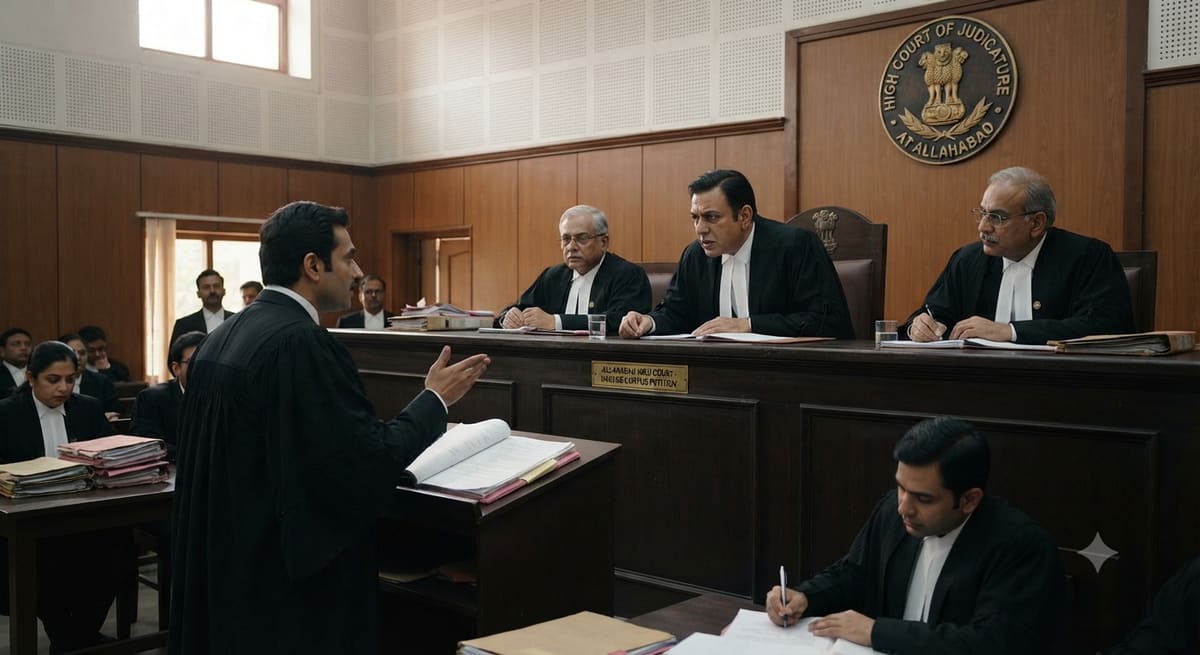
The Allahabad High Court has reaffirmed that a habeas corpus petition is not maintainable once the trial of the accused has commenced, dismissing a petition filed by an individual whose bail applications had already been rejected by both the trial court and the High Court. This decision underscores the limited scope of habeas corpus relief in ongoing criminal proceedings, particularly after judicial remand orders have been passed and trial proceedings have begun.
Background & Facts
The Dispute
The petitioner, Manish Garothiya @ Manish Arya @ Manoj, filed a habeas corpus writ petition under Article 226 of the Constitution of India seeking his immediate release from custody. The petitioner alleged illegal detention and vitiation of subsequent remand orders passed by the magistrate. The petitioner had been in custody, and his bail applications had been rejected at both the trial court and High Court levels. The trial against him had already commenced at the time of filing the present petition.
Key Facts
- The petitioner was in custody, and his bail applications were rejected by the Trial Court and the High Court
- The trial against the petitioner had commenced
- The petitioner relied on several Supreme Court and High Court judgments to argue that his detention was illegal, including:
- Prabir Purkayastha v. State (NCT of Delhi)
- Pankaj Bansal v. Union of India
- Vihaan Kumar v. State of Haryana
- Ashish Kakkar v. U.T. Chandigarh
- Kusireddy Upender Reddy v. State of Andhra Pradesh
- Manjeet Singh Chana v. State of Uttar Pradesh & Others
- Anwar Dhebar v. State of U.P. & 2 Others
- Umang Rastogi v. State of U.P.
Procedural History
- Bail applications rejected: Both by the Trial Court and the High Court
- Trial commenced: The criminal trial against the petitioner had already begun
- 30.06.2026: Earlier order of the High Court directing production of the corpus (petitioner)
- 08.07.2026: Present habeas corpus petition dismissed by the High Court
Relief Sought
The petitioner sought the following reliefs:
- A writ of habeas corpus directing the respondents to produce the corpus before the Court and set him at liberty
- A writ of mandamus directing the concerned magistrate to pass just and appropriate orders, considering the alleged illegal detention and vitiation of remand orders
- Any other suitable order or direction the Court deemed fit
- Costs of the petition in favour of the petitioner
The Legal Issue
The central question before the Court was whether a habeas corpus petition remains maintainable after the trial against the accused has commenced and bail applications have been rejected by competent courts.
Arguments Presented
For the Petitioner
The petitioner’s counsel relied on several judgments to argue that the detention was illegal and that the remand orders were vitiated. The key contentions included:
- The principles laid down in Prabir Purkayastha and Pankaj Bansal regarding the legality of detention
- The precedent in Vihaan Kumar and Ashish Kakkar on the scope of judicial review of remand orders
- The High Court’s own decision in Manjeet Singh Chana and Anwar Dhebar, which allegedly supported the petitioner’s claim of illegal detention
For the Respondent
The State, represented by the Advocate General, contended that the habeas corpus petition was not maintainable once the trial had commenced. The State relied on the exception carved out in Neeraj v. State of U.P., which held that habeas corpus petitions are barred in cases where the trial has already begun.
The Court's Analysis
The Court observed that the petitioner’s bail applications had already been rejected by both the trial court and the High Court, and the trial had commenced. The Court relied on paragraph 88 of the judgment in Neeraj v. State of U.P., which explicitly carves out an exception to the maintainability of habeas corpus petitions once the trial has begun. The Court noted:
"In view of exception carved out in paragraph 88 of the judgement of this court in Neeraj and another Vs. State of U.P. and another, in Habeas Corpus Writ Petition No. 218 of 2026, this habeas corpus writ petition is not maintainable and is, accordingly, dismissed."
The Court did not delve into the merits of the petitioner’s claims regarding illegal detention or vitiated remand orders, as the maintainability of the petition itself was barred by precedent.
The Verdict
The High Court dismissed the habeas corpus writ petition as non-maintainable. The Court held that once the trial has commenced and bail applications have been rejected, a habeas corpus petition cannot be entertained. No costs were awarded, and no further directions were issued.
What This Means For Similar Cases
Habeas Corpus Petitions Are Barred Once Trial Commences
- Practitioners must note that habeas corpus petitions are not maintainable once the trial against the accused has commenced. This principle, as reaffirmed in Neeraj v. State of U.P., acts as a procedural bar to such petitions
- Courts will not entertain habeas corpus petitions where the accused’s bail applications have already been rejected, and the trial is underway
Reliance on Precedent Is Critical
- The judgment underscores the importance of binding precedent in determining the maintainability of petitions. Practitioners must carefully analyze whether exceptions apply before filing habeas corpus petitions in ongoing trials
- The Court’s reliance on Neeraj demonstrates that judicial remand orders passed during trial are not subject to challenge via habeas corpus, absent extraordinary circumstances
Strategic Considerations for Defense Counsel
- Defense counsel should prioritize bail applications at the earliest stages of proceedings, as habeas corpus relief becomes unavailable once the trial commences
- If remand orders are alleged to be illegal, challenges must be raised before the trial begins, either through bail applications or revision petitions, rather than waiting to file a habeas corpus petition later