The Uttarakhand High Court has reaffirmed that unreasonable delay in challenging seniority lists in public employment invokes the doctrine of laches, barring judicial intervention even where substantive grievances may exist. This judgment reinforces the principle that administrative stability must not be disrupted by belated challenges, particularly when incumbents have relied on settled seniority for years.
Background & Facts
The Dispute
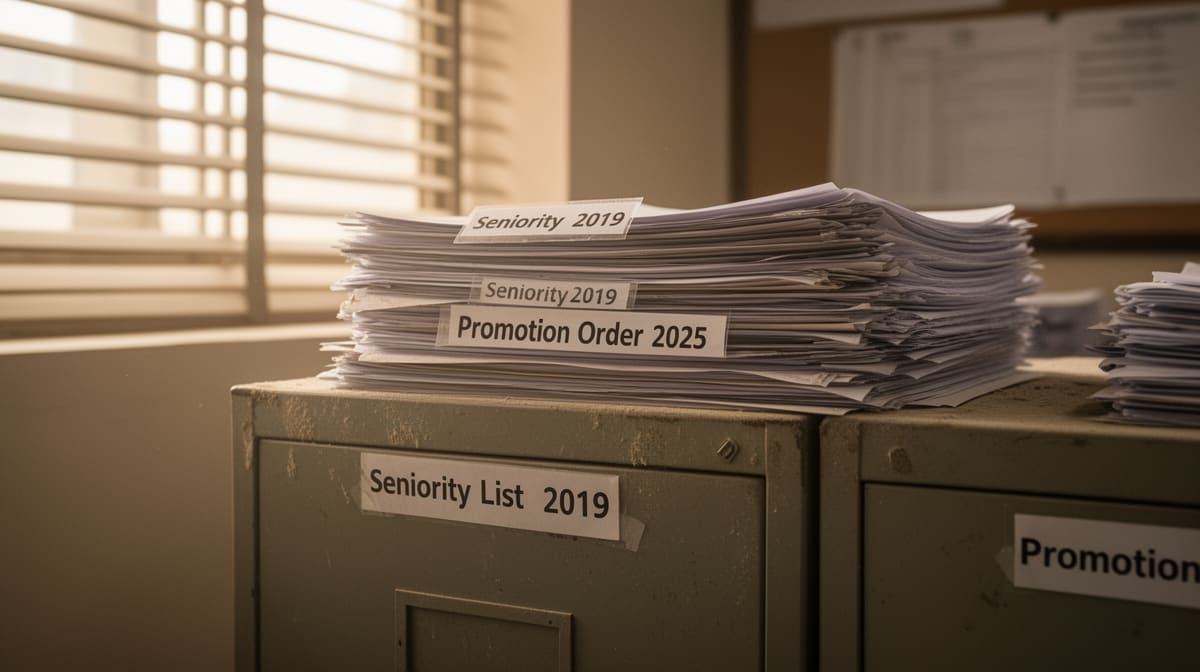
The appellant, Suneeti Pal, was a government employee whose seniority was placed below that of respondent no.5 in the 2019 seniority list. He initially challenged this list in 2020 through WPSS No.1193/2020, leading to an order directing the authorities to reconsider his objection. In 2021, the authorities rejected his claim, affirming respondent no.5’s seniority. Despite this final administrative decision, the appellant took no further legal action for over four years.
Procedural History
- 2019: Seniority list issued placing appellant junior to respondent no.5
- 2020: Appellant filed WPSS No.1193/2020 challenging the list
- October 2020: Court directed authorities to decide appellant’s objection
- February 2021: Authority rejected appellant’s objection; seniority list upheld
- October 2025: Respondent no.5 promoted to Naib Tehsildar on ad hoc basis
- November 2025: Appellant filed WPSS No.1909/2025 challenging promotion and seniority list
- February 2026: Special Appeal filed against dismissal of writ petition
Relief Sought
The appellant sought quashing of the 2019 seniority list, declaration of his seniority over respondent no.5, and setting aside the ad hoc promotion granted to respondent no.5.
The Legal Issue
The central question was whether a petitioner who fails to challenge a final administrative order on seniority for over four years, despite having had a prior opportunity to do so, can still invoke the writ jurisdiction of the High Court under Article 226 of the Constitution.
Arguments Presented
For the Appellant
The appellant’s counsel argued that the seniority list was legally flawed due to incorrect computation of service duration and that the delay was not intentional but due to procedural confusion. He relied on the principle that fundamental rights under Article 311 cannot be extinguished by mere lapse of time, and that the doctrine of laches must yield to substantive justice.
For the Respondent/State
The State contended that the appellant had ample opportunity to challenge the 2021 order but chose not to, thereby acquiescing in the settled position. The State emphasized that promotions and postings had been made in reliance on the 2019 list, and allowing a belated challenge would disrupt administrative order and violate the legitimate expectations of other employees.
The Court's Analysis
The Court examined the doctrine of laches as a principle of equity, distinct from statutory limitation, and held that it applies with particular force in matters of administrative seniority. The Court explicitly adopted the reasoning from Trilokchand Motichand & others v. H.B. Munshi, a Constitution Bench decision, which cautioned against entertaining writ petitions after prolonged inaction.
"It seems to me, however, that the above solution is not quite appropriate for petitions under Article 32. A delay of 12 years or 6 years would make a strange bed-fellow with a direction or order or writ in the nature of mandamus, certiorari and prohibition."
The Court noted that the appellant’s failure to challenge the 2021 order - despite its finality - constituted a clear abandonment of his right to contest seniority. The Court emphasized that while the Limitation Act does not strictly govern writ petitions, the Court retains the discretion to dismiss claims tainted by inexcusable delay. The Court further observed that the promotion of respondent no.5 in 2025 was a consequence of the settled seniority, not an independent wrong. Allowing the challenge at this stage would destabilize the administrative hierarchy and penalize those who acted in good faith on the basis of the official list.
The Verdict
The appeal was dismissed. The Court held that unreasonable delay in challenging a final seniority list invokes the doctrine of laches, and writ jurisdiction cannot be invoked to revive stale claims when other employees have relied on the established order for years.
What This Means For Similar Cases
Delay Is a Bar Even Without Statutory Limitation
- Practitioners must file writ petitions challenging seniority lists within one year of the final administrative order
- Mere absence of a limitation period does not excuse inaction
- Courts will examine whether the delay prejudiced third parties or disrupted administrative stability
Finality of Administrative Orders Is Protected
- Once a seniority list is formally adopted and no challenge is mounted, it acquires a de facto finality
- Promotions based on such lists cannot be undone years later without grave disruption
- Employees must act promptly; silence after a final order constitutes acquiescence
Judicial Restraint in Service Matters
- Courts will not act as appellate forums for delayed grievances in service law
- The writ jurisdiction under Article 226 is not a substitute for a delayed appeal
- Petitioners must exhaust all internal remedies and act swiftly - delay will be fatal to relief