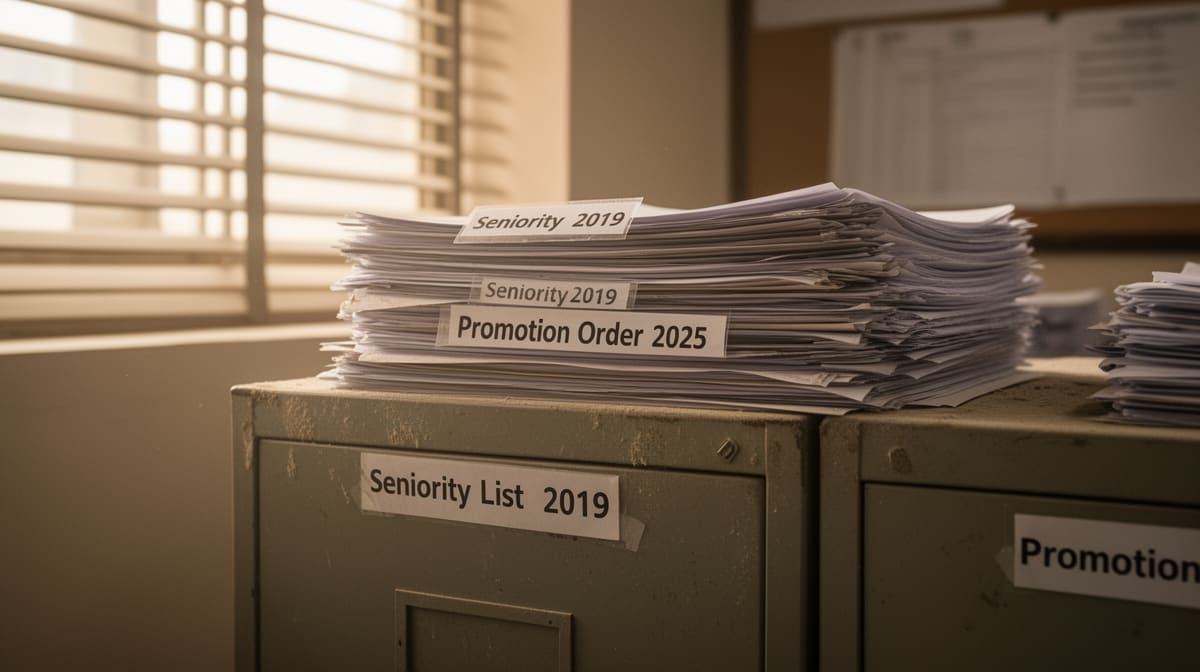
The Chhattisgarh High Court has reaffirmed a foundational principle of service law: once seniority is settled and operational for a prolonged period, it cannot be disturbed retroactively without compelling justification. This judgment underscores the importance of administrative certainty and the protection of accrued rights in public employment.
Background & Facts
The Dispute
The petitioner, Dilip Rangare, and respondent No. 4, Gyaneshwar Bansod, were both appointed as Lower Division Clerks on 11.03.1987, with the petitioner placed higher in the appointment order. Both were later promoted to the post of Junior Account Officer, but a dispute arose over their inter se seniority in that cadre. The Departmental Promotion Committee (DPC) in 1996 and subsequent gradation lists consistently placed the petitioner senior. However, in 2023 - nearly a decade after the petitioner’s promotion - the authorities reversed this position, granting seniority to respondent No. 4.
Procedural History
- 1987: Both appointed as Lower Division Clerks; petitioner ranked Sl. No. 3, respondent No. 4 at Sl. No. 5.
- 1996: DPC granted petitioner seniority over respondent No. 4.
- 2007: Respondent No. 4 promoted to Junior Account Officer after clearing mandatory Accounts Training; petitioner was not initially considered due to lack of training.
- 2007 (Review): After representation, petitioner was granted promotion to Junior Account Officer with effect from 13.06.2007, same date as respondent No. 4.
- 2013: Gradation list showed petitioner senior to respondent No. 4.
- 2023: Respondent No. 2 issued impugned order reversing seniority, placing respondent No. 4 above petitioner.
Relief Sought
The petitioner sought quashing of the 2023 order and restoration of his seniority as per the DPC and gradation lists.
The Legal Issue
The central question was whether seniority in a promotional cadre, once established through a DPC recommendation and operational for nearly a decade, can be altered retroactively on the basis of a later reinterpretation of eligibility criteria, particularly after the contesting officer has retired.
Arguments Presented
For the Petitioner
The petitioner’s counsel argued that seniority flows from the date of initial appointment and is governed by the DPC’s recommendations and published gradation lists. Reliance was placed on V. Vincent Velankanni v. Union of India to assert that once an officer is promoted and functions in the post for years, their accrued rights cannot be disturbed without statutory authority. The reversal after ten years was termed arbitrary and violative of Articles 14 and 16.
For the Respondent
The State contended that eligibility for promotion to Junior Account Officer required mandatory Accounts Training, which the petitioner lacked at the relevant time. Respondent No. 4, having cleared the training, was lawfully promoted first. The 2023 order was framed under amended Rule 12(b) of the Chhattisgarh Civil Services Rules, 1961, and reflected a correct interpretation of service norms. The petitioner’s subsequent promotion was a procedural accommodation, not a recognition of seniority.
The Court's Analysis
The Court acknowledged that respondent No. 4 was eligible for promotion in 2007 due to possession of the mandatory Accounts Training, while the petitioner was not. However, the Court emphasized that the petitioner’s promotion in 2007, albeit retroactive, was not merely procedural - it was a formal recognition by the DPC that placed him on par with respondent No. 4 in the same cadre. From 2007 to 2023, the petitioner functioned in the post, and the gradation list reflected his seniority.
"...the question of disturbing the existing seniority structure at this belated stage - after nearly a decade of promotion - would not be appropriate. The rights accrued in favour of the petitioner by virtue of long continuance on the promotional post cannot lightly be unsettled."
The Court extensively relied on V. Vincent Velankanni and a series of Supreme Court precedents - including Malcom Lawrence Cecil D'Souza, R.S. Makashi, and B.S. Bajwa - to establish that reopening seniority after a long lapse undermines administrative stability and violates the principle of legitimate expectation. The Court noted that while eligibility for promotion is determined by qualifications, seniority within the cadre must be determined by the date of substantive appointment and consistent gradation. The 2023 order, though technically grounded in Rule 12(b), failed to account for the settled position and the rights accrued over ten years.
The Court further observed that respondent No. 4 had retired, rendering the dispute largely academic. Yet, the principle at stake transcended individual benefit - it concerned the integrity of service jurisprudence.
The Verdict
The petitioner did not obtain reversal of the 2023 order, but the Court declined to interfere with his continued service in the post. The Court held that while the seniority list may stand as revised, the petitioner’s accrued rights and future service benefits must be protected. The core holding is that seniority, once settled and operational for a prolonged period, cannot be disturbed retroactively without compelling statutory justification.
What This Means For Similar Cases
Seniority Once Settled Is Presumptively Final
- Practitioners must argue that any attempt to alter a seniority list after five or more years of operational stability is prima facie arbitrary.
- DPC recommendations and published gradation lists constitute binding administrative determinations unless set aside through a valid review process within a reasonable time.
Qualification Does Not Automatically Override Seniority
- Meeting eligibility criteria for promotion does not entitle an officer to override seniority established through prior gradation lists.
- Where two officers are promoted to the same cadre, seniority must be determined by the date of substantive appointment and consistent placement, not merely by the date of qualification.
Retirement Renders Seniority Disputes Academic, But Principles Remain
- Even if the contesting officer has retired, courts must still examine whether the reversal of seniority violates settled service jurisprudence.
- Authorities must ensure that future benefits - such as pay fixation, pension calculations, and promotion eligibility - are not adversely affected by past seniority disputes.