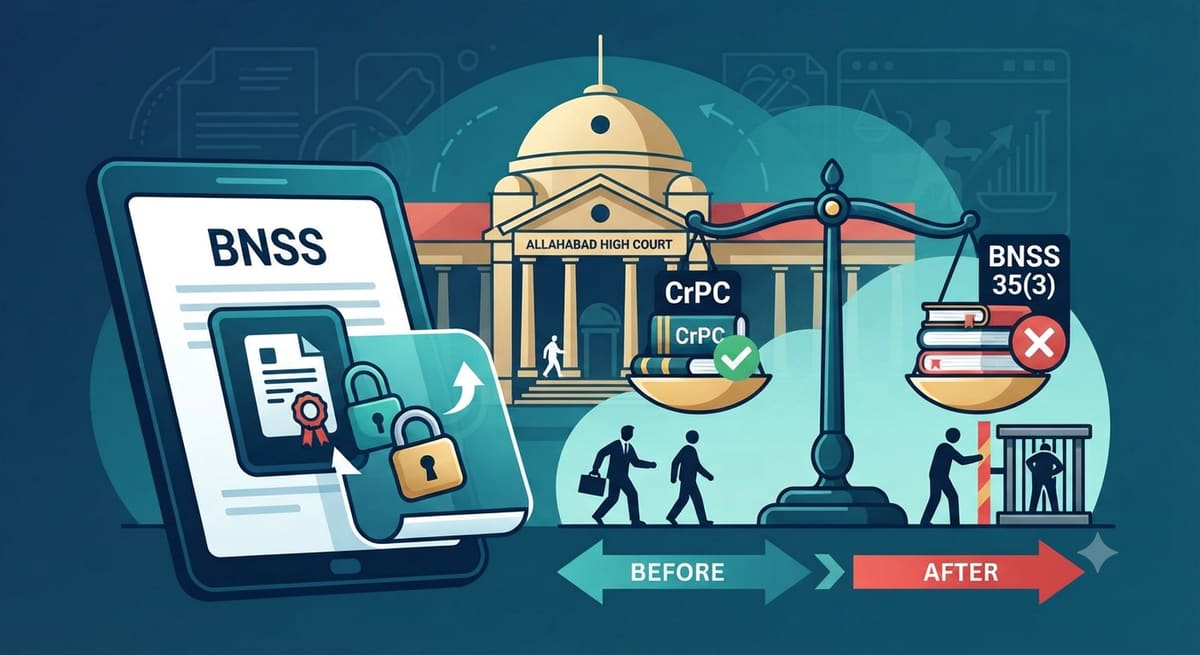
The Gauhati High Court has clarified that the 60-day default bail window under the Bharatiya Nagarik Suraksha Sanhita, 2023 applies to offences involving attempted sexual offences against children under the POCSO Act, provided the maximum punishment for the attempted offence does not exceed ten years. This ruling reinforces the procedural safeguard of default bail as a statutory right, not a discretionary privilege, when investigation timelines are breached.
Background & Facts
The Dispute
The petitioner, Sri Tanka Prasad Newar, was arrested on 08.08.2025 in connection with Pengaree P.S. Case No. 21/2025, registered under Sections 64(2)(f)/62 of the Bharatiya Nagarik Suraksha Sanhita (BNS), 2023, read with Section 10 of the Protection of Children from Sexual Offences (POCSO) Act. The allegations pertained to an attempt to commit sexual offences against a minor. The charge-sheet was filed on 29.10.2025.
Key Facts
- The FIR was registered on 08.08.2025.
- The petitioner was taken into custody on the same day, 08.08.2025.
- The initial FIR invoked Sections 68, 62 of the BNS and Section 8 of the POCSO Act, which carry punishments of 5 - 10 years and 3 - 5 years respectively.
- The prosecution later amended the charges to Sections 64(2)(f)/62 of the BNS, 2023, which prescribe a minimum punishment of 10 years for the completed offence.
- However, since the charge sheet alleged an attempt to commit the offence, the maximum punishment under Section 62 of the BNS would be half of the maximum for the completed offence - i.e., 5 years, not 10.
- The petitioner’s counsel argued that the applicable detention period for filing the charge-sheet was 60 days, not 90, because the maximum punishment for the attempted offence was less than 10 years.
Procedural History
- 08.08.2025: Petitioner arrested and taken into custody.
- 09.12.2025: Petitioner filed a bail application before the Trial Court, seeking default bail on grounds that the charge-sheet was filed beyond the 60-day limit.
- 09.12.2025: Trial Court dismissed the bail application, holding that the 90-day period applied because the offence invoked carried a minimum sentence of 10 years.
- 29.10.2025: Charge-sheet was filed - 82 days after arrest.
- 20.03.2026: Bail application filed before the Gauhati High Court under Section 483 of the BNSS, 2023.
Relief Sought
The petitioner sought release on bail on the ground that his continued detention after 07.10.2025 - the 60th day from arrest - was illegal, and that he was entitled to default bail as a matter of right under Section 483 of the BNSS, 2023.
The Legal Issue
The central question was whether the 60-day default bail period under Section 483 of the BNSS, 2023 applies when the accused is charged with an attempt to commit an offence under Section 64(2)(f)/62 of the BNS, 2023, read with Section 10 of the POCSO Act, where the maximum punishment for the attempted offence is less than 10 years.
Arguments Presented
For the Petitioner
The petitioner’s counsel argued that Section 62 of the BNS, 2023, which governs punishment for attempt, mandates that the sentence be half of the punishment for the completed offence. Even if the completed offence under Section 64(2)(f) carries a minimum of 10 years, the attempt attracts a maximum of 5 years. Since the maximum punishment for the offence charged is less than 10 years, the 60-day limit under Section 483(1) of the BNSS applies. The charge-sheet was filed on 29.10.2025 - 82 days after arrest - rendering the detention illegal after 07.10.2025. The petitioner was therefore entitled to default bail as a statutory right.
For the Respondent/State
The State contended that since the original charges invoked Section 64(2)(f) of the BNS, which carries a minimum punishment of 10 years, the 90-day period under Section 483(2) of the BNSS applied. The Trial Court’s dismissal of bail was correct because the charge-sheet was filed within 90 days. The nature of the offence - involving a minor under POCSO - warranted a longer investigation period, and the accused’s detention was lawful.
The Court's Analysis
The Court undertook a careful statutory interpretation of Section 62 of the BNS, 2023, which states: "Whoever attempts to commit an offence punishable under this Sanhita shall be punished with half the punishment provided for the offence." The Court emphasized that the punishment for the attempted offence, not the potential punishment for the completed offence, governs the applicable detention period under Section 483 of the BNSS, 2023.
"Even if it is taken that the maximum punishment for the commission of the offence under Section 64(2)(f)/62 of the BNS, 2023, would be not less than 10 years, and even if the commission of an attempt for such offence is made out against the petitioner, he would be liable to be imposed a punishment of half of the aforesaid punishment, which would be not more than 10 years."
The Court clarified that the phrase "not more than 10 years" in Section 483(1) refers to the actual punishment applicable to the accused, not the theoretical maximum for the completed crime. Since the punishment for attempt is capped at 5 years, the 60-day rule applies. The Court further held that the invocation of POCSO Section 10 does not alter the punishment ceiling under the BNS for attempt. The charge-sheet’s filing on 29.10.2025, beyond the 60-day limit, rendered the petitioner’s detention illegal from 08.10.2025 onwards.
The Court rejected the State’s argument that the gravity of the offence or the involvement of a minor could override the statutory timeline. It reaffirmed that default bail is a substantive right, not a procedural formality, and must be granted when the conditions are met.
The Verdict
The petitioner succeeded. The Court held that the detention after 07.10.2025 was illegal and granted bail. The petitioner is directed to be released on bail in connection with POCSO Case No. 67(M)/2025 upon furnishing a personal bond of Rs. 30,000/- with two sureties of the like amount, to the satisfaction of the Trial Court. The Trial Court may impose conditions to ensure the petitioner’s cooperation in the trial, including a prohibition on contacting the alleged victim or witnesses during the investigation. The order is effective immediately.
What This Means For Similar Cases
Default Bail Applies to Attempted Offences Even Under POCSO
- Practitioners must calculate the applicable detention period based on the actual punishment for the attempted offence, not the completed offence.
- If the attempt attracts a maximum punishment under 10 years, the 60-day default bail window under BNSS Section 483(1) applies, regardless of the underlying nature of the offence.
Statutory Timelines Trump Subjective Gravity
- Courts cannot extend detention periods based on the perceived seriousness of the crime if the statutory framework prescribes a shorter limit.
- The POCSO Act’s protective intent does not override the BNSS’s procedural safeguards for bail.
Charge-Sheet Timing Must Be Precisely Calculated
- The 60-day period begins from the date of first custody, not from the date of FIR registration.
- Any delay beyond the statutory limit - even by one day - triggers the right to default bail.
- Legal teams must maintain precise timelines and file bail applications immediately upon expiry.