The Himachal Pradesh High Court has clarified that a civil court’s observation that a document is not genuine does not, by itself, establish the criminal offence of forgery under the Indian Penal Code. This ruling reinforces the threshold for invoking police investigation under Section 156(3) CrPC and underscores the necessity of specific, cogent allegations of dishonest intent.
Background & Facts
The Dispute
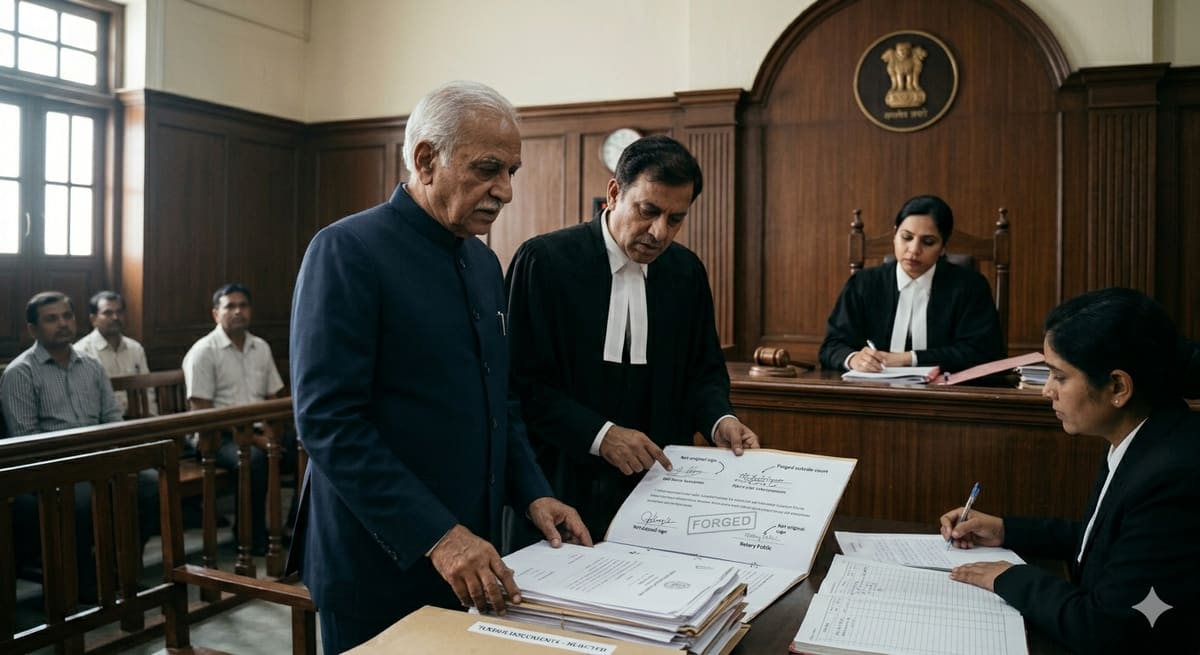
The petitioner, M/s Birla Textile Mills, filed an application under Section 156(3) CrPC before the Additional Chief Judicial Magistrate, Nalagarh, seeking registration of an FIR against the accused for allegedly forging the death certificate of Sunder, father of the accused. The petitioner alleged that the accused fabricated the death certificate dated 11.5.2001 to support a claim in a civil suit, when the actual date of death recorded in Panchayat records was 28.4.2002. The petitioner contended that this act constituted offences under Sections 467, 468, 420 and 471 IPC.
Key Facts
- The accused produced the death certificate dated 11.5.2001 in Civil Suit No. 165/1 of 2009/2007, titled Ram Asra v. M/s Birla Textile Mills Ltd. and others.
- The civil court delivered its judgment on 06.04.2016, dismissing the suit.
- In paragraph 25 of the judgment, the civil court observed: "As far as the evidence of Dr. PW-2 is concerned, admittedly he issued the death certificate on 31.12.2008 i.e. during the pendency of the suit, meaning thereby this certificate was procured specifically for creating evidence in the case in hand and hence no reliance can be placed upon the death certificate Ex. PW-2/B."
- The civil court did not find that the accused forged the certificate; it only held that the certificate was not genuine and was procured during litigation.
- The Panchayat record showed Sunder’s death date as 28.4.2002, contradicting the certificate’s date of 11.5.2001.
- The petitioner did not lead any independent evidence of forgery, such as handwriting analysis, expert opinion, or proof of fabrication.
Procedural History
- 30.01.2018: Additional Chief Judicial Magistrate, Nalagarh, rejected the Section 156(3) CrPC application. Ordered the complaint to be treated as a private complaint under Section 200 CrPC and adjourned for preliminary evidence on 21.04.2018.
- 01.04.2022: Additional Sessions Judge, Nalagarh, dismissed the criminal revision (Cr. Rev. No. 4-NL/10 of 2018), upholding the Magistrate’s order.
- 12.03.2026: Petitioner filed Writ Petition under Section 482 CrPC before the Himachal Pradesh High Court.
- 12.03.2026: High Court dismissed the petition and upheld both lower court orders.
The Parties' Positions
Petitioner (M/s Birla Textile Mills): Argued that the civil court’s finding that the certificate was procured to create false evidence amounted to prima facie forgery. Contended that Section 156(3) CrPC mandates police investigation for cognizable offences and that the Magistrate erred by not calling for a police report.
Respondent (State of Himachal Pradesh and Accused): Argued that forgery requires proof of dishonest intention and fabrication, which the civil court never found. Emphasized that the word "may" in Section 156(3) CrPC confers discretion on the Magistrate. Stated that the petitioner failed to provide any evidence beyond the civil court’s observation.
Relief Sought
The petitioner sought quashing of the orders dated 30.01.2018 and 01.04.2022, and a direction to the police to register an FIR under Sections 467, 468, 420 and 471 IPC.
The Legal Issue
The central question was whether a civil court’s observation that a document is "not genuine" and "procured for creating evidence" constitutes a prima facie case of forgery under Sections 467, 468, 420 and 471 IPC, sufficient to trigger mandatory police investigation under Section 156(3) CrPC.
Arguments Presented
For the Petitioner
Mr. N.K. Thakur, Senior Advocate, argued that the civil court’s finding that the death certificate was procured during litigation to fabricate evidence amounted to a clear case of forgery. He contended that Section 156(3) CrPC imposes a duty on the Magistrate to order police investigation when cognizable offences are disclosed, and that the Magistrate erred by treating the complaint as a private complaint without first calling for a police report. He further argued that forgery requires expert evidence, which the Magistrate should have directed.
For the Respondent
Dr. Rajesh Kumar Parmar, Advocate for the accused, countered that the civil court never held that the accused forged the document. He emphasized that the term "not genuine" does not equate to "forged" - the certificate could have been issued in error or by a negligent official. He cited the discretionary nature of Section 156(3) CrPC and relied on Surjit Singh v. State of Haryana to affirm that the complainant could file the complaint, but the merits must be evaluated. He argued that without specific allegations of fabrication or intent, no cognizable offence was made out.
The Court's Analysis
The High Court undertook a detailed examination of the civil court’s judgment and the statutory framework under Section 156(3) CrPC. It held that the civil court’s observation - that the death certificate was procured during litigation and could not be relied upon - did not amount to a finding of forgery by the accused.
"Mere observation by civil court in civil suit, to the effect that death certificate was procured for creating evidence and no reliance can be placed thereupon, may not be sufficient to conclude act of ‘forgery’ committed by the accused."
The Court clarified that forgery under Section 463 IPC requires proof of making a false document with dishonest intent. The civil court’s finding of non-genuineness, even if coupled with suspicion of tactical use, does not establish the necessary mens rea. The Court noted that the petitioner had not produced any independent evidence - such as handwriting comparison, forensic analysis, or witness testimony - to substantiate the claim of fabrication.
The Court also rejected the petitioner’s argument that the Magistrate was obligated to call for a police report before rejecting the application. It held that Section 156(3) CrPC does not mandate a mechanical process; the Magistrate must first satisfy itself whether the complaint, on its face, discloses a cognizable offence. Where the allegations are vague or lack prima facie credibility, the Magistrate may decline to order investigation and instead treat the matter as a private complaint.
Regarding the need for expert evidence, the Court observed that while scientific proof may assist in proving forgery, it is not a prerequisite for initiating a private complaint. A complainant may seek expert opinion through the court, but the burden of adducing evidence remains with the complainant.
The Verdict
The petition was dismissed. The High Court upheld the orders dated 30.01.2018 and 01.04.2022. The Magistrate’s decision to treat the Section 156(3) CrPC application as a private complaint was affirmed. No direction was issued for registration of FIR. The petitioner must pursue the matter as a private complaint under Section 200 CrPC and prove forgery through cogent and convincing evidence.
What This Means For Similar Cases
A Civil Court’s Non-Genuineness Finding Is Not Enough for Criminal FIR
- Practitioners must not assume that a civil court’s rejection of a document as "not genuine" or "fabricated for litigation" automatically triggers criminal liability.
- To invoke Section 156(3) CrPC, the complaint must contain specific allegations of dishonest intent, fabrication, and knowledge of falsity.
- Merely pointing to a discrepancy between documents is insufficient without evidence of deliberate falsification.
Magistrates Have Discretion Under CrPC 156(3) - But Must Apply It Judicially
- Magistrates are not required to call for police reports in every case; they must conduct a preliminary assessment of the complaint’s prima facie credibility.
- Where allegations are speculative or rely solely on civil court observations, treating the matter as a private complaint is legally sound.
- Courts should avoid using Section 156(3) as a substitute for civil litigation.
Private Complaints Remain Viable for Forgery Claims
- Complainants may still pursue forgery cases through private complaints under Section 200 CrPC.
- They may request the court to summon expert witnesses or direct forensic examination.
- The burden of proof remains on the complainant, but the procedural path remains open.