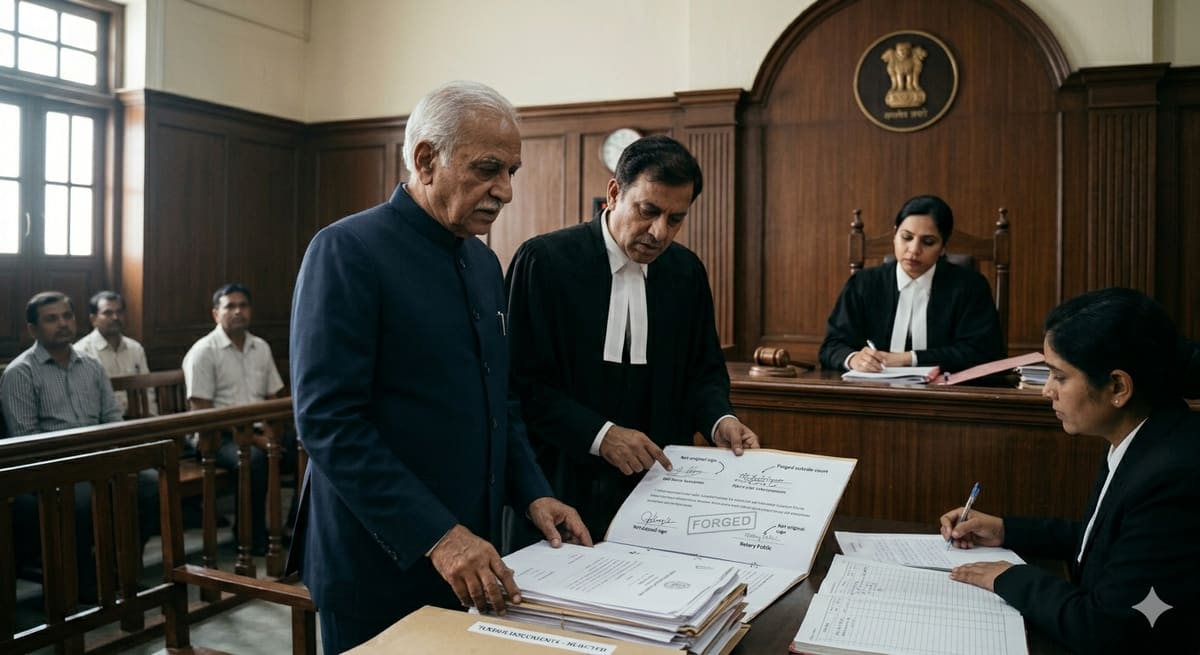
The Punjab and Haryana High Court has clarified that criminal prosecution for forgery and cheating is not barred under Section 195 Cr.P.C. when the fraudulent document is fabricated prior to its production in civil proceedings. The judgment reinforces the principle that any aggrieved person may initiate criminal proceedings, even if not a direct signatory to the disputed instrument.
Background & Facts
The Dispute
The dispute arose from a contested agricultural land transaction between the petitioner, Dalbir Singh, and the father of the complainant, Munshi Ram. On 12.08.2005, an agreement to sell 31 kanal 12 marlas of land was executed for Rs. 4,20,000 per acre, with an earnest money payment of Rs. 1,66,000. The sale deed was to be executed by 31.03.2006. The petitioner failed to perform his obligations, leading to a compromise on 12.09.2006, wherein the agreement was cancelled and the petitioner received Rs. 3,20,000 - double the earnest money - after deduction of Rs. 12,000 in expenses. The cancellation deed was recorded on the reverse of the original agreement, with both parties and witnesses present.
Key Facts
The petitioner represented at the time of cancellation that he was returning the original agreement and receipt.
Despite the cancellation, the petitioner filed a civil suit for specific performance on 14.06.2008 (Civil Suit No. 232 of 2008), producing the original agreement dated 12.08.2005 as Exhibit P-1.
The petitioner claimed the original documents were never cancelled and had remained in his possession.
The complainant’s father produced the same agreement with the cancellation endorsement on the reverse, which the Civil Court found to be the genuine original.
The trial court in the civil suit, by judgment dated 29.10.2013, concluded that the document produced by the petitioner was a scanned, altered copy: special adhesives were concealed, old adhesives from other documents were pasted, and signatures and thumb impressions of the stamp vendor were forged.
The appellate court upheld this finding on 28.03.2018, dismissing the petitioner’s appeal.
The complainant filed Criminal Complaint No. COMI/294/2014 on 17.12.2013 under Sections 420, 467, 468, and 471 IPC, alleging forgery, cheating, and use of forged documents.
Procedural History
12.08.2005: Agreement to sell executed between petitioner and Munshi Ram.
12.09.2006: Agreement cancelled; petitioner received Rs. 3,20,000; cancellation deed recorded on reverse of original.
01.04.2008 & 03.05.2008: Legal notices issued by petitioner demanding execution of sale deed.
14.06.2008: Civil Suit No. 232 of 2008 filed by petitioner for specific performance.
29.10.2013: Civil Court dismissed suit, finding petitioner’s documents forged and altered.
28.03.2018: Appellate Court upheld dismissal of civil suit.
17.12.2013: Criminal complaint filed by complainant.
14.06.2017: Judicial Magistrate Ist Class, Sonepat, issued summoning order.
14.08.2019: Revisional Court upheld summoning order.
30.04.2026: Punjab and Haryana High Court dismissed petition under Section 482 Cr.P.C.
The Parties' Positions
For the Petitioner
Argued that the complainant lacks locus standi as he was not a party to the agreement.
Claimed the cancellation deed was genuine and the civil suit was legitimate.
Asserted that the criminal complaint is barred under Section 195 Cr.P.C. because the forged documents were produced in civil proceedings.
Alleged that the father of the complainant had cheated him by failing to execute the sale deed and later selling the land to third parties.
For the Respondent/Complainant
Contended that the petitioner forged the original agreement by creating a scanned copy, concealing original adhesives, and fabricating signatures.
Stated that the petitioner misrepresented the document’s authenticity to the civil court and fraudulently obtained Rs. 3,20,000.
Emphasized that the forgery occurred before any court proceeding and thus Section 195 Cr.P.C. does not apply.
Highlighted that the complainant, as legal heir, suffered direct financial and proprietary harm.
Relief Sought
The petitioner sought quashing of the criminal complaint, summoning order dated 14.06.2017, and revisional order dated 14.08.2019, arguing that the proceedings were legally barred and lacked jurisdiction.
The Legal Issue
The central question was whether Section 195 Cr.P.C. bars a criminal complaint for forgery and cheating when the allegedly forged document was created prior to its production in civil court, and whether a person who is not a signatory to the disputed agreement has locus standi to file such a complaint.
Arguments Presented
For the Petitioner
The petitioner’s counsel relied on Iqbal Singh Marwah v. Meenakshi Marwah to argue that Section 195 Cr.P.C. applies whenever a document is used in court proceedings, regardless of when forgery occurred. He contended that since the forged agreement was produced in the civil suit, the criminal complaint was barred. He further argued that the complainant, not being a party to the agreement, had no standing to initiate criminal proceedings under Section 200 Cr.P.C.
For the Respondent
The respondent’s counsel countered that the forgery was committed on 12.09.2006, well before the civil suit was filed in 2008, and thus the document was not in custodia legis at the time of fabrication. He cited A.R. Antulay v. Ramdas Sriniwas Nayak and Sheonandan Paswan v. State of Bihar to establish that any person aggrieved by a cognizable offence may initiate criminal proceedings, irrespective of direct contractual involvement. He emphasized that the complainant, as heir to the victim, suffered direct loss and had clear standing.
The Court's Analysis
The Court undertook a detailed analysis of the interplay between Section 195 Cr.P.C. and the timing of forgery. It held that the statutory bar under Section 195(1)(b)(ii) applies only when the offence of forgery or fabrication is committed with respect to a document while it is in the custody of the court - that is, during the pendency of judicial proceedings. The Court emphasized that the agreement in question was forged and altered in September 2006, nearly two years before the civil suit was instituted in June 2008. The document was not before any court at the time of the alleged forgery.
"The document in question, therefore, cannot be said to have been forged while in custodia legis or during the pendency of judicial proceedings so as to attract the statutory bar engrafted under Section 195 Cr.P.C."
The Court relied on the Supreme Court’s ruling in Iqbal Singh Marwah & Anr. v. Meenakshi Marwah & Anr. (2005) to affirm that the bar under Section 195 Cr.P.C. is strictly limited to offences committed during court proceedings. The Court observed that the petitioner’s conduct - producing a forged copy as original, concealing alterations, and falsely claiming the agreement was never cancelled - constituted a continuing fraud, independent of the civil litigation.
Regarding locus standi, the Court rejected the petitioner’s argument that the complainant’s non-signatory status invalidated the complaint. It held that criminal proceedings are not private remedies but public actions for societal order. The Court cited A.R. Antulay and Sheonandan Paswan to affirm that any person aggrieved by a cognizable offence may set the criminal law in motion. The complainant, as the legal heir of the victim and the party who suffered financial loss due to the petitioner’s fraud, was clearly aggrieved.
The Court further held that the Magistrate had applied judicial mind at the summoning stage, examining preliminary evidence from three witnesses. It referenced Sonu Gupta v. Deepak Gupta to underscore that at the cognizance stage, the Magistrate need not evaluate the merits of evidence or anticipate defence arguments - only whether a prima facie case exists. The Court found no perversity, illegality, or abuse of process warranting interference under Section 482 Cr.P.C.
The Verdict
The petition was dismissed. The High Court upheld the summoning order dated 14.06.2017 and the revisional order dated 14.08.2019. The criminal proceedings under Sections 420, 467, 468, and 471 IPC shall continue before the Court of Judicial Magistrate Ist Class, Sonepat. No monetary relief was awarded as the matter proceeds to trial, but the Court affirmed the complainant’s right to pursue prosecution and rejected all grounds for quashing.
What This Means For Similar Cases
Forgery Before Court Use Is Prosecutable
Practitioners must now argue that Section 195 Cr.P.C. is not a shield for fraudsters who forge documents before litigation begins.
Criminal complaints for forgery, cheating, and fabrication of documents are maintainable even if the same documents are later produced in civil suits.
The timing of forgery - not its subsequent use - determines applicability of Section 195 Cr.P.C.
Locus Standi in Criminal Complaints Is Broad
A complainant need not be a signatory to a contract to file a criminal complaint if they are a legal heir or directly affected party.
Courts will not apply narrow civil standing rules to criminal proceedings initiated for offences against society.
Aggrieved persons, including heirs, beneficiaries, or third parties suffering financial loss, may initiate criminal action under Sections 420, 467, 468 IPC.
Prima Facie Standard at Summoning Is Low
Magistrates need not weigh evidence or anticipate defences at the summoning stage.
A prima facie case based on preliminary testimony and documentary inconsistencies is sufficient to issue process.
High Courts must refrain from interfering at this stage unless there is patent illegality or abuse of process.