The Karnataka High Court has clarified that in motor accident claims, contributory negligence cannot be inferred from police charge sheets alone unless specifically pleaded by the defendant. The judgment also sets a precise methodology for calculating permanent disability in compensation cases, emphasizing the need for doctrinal rigor over speculative assessments.
Background & Facts
The Dispute
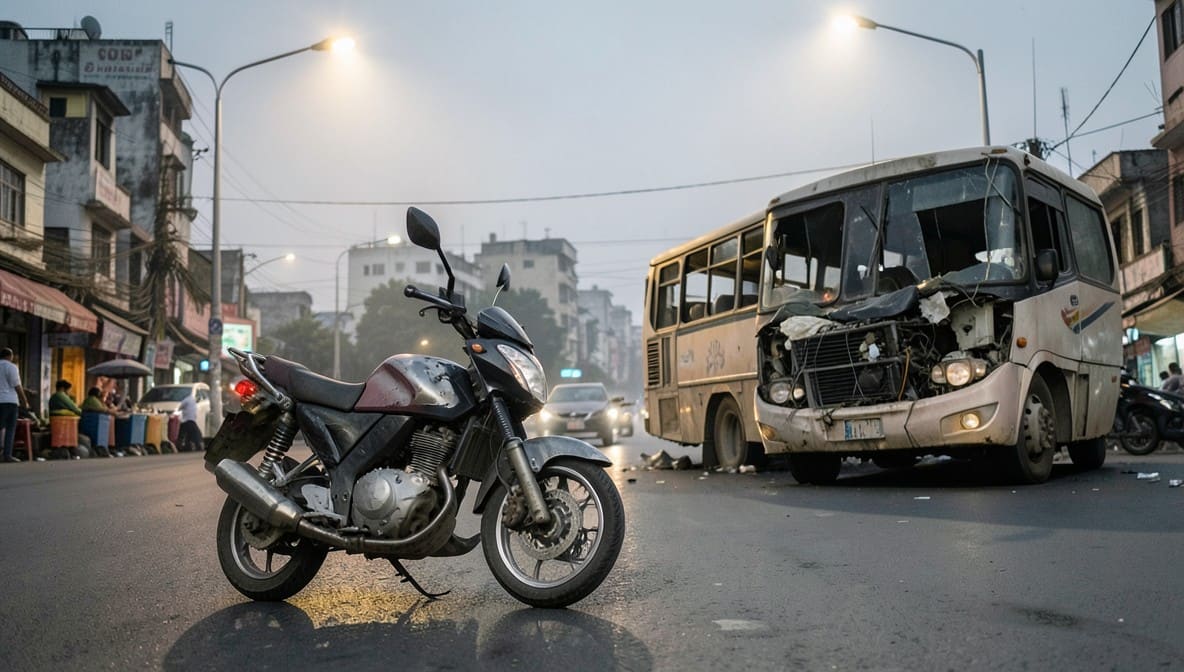
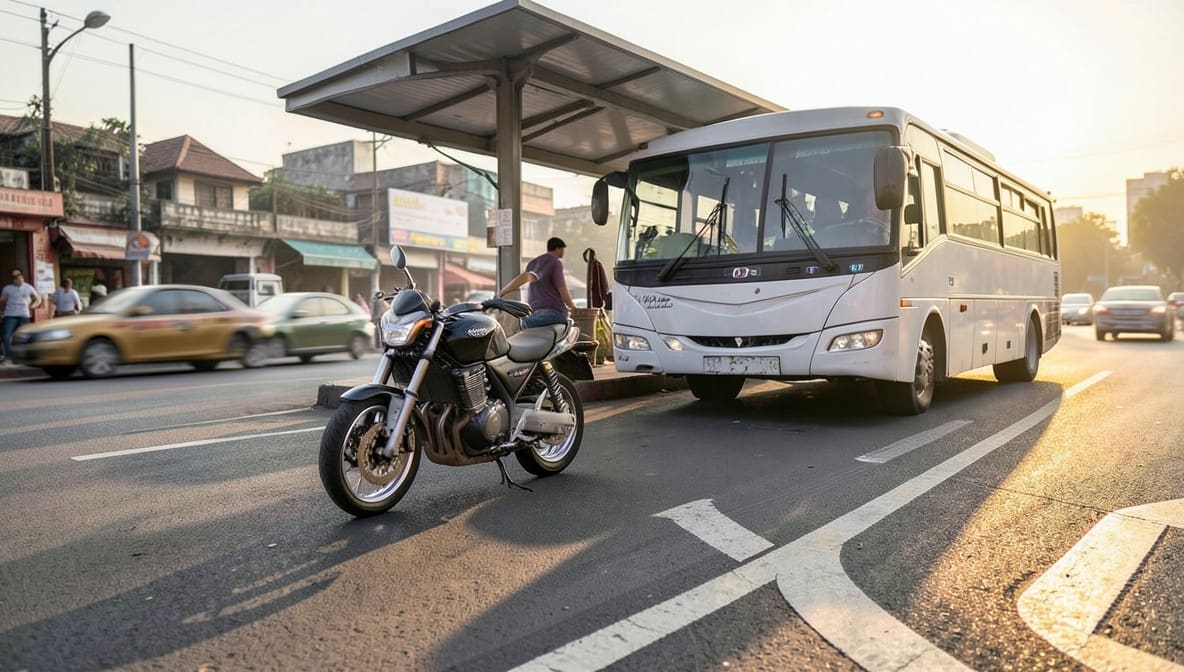
The respondent, Ajaya Parashram Nalavade, a 24-year-old car driver, filed a claim petition under Section 166 of the Motor Vehicles Act, 1988, seeking compensation for injuries sustained in a road accident on 25.02.2014 at approximately 1.45 a.m. near the Central Bus Stand Main Gate in Belagavi. He alleged that the driver of a bus operated by the North Western Karnataka Road Transport Corporation (NWKRTC), bearing registration number KA-42-F-1559, negligently emerged from the bus stand and collided with his motorcycle (KA-22-EG-8286), causing severe injuries.
Key Facts
- The accident occurred on 25.02.2014 at approximately 1.45 a.m.
- The claimant was 21 years old at the time of the accident.
- He was employed as a car driver and claimed a monthly income exceeding Rs.12,000, though no documentary proof was submitted.
- He sustained a displaced fracture of the upper one-third shaft of the right femur and soft tissue injury to the right elbow.
- He was treated with CRIM with IMIL nailing and remained an inpatient for 27 days.
- The claimant filed a complaint against the bus driver, leading to a charge sheet (Ex.P1 to P6).
- The bus driver filed a counter-complaint, resulting in a separate charge sheet against the claimant (Ex.R1 to R6).
- The claim petition was filed on 19.03.2014.
- The Tribunal delivered its award on 08.06.2016.
- The Corporation filed this appeal on 17.03.2026.
Procedural History
- 25.02.2014: Accident occurred near Central Bus Stand, Belagavi.
- 19.03.2014: Claim petition filed before the Additional Motor Accident Claims Tribunal, Belagavi (MVC No.544/2014).
- 08.06.2016: Tribunal awarded Rs.7,60,000/- with 9% interest from the date of petition.
- 17.03.2026: Appeal heard and reserved for judgment.
- 01.06.2026: Judgment delivered by the Karnataka High Court, Dharwad Bench.
The Parties' Positions
For the Appellant (NWKRTC)
- Argued that the claimant was contributorily negligent, citing the police charge sheet filed against him.
- Contended that the Tribunal erred in assessing monthly income at Rs.7,500/- without documentary evidence.
- Challenged the 30% disability assessment as inflated and unsupported.
- Asserted that the compensation awarded under heads like loss of future happiness and incidental charges was excessive.
For the Respondent (Claimant)
- Maintained that the Corporation failed to plead contributory negligence in its written statement.
- Submitted that the police charge sheets were contradictory and unreliable.
- Argued that the Tribunal’s findings on income, disability, and compensation were well-reasoned and supported by medical evidence.
Relief Sought
The appellant sought modification or reduction of the Tribunal’s award of Rs.7,60,000/-, including reduction in interest rate, income assessment, disability percentage, and compensation under various heads. The respondent sought confirmation of the Tribunal’s award.
The Legal Issue
The central questions were: (1) Whether the appellant could raise the plea of contributory negligence for the first time in appeal without having pleaded it before the Tribunal? (2) Whether the Tribunal erred in assessing the claimant’s permanent physical disability at 30% and his monthly income at Rs.7,500/-, and whether the compensation awarded under various heads was excessive?
Arguments Presented
For the Appellant
The appellant relied on the two conflicting charge sheets filed by police to argue that the claimant’s own rash driving caused the accident. It contended that the Tribunal should have apportioned 75% liability to the claimant. It further argued that the claimant’s income of Rs.7,500/- was arbitrarily assumed without proof, and that the 30% disability assessment ignored medical norms. The appellant cited Smt. Narasamma v. Baburao to justify the income assumption but challenged the disability multiplier and compensation heads as disproportionate.
For the Respondent
The respondent emphasized that the appellant had not pleaded contributory negligence in its written statement, making it impermissible to raise it in appeal. He relied on State of Karnataka v. K. Srinivas to argue that contradictory police reports cannot be used to establish fault. He submitted that the Tribunal’s reliance on the doctor’s testimony, despite its limitations, was reasonable given the nature of the injury and the claimant’s occupation. He defended the compensation heads as aligned with precedents and the claimant’s age and earning capacity.
The Court's Analysis
The Court first addressed the issue of contributory negligence. It held that the appellant’s reliance on the charge sheet filed against the claimant was legally unsustainable because no such plea was raised in the written statement before the Tribunal. The Court observed:
"No weight can be attached to RW-1’s statements without necessary pleading."
It further noted that the existence of two contradictory charge sheets indicated a defective investigation and could not serve as a basis for apportioning liability. The Court held that the claimant’s version, corroborated by medical evidence and consistent with the Tribunal’s findings, was credible.
On the issue of income, the Court upheld the Tribunal’s use of Rs.7,500/- per month as a notional income, citing the Smt. Narasamma precedent and the KSLSA chart for 2014, noting that the appellant did not dispute the claimant’s age or occupation.
The critical error lay in the assessment of permanent disability. The Court examined the medical evidence: the claimant suffered a single fracture of the right femur. The examining doctor (PW-2) opined a 35% disability of the right lower limb. The Court applied the established principle that for a weight-bearing limb, one-third of the limb’s disability is taken as the percentage of whole-body disability. Thus, 35% of the limb translates to 11.67%, rounded to 12% for the whole body. The Court held:
"Applying this formula, the claimant would have only 12% permanent physical disability of the whole body."
Accordingly, the loss of future income was recalculated as Rs.7,500 x 12 x 18 x 12% = Rs.1,94,400/-.
The Court also reduced the compensation under "loss of future happiness and amenities" from Rs.1,00,000/- to Rs.25,000/-, finding it disproportionate to the injury. Incidental charges were reduced from Rs.28,000/- to Rs.20,000/- as excessive. All other heads - pain and suffering, medical bills, loss of income during treatment, and future medical expenses - were upheld.
On interest, the Court affirmed the 9% rate, noting the prolonged delay in adjudication since the accident in 2014 and the petition in 2014.
The Verdict
The appeal was partly allowed. The judgment and award dated 08.06.2016 of the Additional Motor Accident Claims Tribunal, Belagavi, was modified. The claimant is entitled to a total compensation of Rs.3,85,400/-, comprising:
- Pain and suffering: Rs.50,000/-
- Loss of future happiness and amenities: Rs.25,000/-
- Loss of income during treatment: Rs.30,000/-
- Incidental charges: Rs.20,000/-
- Medical bills: Rs.51,000/-
- Loss of future income: Rs.1,94,400/-
- Future medical expenses: Rs.15,000/-
Interest at 9% per annum shall accrue from the date of the petition (19.03.2014) until realization. The registry is directed to transmit any deposited amount to the Tribunal along with the trial record.
What This Means For Similar Cases
Contributory Negligence Requires Pleading
- Practitioners must ensure that any plea of contributory negligence is explicitly pleaded in the written statement before the Tribunal.
- Reliance on police charge sheets or witness testimony without pleading is legally impermissible in appeals.
- Courts will disregard such arguments raised for the first time in higher forums.
Disability Assessment Must Follow Medical Norms
- Permanent disability for a single fracture of a weight-bearing limb must be calculated as one-third of the limb’s disability.
- Non-treating doctors’ opinions are admissible but must be evaluated against established medical formulas.
- Speculative or arbitrary disability percentages (e.g., 30% for a femur fracture) will be corrected on appeal.
Income Assumption Is Permissible Without Documentary Proof
-
In the absence of income proof, notional income based on standard charts (e.g., KSLSA) or precedents like Smt. Narasamma is valid.
-
Courts will not penalize claimants for lack of formal documentation if occupation is established.
-
The multiplier of 18 remains applicable for claimants under 40 years.
-
Compensation under "loss of amenities" must be proportionate to injury severity - excessive awards will be reduced.
-
Interest at 9% remains justified in delayed claims, even if the accident occurred years prior.