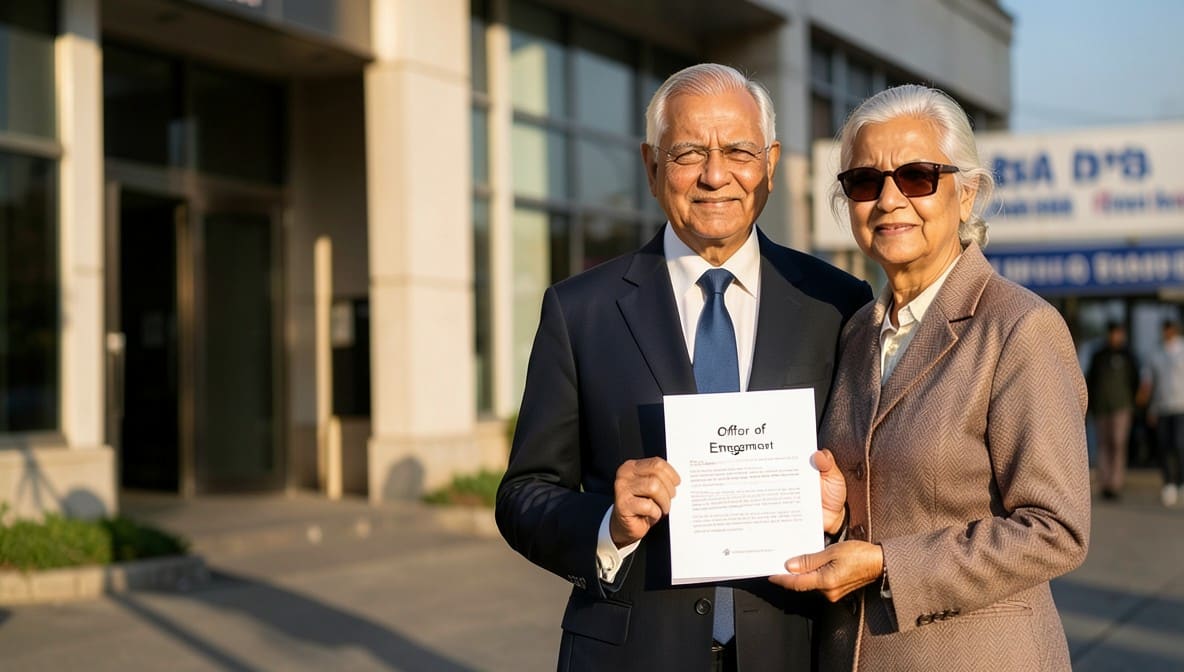
The Calcutta High Court has granted interim relief to a retired Central government officer whose contractual tenure was retrospectively curtailed from five years to two, holding that such action violates the principle of vested rights and the rules of natural justice under Article 14 of the Constitution. The judgment underscores that administrative circulars cannot override established contractual terms once accepted by the employee.
Background & Facts
The Dispute
The petitioner, Dr. Sham Kumar Sharma, a retired Chief Engineer of the Jal Shakti Vibhag, Himachal Pradesh, with over 33 years of service in water and sanitation, applied for the sanctioned post of Scientist F (Level 13A, 7th CPC) at the Dr. Shyama Prasad Mookerjee National Institute of Water and Sanitation, Kolkata, in response to a vacancy notice published in October 2023. The notice specified that the maximum tenure of engagement for retired government officers would be the age of superannuation plus five years, subject to annual satisfactory performance.
Key Facts
- The petitioner is a permanent resident of Himachal Pradesh and relocated to Kolkata to accept the position.
- The vacancy notice explicitly stated the engagement period as "age of superannuation plus five years, as applicable."
- The petitioner was selected after interview and issued an offer of engagement on 15th March, 2024.
- The offer letter reiterated the five-year tenure limit, subject to performance and further orders.
- The petitioner joined duty on 27th March, 2024.
- On 27th October, 2025, the Institute issued a revised term of engagement, reducing the tenure to an initial period of one year, extendable by another year, or up to five years from superannuation, whichever is earlier - with retrospective effect from the date of the original engagement offer.
- The revision was based on the Department of Expenditure’s Office Memo dated 9th December, 2020, which the Institute misinterpreted as a tenure cap.
- The petitioner submitted objections on 11th December, 2025, and again on 6th March, 2026, highlighting prejudice and lack of hearing.
- A relieving order dated 23rd March, 2026, was issued, and the petitioner handed over charge on 26th March, 2026, under protest.
- The petitioner had completed two years of service by 26th March, 2026, with no allegation of poor performance.
Procedural History
- October 2023: Vacancy notice published for Scientist F post.
- 30th December 2023: Last date for receipt of applications.
- 15th March 2024: Offer of engagement issued, specifying five-year tenure.
- 27th March 2024: Petitioner joined duty.
- 27th October 2025: Revised terms issued with retrospective effect.
- 11th December 2025: Petitioner’s first objection filed.
- 3rd February 2026: Executive Council approved revised terms.
- 3rd March 2026: Official reply rejecting objection.
- 5th March 2026: Notice issued that tenure would end on 26th March 2026.
- 6th March 2026: Petitioner’s second objection submitted with performance summary.
- 23rd March 2026: Relieving order issued.
- 26th March 2026: Petitioner handed over charge under protest; no-due certificate issued.
- 28th March 2026: Writ Petition (WPA 7908 of 2026) filed before Calcutta High Court.
- 2nd April 2026: Hearing held.
- 8th April 2026: Judgment delivered.
The Parties' Positions
For the Petitioner:
- The offer of engagement crystallized a vested right to serve for five years.
- Retrospective alteration of terms violates Article 14 and principles of natural justice.
- The Office Memo dated 9th December, 2020, governs remuneration, not tenure.
- No opportunity of hearing was afforded before curtailment.
- Reliance on H.L. Theran, Bharat Sanchar Nigam Limited, and Punjab State Cooperative Agricultural Development Bank Limited.
For the Respondent:
- The petitioner was engaged on contract basis and has no legal right to continued employment.
- The Institute is bound by the Department of Expenditure’s Office Memo dated 9th December, 2020.
- The Memo permits extension beyond two years only with justification, implying a default two-year limit.
- The Institute has the right to revise terms of contractual engagement.
- The petitioner’s rights ceased upon relieving order.
Relief Sought
The petitioner seeks:
- Quashing of the revised terms dated 27th October, 2025, and the relieving order dated 23rd March, 2026.
- Reinstatement to the post of Scientist F.
- Continuation of service for the full five-year tenure.
- Payment of full remuneration for the period of unlawful termination.
- Interim relief pending final disposal.
The Legal Issue
The central question was whether an administrative authority can retrospectively curtail a contractual tenure explicitly offered and accepted by a retired government officer, thereby extinguishing a vested right, without affording an opportunity of hearing, and whether such action violates Article 14 and the principles of natural justice.
Arguments Presented
For the Petitioner
The petitioner relied on three landmark judgments: H.L. Theran & Ors. v. Union of India (1989) 1 SCC 764, which held that any curtailment of existing service rights without prior hearing violates natural justice; Bharat Sanchar Nigam Limited v. Tata Communication (2022) 20 SCC 96, which ruled that administrative circulars cannot have retrospective effect unless expressly authorized by statute; and Punjab State Cooperative Agricultural Development Bank Limited v. Registrar of Cooperative Societies (2022) 4 SCC 363, which held that retrospective amendments divesting accrued benefits violate Articles 14 and 16. The petitioner argued that the offer letter constituted a binding contractual term, and the Office Memo of 9th December, 2020, was meant only to regulate remuneration, not to cap tenure.
For the Respondent
The respondents contended that the petitioner was a contractual appointee with no right to permanent service. They argued that the Office Memo dated 9th December, 2020, clearly limits initial engagement to one year, extendable by another, and that the five-year cap in the vacancy notice was merely aspirational. They asserted that the Institute, as a government body, has the authority to revise contractual terms in line with policy, and that the petitioner’s rights terminated upon issuance of the relieving order. No legal right to continuation, they argued, could arise from a contract subject to performance and administrative discretion.
The Court's Analysis
The Court conducted a meticulous review of the vacancy notice, the offer letter, and the Office Memo dated 9th December, 2020. It found that the Office Memo was explicitly framed to standardize remuneration for retired officers engaged on contract, not to prescribe tenure limits. The Memo states: "The term of appointment shall ordinarily be for an initial period not exceeding one year, which is extendable by another one year. The term may be extended beyond two years after the age of superannuation where adequate justification exists... provided it shall not be extended beyond five years after superannuation."
"The Office Memo itself relates to remuneration and the period of remuneration has been specified in the Office Memo."
The Court held that the Institute had misread the Memo, conflating the upper limit of remuneration eligibility with a mandatory tenure cap. The vacancy notice, which the petitioner relied upon, clearly stated the five-year tenure, and the offer letter confirmed it. The petitioner, a permanent resident of Himachal Pradesh, had relocated to Kolkata based on this assurance, incurring significant personal and financial costs.
The Court emphasized that once a contractual term is accepted and acted upon, it crystallizes into a vested right. The retrospective application of the revised terms, which effectively reduced the tenure from five to two years, was held to be arbitrary and violative of Article 14. The absence of any opportunity of hearing prior to the curtailment further violated the principles of natural justice, as affirmed in H.L. Theran.
"Any arbitrary or whimsical exercise of power prejudicially affecting the existing service condition of a Government employee, will offend provision of Article 14 and would offend the rules of natural justice."
The Court also noted that the Institute, as a public institution under the Department of Drinking Water and Sanitation, serves a vital public purpose. Curtailing the service of a highly experienced officer without cause undermines public interest.
The Verdict
The petitioner succeeded on interim relief. The Court directed the respondents to keep the relieving order dated 23rd March, 2026, in abeyance until 26th June, 2026. The petitioner was directed to be reinstated with immediate effect, and positively by 10th April, 2026. The period from 27th March, 2026, to 10th April, 2026, shall not be treated as a break in service, and the petitioner shall be entitled to full remuneration during this period. The respondents were directed to file their affidavit in opposition by 7th May, 2026, and the matter was listed for final hearing on 8th June, 2026.
What This Means For Similar Cases
Vested Contractual Rights Cannot Be Retrospectively Diminished
- Practitioners must argue that any contractual term explicitly offered and accepted by a government employee becomes a vested right, even in contractual appointments.
- Administrative circulars cannot be invoked retrospectively to override such terms unless expressly authorized by statute.
- The burden lies on the employer to prove that the revised policy was communicated before acceptance of the offer.
Natural Justice Applies Even in Contractual Employment
- The principle of audi alteram partem applies to all government employment, including contractual roles.
- Post-decisional hearings are insufficient; prior opportunity to be heard is mandatory before altering terms that affect livelihood.
- Failure to provide hearing renders the action voidable under Article 14.
Misinterpretation of Policy Documents Is Not a Valid Defense
-
Courts will examine the actual language of policy documents and their intended purpose.
-
Employers cannot use ambiguous or misapplied circulars to justify curtailment of rights.
-
Vacancy notices and offer letters form the binding contractual framework, not internal memos.
-
Always verify whether a policy document governs tenure, remuneration, or both.
-
Document all communications and reliance on advertised terms.
-
File writ petitions promptly where retrospective changes are applied, as delay may extinguish the cause of action.