The Kerala High Court has clarified that a public authority cannot recover damages for contract termination without proving actual financial loss. In a significant ruling, the Court rejected the State’s claim for differential costs arising from re-tendering, emphasizing that speculative or hypothetical losses are insufficient to justify retention of a contractor’s security deposit. The judgment reinforces the principle that burden of proof lies squarely with the party alleging damages.
Background & Facts
The Dispute
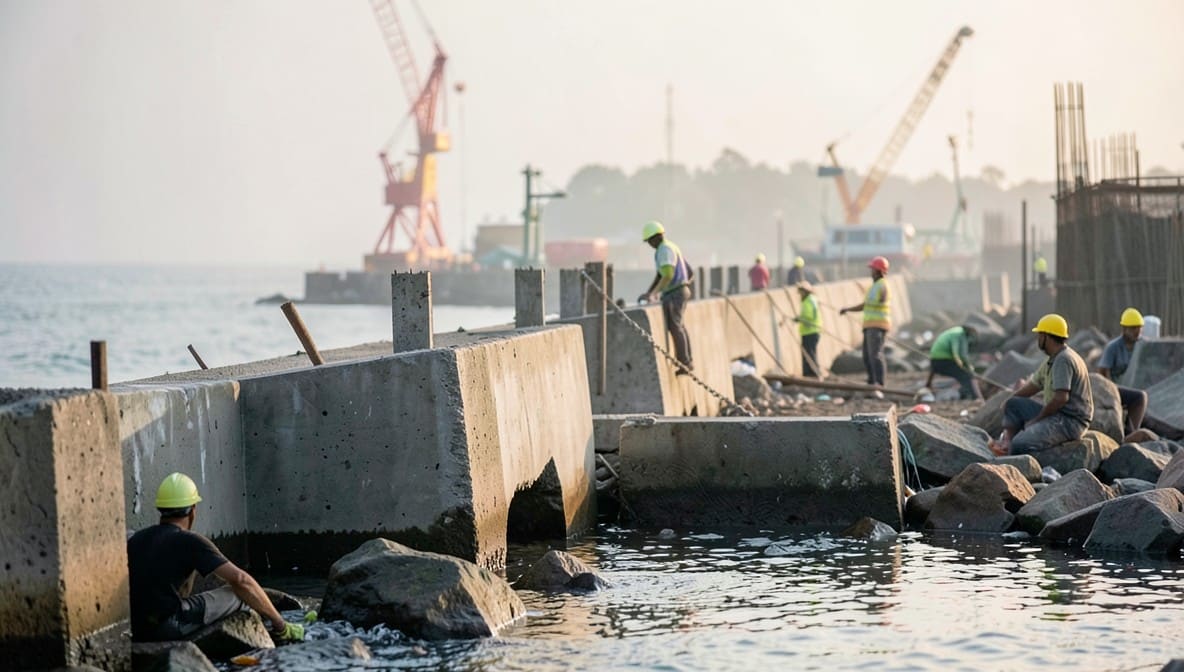
The dispute arose from the construction of a breakwater project at Azheekal, Kerala, awarded by the State of Kerala through a public tender. The defendant, T. Oommen Panicker, was the successful bidder under Ext.A1 tender notice dated 28.02.1994. The estimated project cost was Rs.7,40,00,000/-. An agreement (Ext.A4) was executed on 03.01.1995, fixing a 30-month performance period from site handover. The contract price was 27.7% above the Project Appraisal Committee (PAC) estimate of Rs.7,08,16,125/-. The total contract value was Rs.9,04,32,192/-.
Key Facts
- The contract was extended twice via agreements (Ext.A12 dated 25.03.2003 and others), with penalties imposed on the defendant for delays.
- A Revenue Divisional Officer’s order interdicting a nearby quarry contributed to material delays.
- On 27.06.2006, the State terminated the contract and issued a re-tender notice (Ext.A18) on 31.08.2006.
- The defendant challenged the termination in W.P.(C) No.25733 of 2006; the Court, by judgment dated 13.02.2007, directed the State to reconsider his claims.
- The re-tender was cancelled, and a revised agreement (Ext.A15) was executed on 16.04.2007, later modified by Ext.A16 on 15.05.2007, extending the deadline to 15.10.2007.
- On 05.11.2007, the contract was terminated again (Ext.A17) due to non-completion.
- The work was re-tendered, and a new contract (Ext.A20) was awarded on 15.04.2008 at 29% above PAC, amounting to Rs.3,03,35,182/- for the remaining 20% of work.
- The State initiated revenue recovery proceedings, which were challenged by the defendant in W.P.(C) No.37300 of 2010.
- The Court, by Ext.A22 judgment, interfered with the recovery; a review petition (R.P.No.928 of 2014) led to Ext.A23 order dated 12.12.2014, affirming termination but directing the State to pursue civil remedies.
- The present suit was filed seeking damages under two heads: (i) differential tender rates and (ii) replenishment charges.
- The defendant filed a counterclaim for return of security deposit and retention money withheld.
- The plaintiff failed to produce a joint inspection report (Ext.A26) for alleged defective works, relying instead on internal calculations (Ext.A24), which the defendant contested via Ext.A27.
Procedural History
- 28.02.1994: Tender notice issued for breakwater project
- 03.01.1995: Contract executed (Ext.A4)
- 25.03.2003: Revised agreement incorporating enhanced PAC estimate (Ext.A12)
- 27.06.2006: First termination of contract
- 31.08.2006: Re-tender notice issued (Ext.A18)
- 13.02.2007: High Court judgment in W.P.(C) No.25733/2006 directing reconsideration
- 16.04.2007: Revised agreement (Ext.A15)
- 15.05.2007: Modified agreement (Ext.A16) fixing deadline of 15.10.2007
- 05.11.2007: Final termination (Ext.A17)
- 15.04.2008: New contract awarded to second contractor (Ext.A20)
- 19.11.2007: Notice for joint inspection of defective works (Ext.A26)
- 2010: Defendant files W.P.(C) No.37300 challenging revenue recovery
- 12.12.2014: High Court’s Ext.A23 order affirming termination but relegating damages claim to civil court
- 2015: Suit filed in Sub-Court, Kozhikode (OS No.135/2015)
- 30.09.2019: Trial court dismissed plaint, allowed counterclaim
- 14.02.2020: Appeal filed before High Court (RFA No.148/2020)
- 15.07.2026: Judgment delivered by Division Bench
Relief Sought
The plaintiff sought recovery of damages amounting to Rs.69,35,182/- (difference between original and re-tendered contract values) and replenishment charges. The defendant sought return of security deposit and retention money withheld, totaling Rs.1,25,00,000/-, with interest.
The Legal Issue
The central question was whether a public authority can recover damages for contract termination based solely on the difference between original and re-tendered contract rates, without proving actual financial loss or establishing that the re-tender was unavoidable and conducted in good faith.
Arguments Presented
For the Appellant/Petitioner
The State contended that the re-tendered contract at 29% above PAC, compared to the original 27.7%, resulted in a 1.3% additional cost, constituting quantifiable damages. It argued that the defendant’s default necessitated re-tendering, and the differential cost was a direct consequence of breach. It relied on the principle that a party in breach must compensate for foreseeable losses.
For the Respondent/State
The defendant countered that the State failed to prove actual loss. The re-tendered contract covered only 20% of the original work, and the higher rate was attributable to inflation and market conditions, not the defendant’s default. He emphasized that the State did not produce a joint inspection report for alleged defects, nor did it prove that the re-tender was conducted at the lowest possible rate. He argued that retention of security deposit without proof of loss violated the doctrine of unjust enrichment.
The Court's Analysis
The Court examined the two heads of claim separately. Regarding the differential tender rate, it noted that the original contract was for 100% of the work, while the re-tender covered only the remaining 20%. The value of the remaining work under the original contract was Rs.3,95,40,000/-. The re-tendered amount was Rs.3,03,35,182/-, which was actually lower than the proportionate value under the original contract. The Court observed:
"The claim of damages based on the difference in tender rates is speculative and cannot be sustained when the re-tendered amount is less than the proportionate value of the unexecuted portion of the original contract."
The Court further held that the State’s reliance on the 29% rate as a benchmark was flawed, as market conditions and inflation had changed since 1995. The State did not demonstrate that the re-tender was conducted competitively or that the rate was the lowest available.
On the replenishment claim, the Court emphasized the absence of the joint inspection report (Ext.A26), which was the only credible evidence of defects. The plaintiff’s internal calculation (Ext.A24) was not binding on the defendant and lacked corroboration. The Court stated:
"The burden of proving defective work lies with the party alleging it. Without a joint inspection report, the claim collapses under the weight of its own uncertainty."
The Court also rejected the State’s argument that the defendant’s delay justified retention of funds, noting that delays were partly attributable to external factors, including the quarry closure. The Court held that the State’s failure to prove any actual loss rendered the retention of security deposit and retention money unlawful.
The Verdict
The appeal was allowed in part. The High Court affirmed the trial court’s dismissal of the plaint and its allowance of the counterclaim. The State was directed to return the security deposit and retention money totaling Rs.1,25,00,000/- with interest at 9% per annum from the date of the suit (15.03.2015) until realization. All other aspects of the trial court’s decree were upheld. No costs were awarded.
What This Means For Similar Cases
Damages Must Be Proven, Not Assumed
- Practitioners must now establish actual financial loss with documentary evidence before claiming damages for contract termination
- Speculative claims based on differential tender rates are insufficient unless the re-tendered amount exceeds the proportionate value of the unexecuted work
- Public authorities must document re-tender processes transparently to justify higher costs
Security Deposit Retention Requires Proof of Loss
- Retention of security deposits or retention money without proof of actual damage or defect is unlawful
- The burden of proof lies entirely with the public authority
- In the absence of joint inspection reports or third-party assessments, claims for replenishment charges will fail
External Delays Mitigate Contractor Liability
- Delays caused by third-party actions (e.g., regulatory orders, environmental restrictions) must be factored into liability assessments
- Contractors cannot be held solely responsible for delays arising from extraneous public actions
- Contract extensions granted under duress or external pressure cannot later be used to justify termination without equitable consideration