
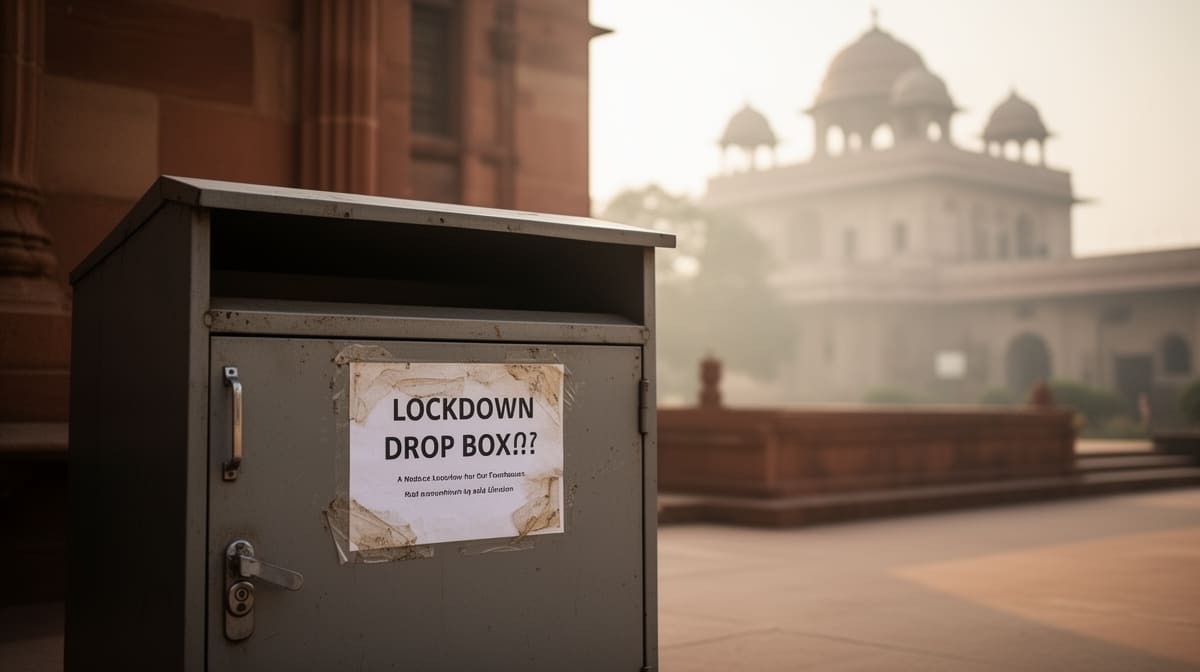
A Madras High Court bench has clarified that non-production of an appeal receipt during the COVID-19 lockdown does not amount to wilful disobedience of court orders, thereby dismissing a contempt petition filed against a temple authority. The judgment underscores the need for judicial empathy in procedural compliance during public emergencies and establishes a pragmatic standard for assessing intent in contempt proceedings.
Background & Facts
The Dispute
The dispute arises from a long-standing property possession conflict between the petitioner, P. Naresh Ambedkar, and the respondent, the Executive Officer of the Arulmigu Matha Angala Easwariamman Temple in Palayamkottai, Tirunelveli. The Temple sought eviction of the petitioner and his mother from temple premises, leading to litigation that spanned over a decade.
Key Facts
The petitioner and his mother were initially ordered to be evicted in an earlier proceeding
They challenged the eviction order in W.P.(MD)No.5683 of 2009, which was allowed by the Single Judge on 29.04.2014
The Temple filed a Writ Appeal in W.A.(MD)No.1253 of 2019
On 24.10.2019, the Division Bench of the Madras High Court allowed the Writ Appeal and directed the petitioner to file an appeal before the Commissioner, H.R. & C.E. Department, within 30 days of receiving a copy of the judgment
The petitioner claims to have filed the appeal on 29.01.2020 via the Drop Box facility due to COVID-19 lockdown restrictions
No formal acknowledgement of filing was obtained
The Temple contends that no appeal appears on its records and that the petitioner has failed to comply with the Division Bench’s direction
The petitioner has been unable to produce any documentary proof of filing, despite repeated requests
Procedural History
29.04.2014: Single Judge allows W.P.(MD)No.5683 of 2009, setting aside eviction order
24.10.2019: Division Bench allows W.A.(MD)No.1253 of 2019, directs filing of appeal before Commissioner within 30 days
29.01.2020: Petitioner claims to have filed appeal via Drop Box during nationwide lockdown
03.06.2025: W.P.(MD)No.14981 of 2025 filed seeking enforcement of the 2019 order
16.03.2026: Contempt Petition filed under Section 11 of the Contempt of Courts Act, 1971
The Parties' Positions
Petitioner’s Position: The appeal was filed on 29.01.2020 under extraordinary circumstances of the pandemic. The absence of an acknowledgement is due to systemic limitations of the Drop Box system during lockdown, not intentional non-compliance.
Respondent’s Position: The petitioner has failed to produce any proof of filing. The absence of the appeal on official records constitutes a clear violation of the Division Bench’s order, warranting punishment for contempt.
Relief Sought
The petitioner seeks dismissal of the contempt petition, with a direction to treat the belatedly produced appeal as a timely filed revision petition and for the Commissioner to decide it on merits.
The Legal Issue
Can the failure to produce an acknowledgement of an appeal filed during the COVID-19 lockdown constitute wilful disobedience under Section 11 of the Contempt of Courts Act, 1971, when the court’s direction was to file an appeal, not to prove its filing?
Arguments Presented
For the Petitioner
The petitioner’s counsel argued that the pandemic created an environment where normal procedural channels were disrupted. The use of the Drop Box was a reasonable, good-faith attempt to comply with the court’s directive. The absence of an acknowledgement was not due to negligence or defiance but due to the absence of a formal receipt system during lockdown. Reliance was placed on the principle that contempt requires mens rea, and mere procedural lapse without intent cannot be punished.
For the Respondent
The respondent contended that the court’s order was clear and unambiguous: file the appeal within 30 days. The petitioner’s failure to produce any proof - despite ample opportunity - demonstrated non-compliance. The Temple had acted in good faith by proceeding on the assumption that no appeal had been filed. The burden of proof lay with the petitioner to establish compliance, which he had failed to discharge.
The Court's Analysis
The Court examined the nature of the obligation imposed by the Division Bench’s order dated 24.10.2019. It noted that the direction was to file an appeal, not to submit proof of filing. The Court emphasized that contempt proceedings require proof of wilful and deliberate disobedience, not mere technical non-compliance.
"When it is pleaded that on account of the COVID-19 pandemic, the appeal was dropped in the Drop Box, it cannot be said that the failure to produce an acknowledgement will be fatal."
The Court acknowledged the unprecedented disruption caused by the pandemic, particularly in early 2020, when physical access to courts and administrative offices was severely restricted. It held that the petitioner’s conduct, while procedurally imperfect, lacked the requisite animus contemnendi. The absence of an official receipt does not equate to non-filing, especially where systemic limitations existed.
The Court further observed that punishing the petitioner for a procedural gap created by a global health emergency would be unjust and disproportionate. The remedy, therefore, was not contempt but a practical resolution: treat the appeal as timely filed upon production.
The Verdict
The contempt petition was dismissed. The petitioner was directed to produce a copy of the appeal filed on 29.01.2020 within one week of receiving the web copy of this order. The produced document shall be treated as a revision petition filed in time. The Commissioner, H.R. & C.E. Department, shall dispose of the same on merits within four months. Possession of the premises shall not be taken until after disposal of the revision petition.
What This Means For Similar Cases
Pandemic-Era Procedural Lapses Are Not Automatically Contemptuous
Practitioners may now argue that delays or lack of documentation during lockdowns (March 2020 - June 2021) cannot be presumed wilful without evidence of bad faith
Courts must distinguish between systemic failures and intentional defiance in contempt proceedings
The burden of proving wilfulness remains on the petitioner in contempt cases, even when compliance appears incomplete
Judicial Discretion Overrides Rigid Proceduralism
Courts are empowered to adopt pragmatic remedies - such as treating belated filings as timely - when strict adherence would defeat justice
The doctrine of substantial compliance gains renewed weight in exceptional circumstances
Practitioners should proactively seek court directions to regularize filings made under extraordinary conditions
Documentation Remains Critical, But Not Absolute
While digital receipts, email confirmations, or witness affidavits should be sought whenever possible, their absence does not automatically invalidate compliance
Courts may rely on circumstantial evidence (e.g., timing, pandemic context, prior conduct) to infer good faith
Lawyers should advise clients to preserve any evidence of attempts to file, even if informal (e.g., photographs of drop boxes, witness statements)





