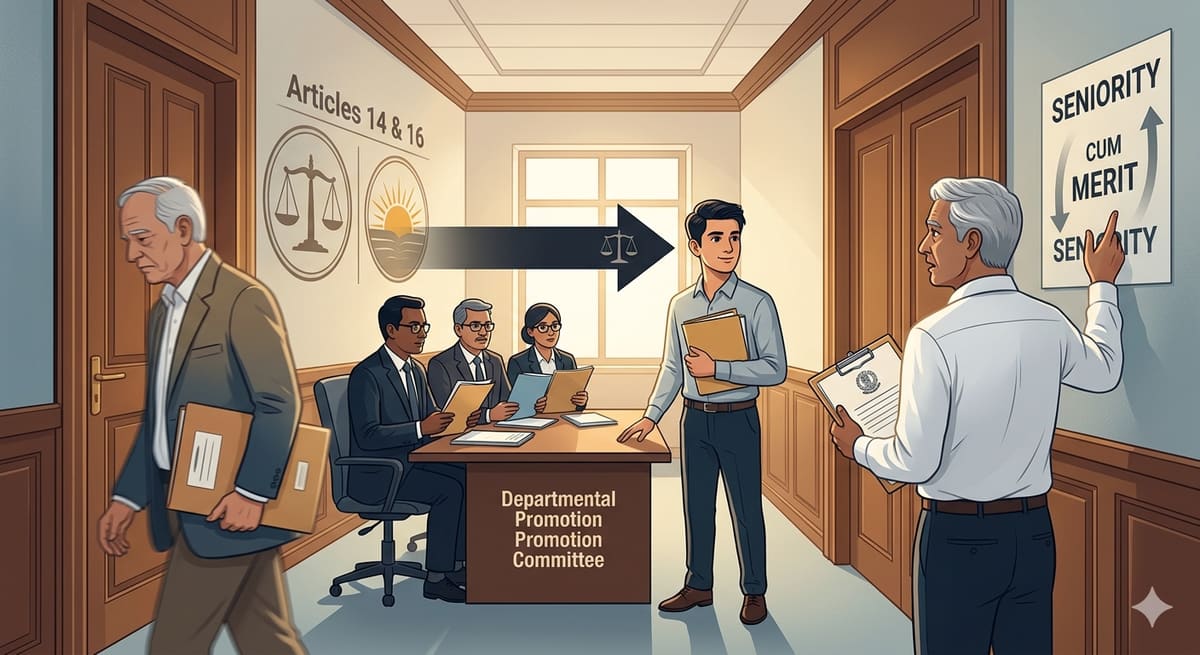
The Karnataka High Court has reaffirmed the legal principle that government corporations must expeditiously finalize seniority lists and consider eligible employees for promotion, failing which constitutional remedies under Article 226 may be invoked. This judgment underscores the duty of public employers to adhere to service regulations and prevent arbitrary delays that deprive employees of legitimate career advancement opportunities.
Background & Facts
The Dispute
The petitioners, ten Assistant Executive Engineers (AEE) employed with the Karnataka Power Transmission Corporation Limited (KPTCL) and Hubli Electricity Supply Company Limited (HESCOM), filed this writ petition under Articles 226 and 227 of the Constitution. They sought a writ of mandamus directing the respondents to finalize and publish the seniority list of AEEs from the 2016 batch and consider their representations for promotion to the post of Executive Engineer (Electrical).
Key Facts
The petitioners were appointed as AEEs pursuant to a recruitment notification dated 08.09.2016 and have been serving since 2017.
Under the applicable Service Rules and Regulations, an AEE becomes eligible for promotion to Executive Engineer upon completion of five years of qualifying service.
The petitioners have completed nearly ten years of service and possess unblemished service records.
Despite their eligibility, the respondents failed to finalize the seniority list, stalling the promotion process.
The petitioners submitted representations (Annexures-A, A1 to A5) requesting the respondents to finalize the seniority list and consider their cases for promotion in accordance with the merit-cum-seniority and reservation principles.
Procedural History
2016: Petitioners appointed as AEEs under the recruitment notification dated 08.09.2016.
2017: Petitioners commenced service as AEEs.
2022: Petitioners completed five years of qualifying service, becoming eligible for promotion.
Subsequent dates: Petitioners submitted representations (Annexures-A, A1 to A5) seeking promotion, but the respondents failed to act.
2026: Writ Petition No. 104128 of 2026 filed before the Karnataka High Court at Dharwad seeking mandamus.
Relief Sought
The petitioners prayed for:
A writ of mandamus directing the respondents to finalize and publish the seniority list of AEEs (2016 batch) in accordance with the applicable Service Regulations, recruitment notification, and governing principles of merit-cum-seniority and reservation.
A writ of mandamus directing the respondents to consider the petitioners' representations for promotion to the post of Executive Engineer within a time-bound period.
The Legal Issue
The central question was whether the inaction of a government corporation in finalizing a seniority list and considering eligible employees for promotion constitutes a violation of service rights, warranting intervention under Article 226 of the Constitution.
Arguments Presented
For the Petitioners
The petitioners were appointed under the recruitment notification dated 08.09.2016 and have completed nearly ten years of service.
Under the Service Rules, they became eligible for promotion to Executive Engineer upon completing five years of qualifying service.
Despite their eligibility, the respondents failed to finalize the seniority list, thereby stalling the promotion process.
The petitioners submitted representations (Annexures-A, A1 to A5), but the respondents took no action, amounting to arbitrary inaction.
The petitioners invoked Article 226 seeking mandamus to compel the respondents to act in accordance with the Service Regulations.
For the Respondents
The Standing Counsel for the respondents submitted that the representations of the petitioners would be considered strictly in accordance with the applicable Service Rules and Regulations.
An appropriate decision would be taken within a reasonable and time-bound period.
The Court's Analysis
The Court observed the following:
It was not in dispute that the petitioners were appointed as AEEs under the recruitment notification dated 08.09.2016 and have been serving since 2017.
It was also not in dispute that under the applicable Service Rules, an AEE becomes eligible for promotion to Executive Engineer upon completing five years of qualifying service.
The petitioners had completed nearly ten years of service and were eligible for promotion.
The grievance was not about denial of promotion on merits but about the failure of the respondents to finalize the seniority list and initiate the promotion process.
The Court emphasized that the respondent-Corporation, as a model employer, is expected to maintain seniority lists in accordance with the applicable Regulations and undertake periodic promotional exercises to prevent deprivation of employees' legitimate rights.
"Having completed the prescribed qualifying service and having rendered nearly ten years of service, the petitioners are certainly entitled to have their claim for promotion considered in accordance with law. The respondent-Corporation, being a model employer, is expected to maintain the seniority list in accordance with the applicable Regulations and undertake promotional exercises periodically so that eligible employees are not deprived of their legitimate right to be considered for advancement in service."
The Court noted that the respondents had not yet taken a decision on the petitioners' representations, but the Standing Counsel fairly submitted that the same would be considered within a reasonable time.
The Court held that the ends of justice would be met by directing the respondents to consider and dispose of the representations in accordance with law.
The Verdict
The Court allowed the writ petition and issued the following directions:
The respondents are directed to consider the representations submitted by the petitioners (Annexures-A, A1 to A5) and pass appropriate orders thereon in accordance with the applicable Service Rules and Regulations.
The respondents must complete this exercise expeditiously, and in any event, within four (4) months from the date of receipt of a certified copy of this order.
What This Means For Similar Cases
Government Employers Must Act Expeditiously on Seniority and Promotion Matters
This judgment reinforces that government corporations and public employers cannot indefinitely delay finalizing seniority lists or considering eligible employees for promotion.
Arbitrary inaction that deprives employees of their legitimate career advancement rights may be challenged under Article 226 of the Constitution.
Practitioners should emphasize the duty of public employers to adhere to Service Regulations and prevent unreasonable delays in promotional exercises.
Mandamus as a Remedy for Service Rights Violations
The Court reiterated that mandamus is an appropriate remedy where a public authority fails to perform a statutory or constitutional duty.
Employees aggrieved by delays in seniority list finalization or promotion consideration may invoke Article 226 to compel action.
The judgment sets a time-bound compliance standard (four months in this case), which may be cited in future petitions to ensure expeditious disposal.
Model Employer Doctrine Applies to Promotional Exercises
The Court invoked the model employer doctrine, holding that government corporations must periodically undertake promotional exercises to prevent deprivation of employees' rights.
This principle may be relied upon in cases involving other public sector undertakings (PSUs) or government departments where promotional delays occur.
Practitioners can argue that inaction in finalizing seniority lists violates the principles of natural justice and fair play in service matters.