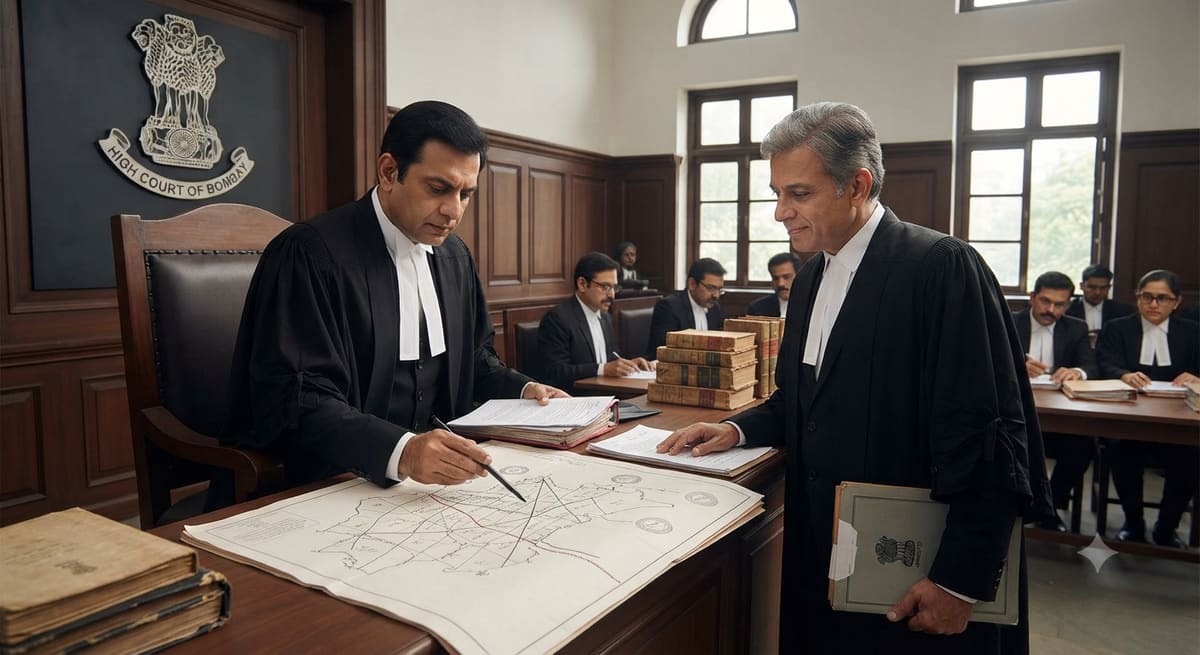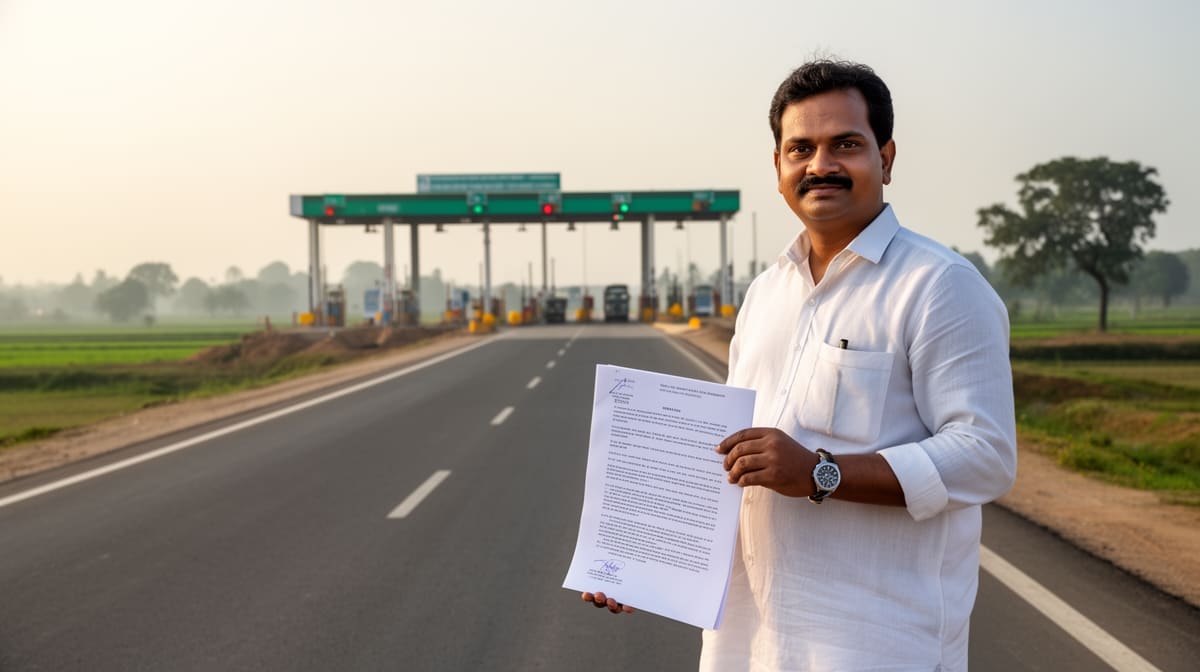
The Bombay High Court has clarified a critical limitation on the powers of Competent Authorities under the National Highways Act, 1956, holding that once an award is issued, any subsequent modification - however well-intentioned - is legally void. This ruling reinforces the finality of statutory awards and curtails administrative overreach in land acquisition proceedings.
Background & Facts
The Dispute
The petitioners, six landowners in Dhule district, owned three separate blocks of land - 188/1, 188/2, and 188/3 - totaling approximately 8,800 square meters, acquired for the four-laning of National Highway 211. The Competent Authority initially treated these blocks as a single unit and applied a belting system to determine compensation, resulting in an award of Rs.69,39,240 on 4 August 2016. The petitioners objected, arguing that each block should be assessed individually with separate market rates.
Procedural History
- 4 August 2016: Competent Authority issued initial award under Section 3-G(1) of the National Highways Act, 1956.
- 31 July 2017: Petitioners filed representations challenging the belting system and requesting individual block-wise assessment.
- 14 August 2017: Competent Authority issued a "Corrigendum" modifying the award to Rs.18,34,221 as additional compensation, removing the belting system.
- 2021: Petitioners filed Writ Petition under Article 226 seeking enforcement of the modified award.
- 2026: Bombay High Court heard the matter finally with consent of parties.
Relief Sought
The petitioners sought a writ of mandamus directing the National Highway Authority of India to disburse the additional compensation of Rs.18,34,221 as per the 14 August 2017 Corrigendum.
The Legal Issue
The central question was whether the Competent Authority, having already passed an award under Section 3-G(1) of the National Highways Act, 1956, retains jurisdiction to issue a modified or supplementary award under the guise of a "Corrigendum" after becoming functus officio.
Arguments Presented
For the Petitioner
The petitioners’ counsel argued that the 14 August 2017 Corrigendum was a corrective measure to rectify a clear error in the initial award - specifically, the failure to recognize distinct ownership of three separate blocks. They relied on Hemant Brijraj Lalwani v. Government of India to contend that where compensation for a part of the land was inadvertently omitted or miscomputed, the authority may issue a supplementary award without violating the principle of functus officio. They emphasized that the modification did not create a new award but corrected a procedural oversight.
For the Respondent
The State and NHAI contended that once an award is passed under Section 3-G(1), the Competent Authority becomes functus officio and loses all jurisdiction to revisit, revise, or modify it. They cited Bhupendrasingh Sardarsingh Parmar v. Competent Authority to assert that the provisions of the Right to Fair Compensation Act, 2013, including Section 33 on correction of awards, do not apply to proceedings under the National Highways Act, 1956. The modification, they argued, was ultra vires and amounted to a nullity.
The Court's Analysis
The Court undertook a detailed statutory interpretation of Section 3-G of the National Highways Act, 1956, and examined the precedents cited by both parties. It emphasized that Section 3-G(5) provides the exclusive remedy for aggrieved parties: filing an arbitration petition before the Arbitrator appointed by the Central Government. This mechanism is designed to be the sole avenue for challenging the determination of compensation.
"Once the award has been passed by the Competent Authority, the Competent Authority loses any authority to tinker with it in any manner whatsoever."
The Court distinguished Hemant Lalwani on its facts. In that case, the original award had failed to determine compensation for a specific portion of land, rendering the award incomplete. Here, the 2016 award covered the entire 8,800 sq. mtrs. The 2017 Corrigendum did not address an omission - it recalculated the value of land already adjudicated. This, the Court held, was not a supplementary award but a revision, which the law does not permit.
The Court further noted that the use of the term "Corrigendum" was legally inconsequential. What matters is substance, not nomenclature. The Competent Authority had discharged its duty under Section 3-G(1) and could not resurrect jurisdiction merely because the petitioners found the compensation inadequate.
The Court acknowledged the petitioners’ legitimate grievance but held that their remedy lay in the arbitration process already initiated, not in a writ petition seeking enforcement of an illegal modification.
The Verdict
The petition was dismissed. The Court held that the Competent Authority, having passed the initial award under Section 3-G(1), became functus officio and lacked jurisdiction to issue a modified award - even if labeled a "Corrigendum." The modification was declared null and void, and the petitioners were directed to pursue their remedy through arbitration.
What This Means For Similar Cases
Modified Awards Are Not Permissible After Final Award
- Practitioners must advise clients that any attempt by a Competent Authority to revise compensation after issuing a final award under Section 3-G(1) is legally invalid.
- A "Corrigendum" or "amended award" cannot be enforced through writ jurisdiction if it revises a previously determined amount.
- The only lawful recourse is to challenge the original award under Section 3-G(5) before the Arbitrator.
Statutory Remedies Are Exhaustive
- The National Highways Act, 1956, does not incorporate the correction mechanisms under the Right to Fair Compensation Act, 2013.
- Courts will not entertain writ petitions to enforce administrative corrections that bypass the statutory arbitration process.
- Landowners must file arbitration petitions within the prescribed time limits to preserve their rights.
Jurisdictional Finality Trumps Administrative Convenience
- Even if an error is apparent, the law prioritizes finality over corrective convenience.
- Practitioners should not rely on informal corrections by authorities; instead, they must initiate formal arbitration proceedings immediately upon receipt of an adverse award.
- This judgment reinforces that statutory timelines and procedures are non-negotiable in land acquisition matters.