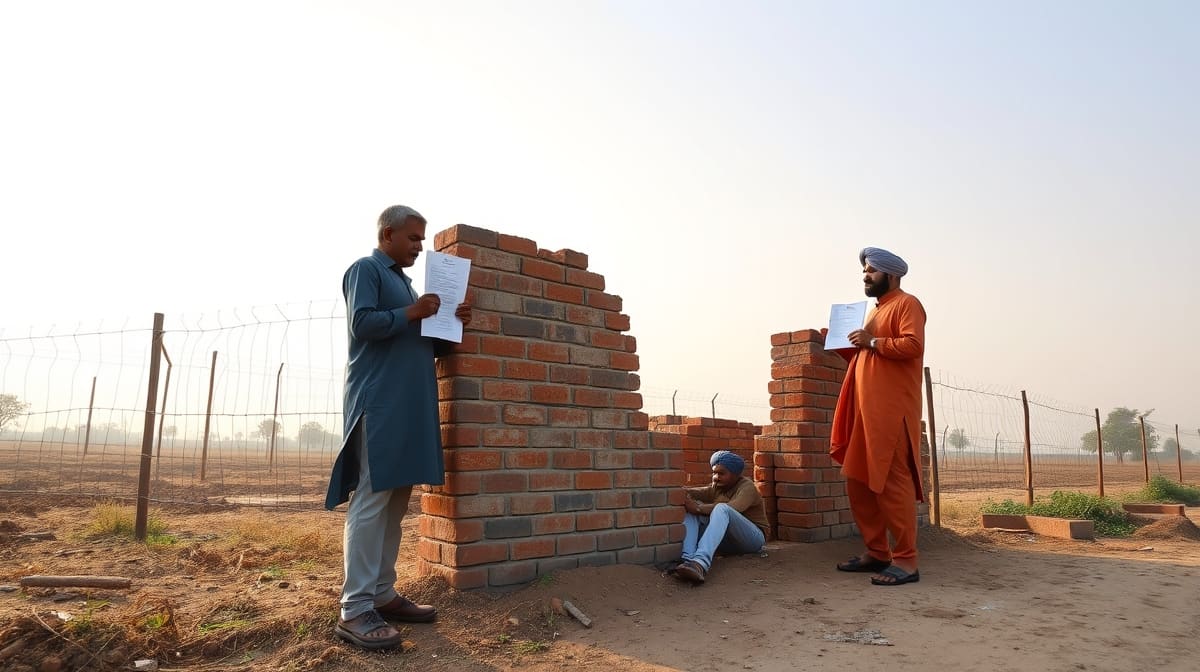
A significant clarification has emerged on the rights of co-owners in joint property when one party seeks to construct without partition. The Punjab and Haryana High Court has affirmed that while exclusive possession does not grant absolute control, acts that undermine the fairness of future partition may be restrained by injunction - even absent formal ouster.
Background & Facts
The Dispute
The respondent-plaintiff filed a suit for mandatory and permanent injunction against the appellants-defendants, who were co-owners of a joint agricultural holding. The plaintiff alleged that the defendants, despite being co-owners, had obstructed partition proceedings and commenced construction on the property without consent, thereby prejudicing the plaintiff’s future entitlement in any partition.
Key Facts
- The parties held undivided rights over a joint agricultural plot in Sangrur district, Punjab
- The plaintiff initiated partition proceedings before the Civil Court on an unspecified date prior to 1998
- The defendants obtained an interim stay order against the partition proceedings, the exact date of which is not specified in the judgment
- The defendants constructed a room, a manger for cattle, and installed an electric motor on the land approximately 10 - 12 years before the suit
- By the time of the suit, construction had reached a height of 7 - 8 feet on the joint property
- The plaintiff claimed the construction would enable the defendants to claim a larger share during partition by asserting higher value for the improved portion
- The defendants claimed exclusive possession and asserted their right to improve the property as co-owners
Procedural History
- Date of suit filing: Not explicitly stated, but judgment dated 26.02.1998 indicates suit was filed prior to this date
- 26.02.1998: Trial Court (Additional Senior Sub-Judge, Sunam) partly decreed the suit, granting permanent injunction against further construction without partition or plaintiff’s concurrence
- Appeal filed: By defendants before the Additional District Judge, Sangrur
- Date of dismissal of appeal: 26.02.1998 (same date as trial court decree; likely a typographical error; appeal dismissed by Additional District Judge prior to RSA filing)
- RSA filed: RSA-3618-1998 (O&M) filed before the Punjab and Haryana High Court
- Reserved: 11.03.2026
- Pronounced: 18.03.2026
The Parties' Positions
Plaintiff-Respondent: Argued that construction during pendency of partition proceedings was a deliberate tactic to alter the property’s value distribution, thereby prejudicing their equitable rights. Relied on the principle that co-owners must not act to the detriment of others.
Defendants-Appellants: Contended that as co-owners in exclusive possession, they had absolute right to improve and construct on the portion they occupied. Asserted that mere construction does not amount to ouster or adverse interference.
Relief Sought
The plaintiff sought:
- A permanent injunction restraining the defendants from raising any further construction on the joint property without partition or plaintiff’s consent
- A mandatory injunction directing demolition of the existing 7 - 8 feet high construction
The defendants sought dismissal of the suit and reversal of the injunction.
The Legal Issue
Can a co-owner in exclusive possession of joint property be restrained by injunction from raising construction if such construction is alleged to prejudice the interests of other co-owners pending partition?
Arguments Presented
For the Appellant
Counsel for the appellants relied on the principle that exclusive possession by a co-owner confers the right to make improvements without consent of other co-owners. They argued that the trial court erred in equating construction with ouster or adverse interference. Citing Bachan Singh v. Swaran Singh, they contended that mere construction does not amount to ouster and that the appropriate remedy for a co-owner out of possession is partition, not injunction.
For the Respondent
Counsel for the respondents argued that the defendants’ conduct was not merely an exercise of ownership rights but a strategic maneuver to gain an unfair advantage in future partition. They emphasized that the defendants had first obtained a stay against partition and then proceeded to construct, thereby consolidating possession and altering the property’s value profile. This, they submitted, fell squarely within Clause (iv) of the Bachan Singh guidelines - acts detrimental to the interests of other co-owners.
The Court's Analysis
The Court undertook a detailed review of the Bachan Singh v. Swaran Singh (AIR 2001 P&H 112) judgment, which had laid down four guiding principles on co-owner rights. The Court focused particularly on Clause (iv): “If the acts of the co-owner in possession are detrimental to the interest of other co-owners, a co-owner out of possession can seek an injunction to prevent such act which is detrimental to his interest.”
"In the peculiar facts and circumstances of the present case, the respondents - plaintiffs had initiated partition proceedings with respect to the joint holding. The appellants - defendants, however, obtained an injunction against the said partition proceedings and thereby prevented the partition of the suit land. Thereafter, having secured such interim protection, the appellants - defendants proceeded to raise construction over the portion allegedly in their exclusive possession."
The Court noted that the defendants’ conduct was not passive use of the property but an active, strategic effort to alter the status quo during litigation. By constructing on the land after securing a stay against partition, they created a fait accompli that could influence the partition court’s valuation and allocation. The Court held that such conduct was not merely an improvement but a prejudicial act.
The Court further emphasized that the grant of injunction is discretionary and must be evaluated in context. Both lower courts had carefully weighed the evidence and found the defendants’ actions prejudicial. The High Court declined to interfere with concurrent findings of fact, noting that a second appeal under Section 41 of the Punjab Courts Act, 1918, does not permit re-appreciation of evidence unless there is a patent illegality.
The Court also clarified that the absence of formal ouster does not immunize a co-owner from equitable restraint where their conduct undermines the fairness of partition.
The Verdict
The appeal was dismissed. The High Court upheld the injunction granted by the trial court, restraining the appellants from raising any further construction on the joint property without partition or the plaintiff’s concurrence. The mandatory injunction for demolition of the existing 7 - 8 feet high construction was not granted, as the Court found the permanent injunction sufficient to prevent further prejudice. All pending miscellaneous applications were disposed of by necessary implication.
What This Means For Similar Cases
Construction During Partition Proceedings Is Not Immune from Injunction
- Practitioners must advise clients that even lawful improvements by a co-owner in possession may be restrained if they are undertaken during pendency of partition proceedings and are likely to distort future valuation
- The mere fact of exclusive possession does not override equitable considerations
- Courts will examine the timing and motive behind construction - especially if it follows a stay against partition
Prejudice to Partition Interests Is a Valid Ground for Injunction
- A co-owner out of possession need not prove ouster to seek an injunction; demonstrating that acts will prejudice partition is sufficient
- Evidence of strategic conduct - such as obtaining a stay and then building - is highly relevant
- Courts will treat such conduct as an attempt to manipulate the partition outcome, warranting equitable intervention
Injunctions Are Discretionary But Not Arbitrary
- Lower courts’ findings on injunctions are entitled to deference in second appeals
- Appellate courts will not interfere unless findings are perverse or based on no evidence
- This judgment reinforces that discretion must be exercised with reference to fairness, not just technical possession rights