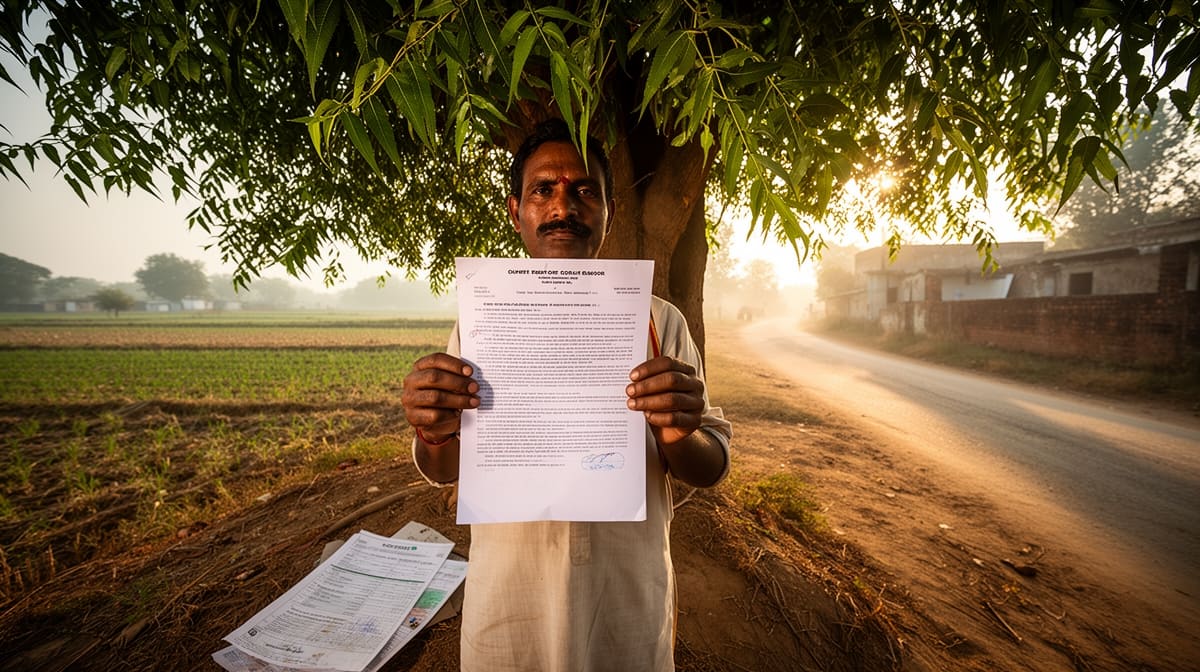
The High Court of Judicature for Rajasthan at Jodhpur has affirmed that financial institutions implementing the Pradhan Mantri Fasal Bima Yojana cannot evade liability for claims denied due to their own data entry errors, even when the error originates from a subordinate cooperative society. This judgment reinforces the principle that beneficiaries of welfare schemes must not suffer for administrative failures beyond their control.
Background & Facts
The Dispute
The petitioners, a group of marginal farmers from Kamediya village in Nagaur district, enrolled in the Kharif 2020 crop insurance scheme under the Pradhan Mantri Fasal Bima Yojana (PMFBY). They paid premiums through the Cooperative Gram Seva Sahkari Samiti Limited, which is affiliated with the Nagaur Central Cooperative Bank Ltd. Due to scanty rainfall, their crops suffered extensive damage. However, their insurance claims were rejected because the National Crop Insurance Portal (NCIP) incorrectly listed their revenue village as "Kherat" instead of "Kamediya".
Procedural History
The dispute unfolded through multiple stages:
- 2020: Farmers submitted all required documents to the Cooperative Society; premium was paid and uploaded by the Bank.
- 2021: Farmers filed writ petition (No. 15137/2021) after claim denial; Court directed authorities to consider their representation.
- 2024: A second writ petition (No. 6128/2024) led to the constitution of a High Level Committee by the Ministry of Agriculture.
- October 9, 2024: The High Level Committee held the Bank liable for the error and directed claim disbursement.
- January 3, 2025: The Committee reaffirmed its order after the Bank’s objections.
- 2025: Both farmers and the Bank filed writ petitions before the Rajasthan High Court.
Relief Sought
The farmers sought enforcement of the High Level Committee’s orders and immediate disbursement of insurance claims. The Bank sought quashing of those orders, arguing it was merely an intermediary with no responsibility for data accuracy.
The Legal Issue
The central question was whether the Nagaur Central Cooperative Bank Ltd. can be held liable for denying crop insurance claims under the Pradhan Mantri Fasal Bima Yojana due to an error in data entry on the National Crop Insurance Portal, when the error was committed by its own staff or designated agents and the farmers had fulfilled all their obligations.
Arguments Presented
For the Petitioners-Farmers
Learned counsel argued that the farmers had no access to or control over the NCIP, and had duly paid premiums and submitted correct details to the Cooperative Society. The Bank, as the nodal agency, was statutorily obligated under PMFBY guidelines to ensure accurate data upload. The Bank had received service charges for enrolling these farmers and had admitted the error before the High Level Committee. Denial of claims on technical grounds violated Articles 14 and 21 of the Constitution, defeating the very purpose of the welfare scheme.
For the Respondent-Cooperative Bank
The Bank contended it was only a conduit, merely uploading data provided by the Cooperative Society. It argued that the erroneous data originated from the Society’s staff, over whom it had no direct control. It claimed no statutory or contractual obligation to verify beneficiary details or bear liability for errors committed by third parties. The Bank further argued that holding it liable would set a dangerous precedent, undermining the scheme’s uniform implementation and exposing banks to unlimited liability.
The Court's Analysis
The Court conducted a detailed examination of the revamped operational guidelines of the Pradhan Mantri Fasal Bima Yojana, particularly clauses 2.11, 17.2, 35.5.9, and 35.5.13. These provisions explicitly mandate that banks must ensure accurate electronic upload of farmer data on the NCIP and hold them responsible for any deficiency in service for which they have received compensation.
"Banks should ensure that farmers are not deprived of any benefit under the Scheme due to errors/omissions/commissions of the concerned branch/PACS, and in case of such errors, the concerned agencies shall have to make good of all such losses."
The Court emphasized that the Bank received a 4% service charge on the total premium remitted for all enrolled farmers, including those with erroneous data. This financial benefit established a quid pro quo: the Bank was compensated for its role in enrollment and data transmission, and therefore bore the corresponding duty of care. The Court rejected the Bank’s attempt to shift blame to the Cooperative Society, noting that the Bank had created the login credentials for the Society’s users and was the entity legally responsible for the integrity of the data submitted to the NCIP.
The Court further observed that the farmers, as vulnerable beneficiaries of a welfare scheme, must not be penalized for administrative failures by implementing agencies. The repeated litigation by the farmers underscored the systemic denial of their rights. The High Level Committee’s findings, grounded in the scheme’s guidelines and supported by documentary evidence, were found to be legally sound and beyond judicial interference in writ jurisdiction.
The Verdict
The farmers won. The Court held that the Nagaur Central Cooperative Bank Ltd. is legally liable for the denial of insurance claims due to its own data entry errors under the PMFBY. The Bank was directed to disburse the full admissible insurance claim amount, along with applicable interest, within eight weeks of receiving a certified copy of the order.
What This Means For Similar Cases
Banks Cannot Outsource Liability for PMFBY Data Entry
- Practitioners must now argue that any financial institution receiving service charges under PMFBY is contractually and statutorily bound to ensure data accuracy on the NCIP.
- Claims cannot be denied on grounds of technical errors if the beneficiary has fulfilled all obligations and the error stems from the bank’s systems or agents.
- The 4% service charge is not merely a fee for transmission but a payment for end-to-end enrollment responsibility.
Welfare Schemes Prioritize Beneficiaries Over Technicalities
- Courts will not permit implementing agencies to use procedural errors as shields against liability when beneficiaries are innocent.
- The principle of ubi jus ibi remedium applies strongly in welfare schemes: where a right exists, a remedy must be available.
- Delayed justice in agricultural insurance cases may now be viewed as a violation of Article 21 (right to livelihood).
Documentation and Audit Trails Are Critical
- Farmers’ advocates should insist on obtaining audit logs of NCIP uploads and service charge invoices from banks to establish liability.
- Banks must maintain verifiable records of data verification processes; failure to do so will be construed as negligence.
- Cooperative Societies may be held jointly liable, but the primary responsibility remains with the bank as the nodal agency.