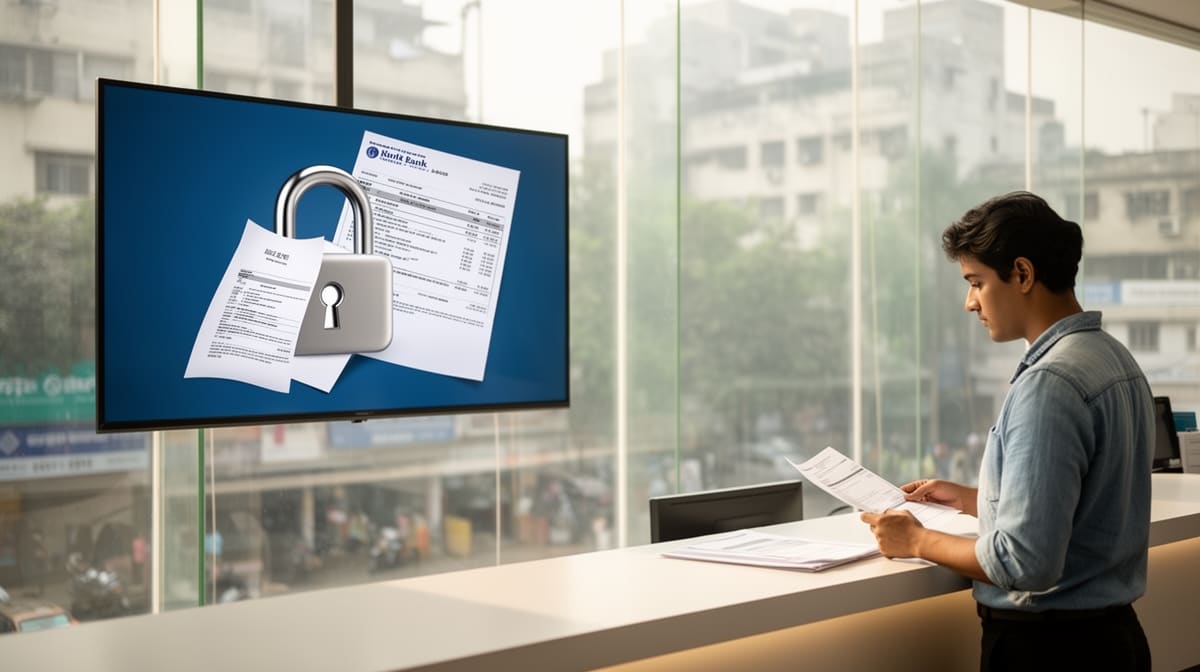
The Rajasthan High Court has established a critical safeguard against arbitrary financial restraint by holding that freezing an entire bank account over a minor disputed transaction violates fundamental rights. This ruling redefines the balance between law enforcement needs and individual economic liberty, setting a new standard for financial freezes in India.
Background & Facts
The Dispute
The petitioner, Ravi Kumar, had his entire bank account frozen by Kotak Mahindra Bank upon receiving a directive from police authorities in Tripura and Madhya Pradesh. The alleged basis for the freeze was the receipt of ₹50,950 in transactions suspected to be proceeds of unlawful activity. No charges had been filed against the petitioner, and no court order had been obtained authorizing the freeze. The petitioner, a private individual with no criminal record, was unable to access funds for daily expenses, business operations, or family obligations.
Procedural History
- The petitioner’s account was frozen without notice or hearing
- No formal complaint or FIR was produced to the bank at the time of freeze
- The petitioner filed a writ petition under Article 226 before the Rajasthan High Court seeking relief
- The bank did not oppose the petition but deferred to police directives
- No respondent appeared to defend the freezing action
Relief Sought
The petitioner sought quashing of the freeze order, restoration of full account access, and a declaration that the action violated Articles 14, 19(1)(g), and 21 of the Constitution.
The Legal Issue
The central question was whether a bank may freeze an entire account based solely on unverified police allegations involving a minor sum, and whether such action constitutes a disproportionate infringement of the right to carry on any occupation under Article 19(1)(g) and the right to life and personal liberty under Article 21.
Arguments Presented
For the Petitioner
The petitioner argued that freezing the entire account - without judicial oversight or proof of guilt - was arbitrary and violative of procedural due process. He relied on K.S. Puttaswamy v. Union of India to assert that economic autonomy is integral to Article 21. He further cited Arnesh Kumar v. State of Bihar to emphasize that presumption of innocence must prevail until proven guilty, and that preliminary police assertions cannot justify severe financial deprivation.
For the Respondent
No formal arguments were presented by the respondents. The bank deferred to police communications without independent verification, while the police authorities did not appear before the Court.
The Court's Analysis
The Court examined the nature of the freeze, the quantum of the disputed amount, and the absence of judicial authorization. It held that economic rights are constitutionally protected and that financial freezes must be narrowly tailored. The Court rejected the notion that police notices alone can justify complete account suspension.
"The freezing of an entire bank account, especially when the disputed amount is a mere ₹50,950, is manifestly disproportionate and strikes at the very root of the petitioner’s livelihood and dignity. The State cannot impose a collective punishment on an individual’s financial existence based on unproven allegations."
The Court distinguished this from cases involving large-scale money laundering or terrorism financing, where broader freezes may be justified. Here, the sum was trivial relative to the account’s total balance, and no evidence of criminal intent was presented. The Court emphasized that Article 14 demands rational classification, and freezing all funds for a minor disputed sum fails this test.
The Court further held that banks cannot act as de facto enforcement agencies without judicial direction. While banks may comply with lawful orders, they must not unilaterally implement police directives that lack judicial sanction.
The Verdict
The petitioner succeeded. The Court held that freezing an entire bank account over a minor disputed sum violates Articles 14, 19(1)(g), and 21. The Court directed that only the disputed amount of ₹50,950 be lienable, while the remainder of the account must be made fully operational.
What This Means For Similar Cases
Account Freezes Must Be Targeted, Not Total
- Practitioners must challenge blanket freezes where the disputed amount is minor relative to the account balance
- Banks must be urged to seek judicial orders before implementing police freezes beyond nominal sums
- The burden shifts to authorities to prove necessity for full freeze - mere suspicion is insufficient
Banks Cannot Act as Unregulated Enforcers
- Financial institutions must verify the legal basis of freeze requests before compliance
- A police notice alone does not constitute a valid legal order under Indian law
- Banks should maintain internal protocols requiring court orders for freezes exceeding ₹1 lakh or affecting livelihood accounts
Proportionality Is Now a Judicial Standard for Financial Restraints
- Courts will apply proportionality review to all financial freezes, regardless of the alleged offence
- The triple test - legitimate aim, rational connection, least restrictive means - now governs such actions
- Petitioners in similar cases may invoke this judgment to seek interim relief pending investigation