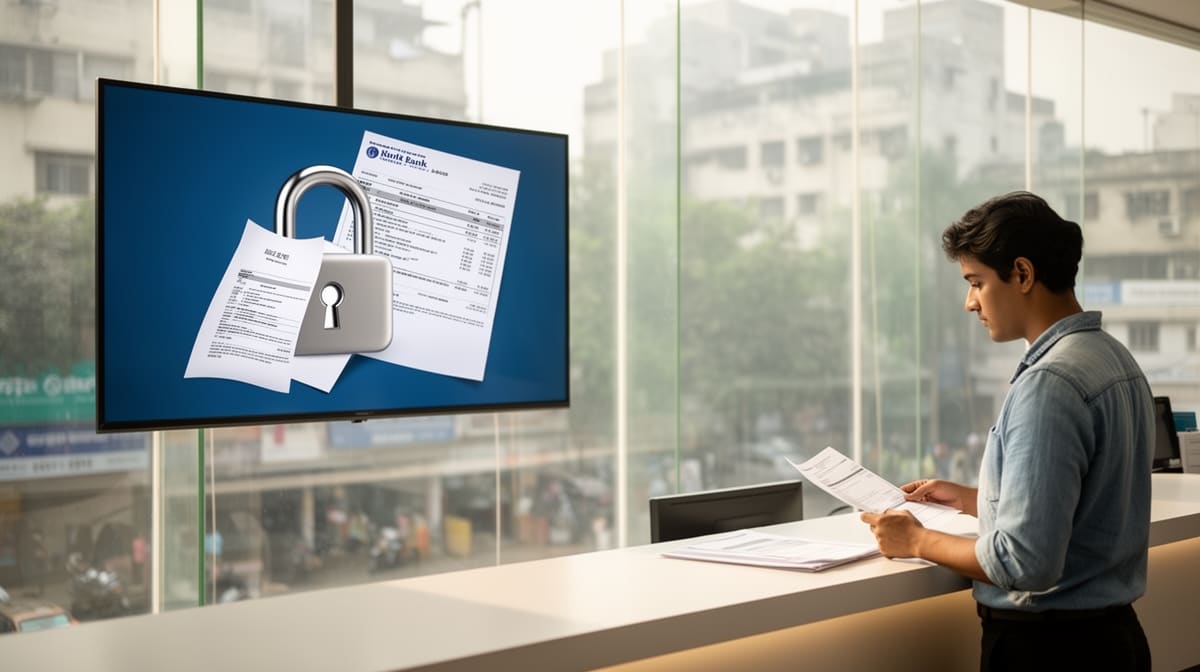
The Rajasthan High Court has affirmed that freezing a bank account without notice, hearing, or disclosure of reasons constitutes a violation of fundamental rights under Article 21. In a significant ruling, the Court balanced law enforcement interests with individual financial rights, directing banks to permit essential transactions while keeping disputed sums frozen pending police clarification.
Background & Facts
The Dispute
The petitioner, Anant Panchal, a resident of Banswara, Rajasthan, had his bank account bearing No. 2121223735333061 with AU Small Finance Bank Limited, Banswara-Mohan Colony Branch, frozen without any prior intimation, explanation, or opportunity to be heard. The freeze was reportedly initiated based on an alleged receipt of funds linked to an ongoing criminal investigation, though no formal charge, notice, or communication was provided to the petitioner.
Key Facts
- The petitioner’s account was frozen on an unspecified date prior to the filing of the writ petition
- No written communication was issued to the petitioner explaining the reason for the freeze
- No opportunity for hearing was granted before or after the freeze
- The petitioner alleged that the freeze disrupted his ability to meet essential expenses including family sustenance, children’s school fees, medical emergencies, and professional obligations
- The disputed amount, allegedly received as proceeds of an offence, was not quantified or disclosed to the petitioner or the bank
- The bank, acting on internal compliance protocols, placed a lien on the entire account without seeking specific instructions from investigating authorities
Procedural History
- The writ petition was filed on an unspecified date in 2026 before the High Court of Judicature for Rajasthan at Jodhpur
- The petition was listed for hearing on 17.04.2026
- No interim order had been granted prior to the final hearing
- No lower court proceedings preceded this writ petition
Relief Sought
The petitioner sought:
- Immediate unfreezing of his bank account
- Quashing of all freeze orders issued without notice or hearing
- Direction to the bank to permit partial operation of the account for essential expenses
- A time-bound conclusion of the investigation
The Legal Issue
The central question was whether freezing a bank account without providing prior notice, an opportunity of hearing, or disclosure of reasons violates the right to life and personal liberty under Article 21 of the Constitution.
Arguments Presented
For the Petitioner
The petitioner’s counsel contended that the unilateral freezing of a bank account, without any procedural safeguards, amounted to an arbitrary deprivation of property and livelihood. They relied on Maneka Gandhi v. Union of India to argue that any state action affecting personal liberty must conform to the principles of natural justice. They emphasized that the petitioner had no knowledge of the alleged offence, no access to the investigation file, and no means to challenge the freeze. The absence of any statutory provision authorizing banks to freeze accounts ex parte was highlighted.
For the Respondent
The respondent bank did not appear or file a written submission. The Court noted that the bank had acted in accordance with internal compliance procedures and directives from investigating agencies, but failed to demonstrate any formal communication received from the police specifying the amount to be frozen or the legal basis for the freeze.
The Court's Analysis
The Court observed that while investigating agencies have the power to direct banks to freeze accounts under Section 102 of the CrPC, such power cannot be exercised arbitrarily or without procedural fairness. The Court emphasized that Article 21 protects not only the right to life but also the right to carry on one’s profession and livelihood, which includes access to banking services.
"The freezing of a bank account without notice or opportunity of hearing strikes at the very root of personal liberty and economic dignity. The right to withdraw funds for essential needs cannot be suspended on speculative or uncommunicated allegations."
The Court rejected the notion that banks can act as de facto enforcement agents without clear, specific, and documented instructions from investigating authorities. It held that the bank’s internal compliance protocols cannot override constitutional mandates. The Court further noted that the petitioner’s account was not frozen under a court order or statutory provision but on the basis of an unverified allegation, rendering the action procedurally defective.
The Court also recognized the legitimate interest of law enforcement in preserving evidence and preventing dissipation of proceeds of crime. However, it held that this interest must be balanced with the individual’s right to access funds for basic survival. The solution, therefore, was not total freeze but a calibrated restriction.
The Verdict
The petitioner succeeded. The Court directed AU Small Finance Bank to keep the disputed amount frozen while permitting the petitioner to operate his account for essential expenses from the remaining balance. If the bank does not receive the exact figure of the disputed amount from the investigating officer within seven days of being notified, it must release the entire amount except for the portion already frozen under a valid court order. The bank is directed to communicate with the investigating officer and endorse a copy of this order. In the absence of a reply within seven days, the bank must act in accordance with this order. All pending applications are disposed of.
What This Means For Similar Cases
Procedural Fairness Is Non-Negotiable
- Banks cannot freeze accounts based on vague or uncommunicated police directives
- Any freeze must be preceded by notice and opportunity to be heard, even if initiated by law enforcement
- Internal bank policies cannot override constitutional rights under Article 21
Partial Freezes Are Legally Permissible
- Courts may permit essential transactions even while keeping disputed sums frozen
- Petitioners in similar cases may now seek partial access for medical, educational, or livelihood-related expenses
- The burden shifts to investigating agencies to specify the exact amount to be frozen, not the bank
Banks Must Act as Intermediaries, Not Enforcers
- Banks must request written clarification from investigating agencies before imposing a lien
- Failure to obtain specific instructions within seven days releases the bank from liability for unfreezing
- This creates a clear timeline and accountability mechanism for both banks and police