
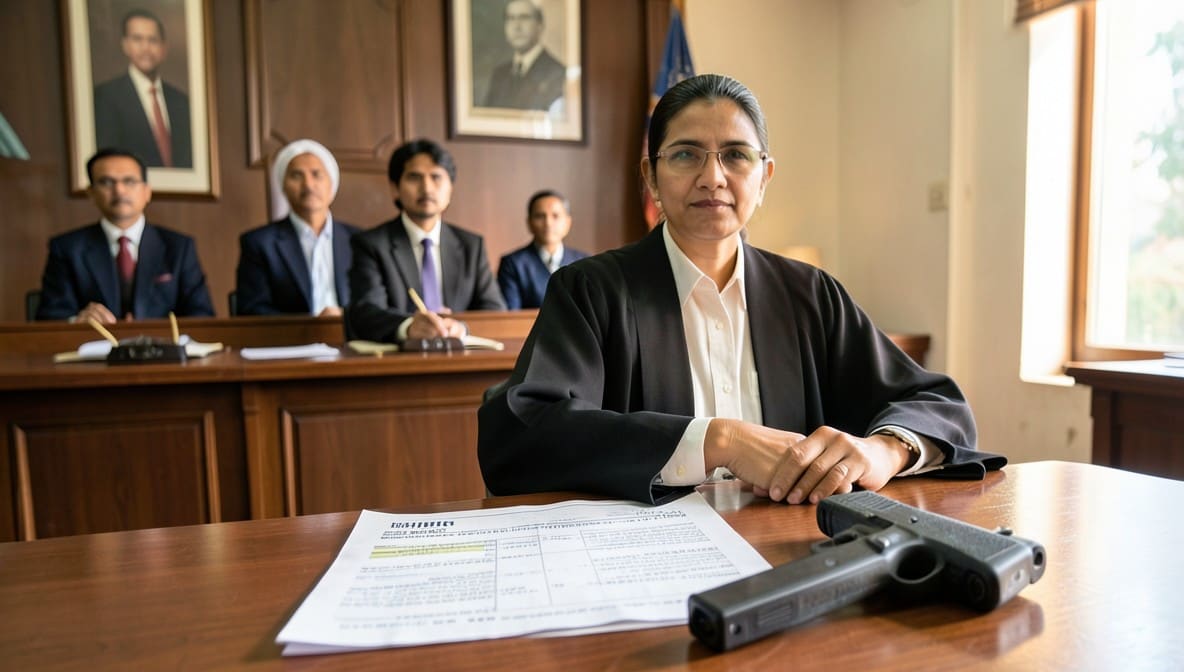
The Supreme Court has reiterated that bail in serious offences must be granted only after a judicious consideration of all material evidence, not merely procedural omissions. In this case, the Court set aside an Allahabad High Court order granting bail to an accused charged with murder, holding that the High Court erred by relying solely on the absence of allegations in the inquest report while ignoring critical evidence such as the FIR, post-mortem report, and recovery of the murder weapon.
Background & Facts
The Dispute
The appellant, Bhagat Singh, is the nephew of the deceased Bharat Singh alias Pappu and the informant in FIR No. 118 of 2025 registered at Police Station Chhata, District Mathura, Uttar Pradesh. The respondent-accused, Kunwarpal Singh, along with two co-accused, is alleged to have murdered the appellant’s uncle on 8th March, 2025 by firing multiple shots at him. The offences invoked include Sections 103(1), 352, 351(2), and 3(5) of the Bharatiya Nyaya Sanhita, 2023, as well as Sections 5, 25, and 27 of the Arms Act, 1959.
Key Facts
- 8th March, 2025, 10:30 a.m.: The deceased and the appellant were proceeding to their agricultural field when the respondent-accused and two co-accused emerged from concealment, armed with country-made pistols, abused the deceased, and fired multiple shots, causing his instantaneous death.
- 8th March, 2025, 6:32 p.m.: FIR No. 118 of 2025 was registered after completion of the inquest and post-mortem.
- 9th March, 2025: The respondent-accused was arrested, and pursuant to his disclosure statement, a country-made .315 bore pistol along with a spent cartridge was recovered from his uncle’s room.
- 29th May, 2025: Chargesheet No. 1 of 2025 was filed after completion of the investigation.
Procedural History
- 26th September, 2025: The Sessions Judge, Mathura, rejected Bail Application No. 3591/2025 filed by the respondent-accused, considering the gravity of the offence, post-mortem report, and recovery of the murder weapon.
- 22nd January, 2026: The Allahabad High Court allowed Criminal Miscellaneous Bail Application No. 2223 of 2026, observing that the informant and another Panch witness had not named the respondent-accused during the inquest proceedings.
- 22nd May, 2026: The present appeal was filed before the Supreme Court challenging the High Court’s order.
Relief Sought
The appellant sought the setting aside of the High Court’s impugned order dated 22nd January, 2026, arguing that it was cryptic, non-speaking, and bereft of reasoning, thereby rendering it perverse and unsustainable in law.
The Legal Issue
The central question was whether the High Court could grant bail solely on the ground that the informant and Panch witnesses did not name the accused during the inquest proceedings, while disregarding other material evidence such as the FIR, post-mortem report, recovery of the murder weapon, and witness statements recorded under Section 180 of the Bharatiya Nagarik Suraksha Sanhita, 2023.
Arguments Presented
For the Appellant
- The High Court’s order was cryptic and failed to consider the material facts, including the specific overt act attributed to the respondent-accused in the FIR, the post-mortem report, and the recovery of the murder weapon at his instance.
- The inquest report, governed by Section 194 of the Bharatiya Nagarik Suraksha Sanhita, 2023 (corresponding to Section 174 CrPC), is limited to ascertaining the apparent cause of death and does not require a detailed account of the incident or the names of the accused.
- Reliance was placed on precedents such as Pedda Narayana v. State of A.P. and Amar Singh v. Balwinder Singh to argue that the inquest report’s scope is narrow and cannot override substantive evidence.
For the Respondent
- The respondent contended that the absence of allegations in the inquest report by the informant and Panch witnesses raised doubts about his involvement in the crime.
- It was argued that the High Court’s discretion in granting bail should not be interfered with lightly, especially when the inquest proceedings did not implicate the respondent.
The Court's Analysis
The Supreme Court critically examined the scope and purpose of an inquest report under Section 194 of the Bharatiya Nagarik Suraksha Sanhita, 2023, which is confined to ascertaining the apparent cause of death. The Court observed:
"The requirement of the section is that the police officer shall record the apparent cause of death describing the wounds as may be found on the body and also the weapon or instrument by which they appear to have been inflicted and this has to be done in the presence of two or more respectable inhabitants of the neighbourhood. The section does not contemplate that the manner in which the incident took place or the names of the accused should be mentioned in the inquest report."
The Court relied on Pedda Narayana v. State of A.P. and Amar Singh v. Balwinder Singh to hold that the inquest report’s limited scope cannot be used to discredit the prosecution’s case, particularly when other material evidence implicates the accused. The Court noted:
"Non-mentioning of the author of the crime or the person who had caused the death in the inquest report cannot, by itself, be a reason to doubt the involvement of the accused, who may be subsequently named."
The Court further emphasized that the judicial discretion to grant bail must be exercised in a reasoned manner, considering all material evidence. In this case, the High Court erred by relying solely on the omission in the inquest report while ignoring:
- The specific overt act attributed to the respondent-accused in the FIR.
- The post-mortem report corroborating firearm injuries.
- The recovery of the murder weapon at the instance of the respondent-accused.
- The statements of witnesses recorded under Section 180 of the Bharatiya Nagarik Suraksha Sanhita, 2023, which prima facie supported the prosecution’s case.
The Court held that these materials could not be brushed aside merely on account of the omission during the inquest proceedings.
The Verdict
The Supreme Court allowed the appeal, setting aside the impugned order dated 22nd January, 2026 passed by the Allahabad High Court. The matter was remanded back to the High Court for fresh consideration of the bail application in accordance with the law. The Court clarified that it had not expressed any opinion on the merits of the case. The respondent-accused was directed to surrender within 1 week to the concerned jail authorities and remain in judicial custody until the High Court passes an appropriate order.
What This Means For Similar Cases
Inquest Reports Cannot Override Substantive Evidence
- Courts must recognize that Section 194 of the Bharatiya Nagarik Suraksha Sanhita, 2023 (and its predecessor Section 174 CrPC) limits the scope of inquest proceedings to ascertaining the apparent cause of death. Omissions in the inquest report cannot be used to discredit the prosecution’s case when other material evidence, such as the FIR, post-mortem report, and recovery of weapons, implicates the accused.
- Practitioners should argue that reliance on inquest report omissions, without considering the totality of evidence, is legally unsustainable and contrary to settled principles.
Bail in Serious Offences Requires Holistic Consideration
- The grant of bail in cases involving grave offences, such as murder under Section 103(1) of the Bharatiya Nyaya Sanhita, 2023, must be based on a judicious assessment of all material facts. Courts cannot grant bail on isolated grounds while ignoring critical evidence like the post-mortem report, recovery of weapons, or witness statements.
- Defence counsel must ensure that bail applications address all material evidence, while prosecution must highlight the insufficiency of relying on procedural omissions alone.
Remand for Fresh Consideration: A Warning Against Cryptic Orders
- The Supreme Court’s decision to remand the matter underscores the importance of reasoned orders in bail applications. High Courts and lower courts must provide detailed reasoning, especially in serious offences, to avoid judicial scrutiny.
- Practitioners should cite this judgment to challenge cryptic or non-speaking bail orders that fail to consider the entirety of the prosecution’s evidence.





