
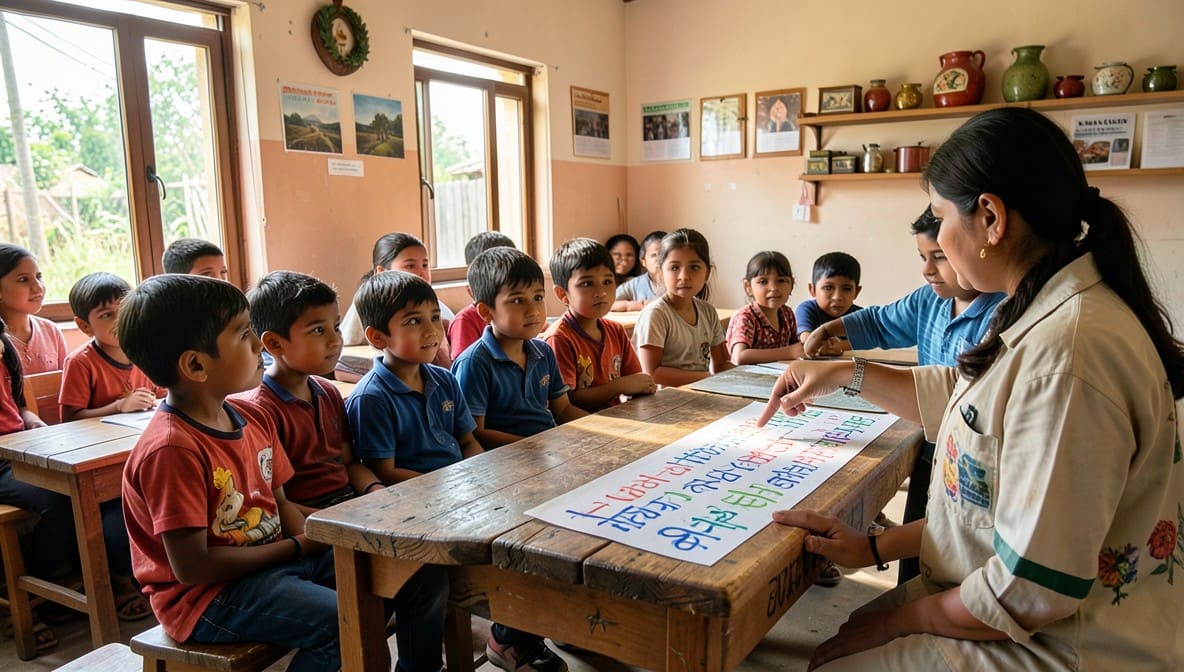
The Supreme Court has affirmed that the right to receive education in one’s mother tongue is not merely a policy preference but a constitutional entitlement, grounded in Articles 19(1)(a), 21A, and 350A, and reinforced by the Right to Education Act, 2009 and the National Education Policy, 2020. The Court directed the State of Rajasthan to take concrete steps to implement Rajasthani as a medium of instruction, rejecting the argument that only Eighth Schedule languages qualify for inclusion.
Background & Facts
The Dispute
The appellants, public-spirited individuals, filed a Public Interest Litigation before the High Court of Judicature for Rajasthan at Jodhpur seeking two primary reliefs: first, that the Rajasthani language be included in the examination syllabus for recruitment to the post of Teacher, Grade-III, Level-I and Level-II under the Rajasthan Eligibility Examination for Teachers, 2021 (REET 2021); and second, that the State provide education to children in Rajasthani or other relevant local languages at the primary level. The High Court dismissed the petition on the ground that no enforceable legal right had been established and no statutory duty had been shown to have been violated.
Key Facts
- Rajasthani is spoken by a substantial population across Rajasthan and has a distinct linguistic identity, grammar, and literary tradition.
- Rajasthani is not included in the Eighth Schedule to the Constitution of India as of the date of the judgment.
- The State of Rajasthan currently offers instruction in Hindi and English as primary mediums in government schools, and includes languages such as Gujarati, Punjabi, and Sindhi as optional subjects, but excludes Rajasthani.
- Rajasthani is taught as a subject at the university level in institutions including Jai Narain Vyas University, Jodhpur; Maharaja Ganga Singh University, Bikaner; and University of Rajasthan, Jaipur, offering B.A. and M.A. degrees.
- The Right of Children to Free and Compulsory Education Act, 2009 (RTE Act) mandates under Section 29(2)(f) that the medium of instruction shall, as far as practicable, be in the child’s mother tongue.
- The National Education Policy, 2020 recommends that the medium of instruction up to at least Grade V, and preferably up to Grade VIII and beyond, should be the home, local, or regional language.
- The appellants submitted that Rajasthani speakers constitute a linguistic minority within Rajasthan, where Hindi is the dominant official language.
Procedural History
- 2021: Public Interest Litigation filed before the High Court of Judicature for Rajasthan at Jodhpur (D.B. Civil Writ Petition No. 5294 of 2021).
- 27 November 2024: High Court dismissed the PIL, holding that no enforceable legal right or statutory duty had been established.
- 2025: Special Leave Petition (SLP(C) No. 1425 of 2025) filed before the Supreme Court.
- 12 May 2026: Judgment delivered by the Supreme Court.
The Parties' Positions
Appellants: Argued that Rajasthani qualifies as a linguistic minority language under Article 350A; that the right to education in one’s mother tongue is implicit in Article 19(1)(a) and Article 21A; that differential treatment of Rajasthani compared to other non-Eighth Schedule languages like Gujarati and Punjabi violates Article 14; and that NEP 2020 and the RTE Act impose a binding obligation on the State.
Respondents (State of Rajasthan): Contended that only languages listed in the Eighth Schedule can be taught in schools; that Article 350A is directory and not enforceable; that NEP 2020 is non-binding policy; and that no statutory duty exists to include Rajasthani in recruitment syllabi or as a medium of instruction.
Relief Sought
The appellants sought:
- Inclusion of Rajasthani language in the REET 2021 examination syllabus for Teacher Grade-III, Level-I and Level-II.
- Direction to the State to impart education to children in Rajasthani or other local languages at the primary level.
- Declaration that exclusion of Rajasthani violates Articles 14, 19(1)(a), 21A, and 350A of the Constitution.
The Legal Issue
The central question was whether the State of Rajasthan is constitutionally and statutorily obligated to recognize Rajasthani as a medium of instruction at the primary level under Article 350A, Section 29(2)(f) of the RTE Act, 2009, and the National Education Policy, 2020, even though it is not included in the Eighth Schedule.
Arguments Presented
For the Appellant
Learned counsel argued that the term "linguistic minority" under Article 350A must be understood relative to the dominant language of the State, not in absolute terms. In Rajasthan, where Hindi is the official language, Rajasthani speakers constitute a linguistic minority. The right to receive education in one’s mother tongue is an intrinsic part of freedom of speech and expression under Article 19(1)(a), as affirmed in English Medium Students Parents Assn. v. State of Karnataka and State of Karnataka v. Associated Management of English Medium Schools. The RTE Act, 2009, specifically mandates that the medium of instruction be, as far as practicable, the child’s mother tongue. The NEP 2020, while not statutory, reflects a settled national policy consistent with constitutional values and must inform administrative action. The exclusion of Rajasthani while including other non-Eighth Schedule languages like Gujarati and Punjabi is arbitrary and violative of Article 14.
For the Respondent
The State contended that Article 350A is merely directory and does not create justiciable rights. It argued that only languages enumerated in the Eighth Schedule are recognized for inclusion in school curricula and recruitment examinations. The NEP 2020, being an executive policy without legislative backing, cannot override administrative discretion. The State further submitted that the recruitment examination for teachers had already been conducted and concluded, rendering the specific relief sought infructuous. The absence of a policy, it argued, cannot be converted into a legal mandate by judicial fiat.
The Court's Analysis
The Court began by acknowledging that the specific relief concerning the REET 2021 examination had become infructuous due to the passage of time and finality of the recruitment process. However, it emphasized that the broader constitutional and statutory issues raised transcended the particular examination and demanded resolution.
"The ability to understand and be understood in one’s own language is not a matter of convenience, but a matter of existential rights, for comprehension must necessarily precede meaningful participation in the society and day to day life activities."
The Court undertook a comprehensive review of constitutional provisions, legislative enactments, and policy frameworks. It held that Article 350A, which obligates States to provide facilities for instruction in the mother tongue at the primary stage, is not directory but a constitutional imperative. The Court rejected the State’s narrow interpretation that only Eighth Schedule languages qualify for inclusion, noting that the provision was designed precisely to protect languages outside the Schedule.
The Court reaffirmed its earlier holdings in English Medium Students Parents Assn. v. State of Karnataka and State of Karnataka v. Associated Management of English Medium Schools, that the right to receive education in a language of one’s choice is protected under Article 19(1)(a). It emphasized that education imparted in an unfamiliar language impedes comprehension, defeats the purpose of the RTE Act, and violates the constitutional guarantee of quality education.
The Court observed that the State’s reliance on the absence of a policy was a non sequitur. The existence of Rajasthani as a subject in universities demonstrated its institutional legitimacy. The State’s selective inclusion of other non-Eighth Schedule languages while excluding Rajasthani was found to be arbitrary and violative of Article 14.
"A right that exists only on paper, without corresponding administrative will or implementation, is in effect no right at all."
The Court held that the National Education Policy, 2020, while not legally binding, represents a binding policy consensus that must guide administrative action. The State’s failure to act, despite clear constitutional, legislative, and policy mandates, amounted to a dereliction of its public duty.
The Verdict
The Supreme Court allowed the appeal and set aside the High Court’s order dated 27 November 2024. The Court directed the State of Rajasthan to formulate a comprehensive policy for the effective implementation of mother tongue-based education, including the recognition of Rajasthani as a local/regional language for educational purposes. The State shall progressively facilitate the adoption of Rajasthani as a medium of instruction, initially at the foundational and preparatory stages of schooling, and thereafter at higher levels. The State shall also take affirmative steps to introduce Rajasthani as a subject in all government and private schools in a phased manner. The State shall file a compliance affidavit by 25 September 2026, and the matter shall be listed for hearing on 30 September 2026.
What This Means For Similar Cases
Mother Tongue Is a Constitutional Right, Not a Policy Option
- Practitioners must now argue that any State’s refusal to implement mother tongue-based education, even for non-Eighth Schedule languages, violates Article 350A and Section 29(2)(f) of the RTE Act.
- The NEP 2020, while non-statutory, creates a binding normative framework that courts will use to assess administrative inaction.
- Courts will no longer accept "absence of policy" as a defense for non-compliance with constitutional mandates.
Linguistic Minorities Are Defined by State Context, Not National Lists
- A linguistic minority is determined relative to the dominant language of the State, not by inclusion in the Eighth Schedule.
- States cannot justify exclusion of regional languages by citing the Eighth Schedule as a gatekeeping mechanism.
- This judgment opens the door for similar claims in other States where regional languages (e.g., Bhojpuri, Tulu, Garhwali) are excluded from school curricula despite widespread use.
Policy Declarations Must Be Operationalized
- The Court has established that constitutional rights cannot remain dormant due to administrative inertia.
- Governments must now proactively design implementation roadmaps for education in local languages, with timelines, budgetary allocation, and teacher training.
- Failure to act may result in judicial intervention, including compliance affidavits and court-monitored deadlines.





