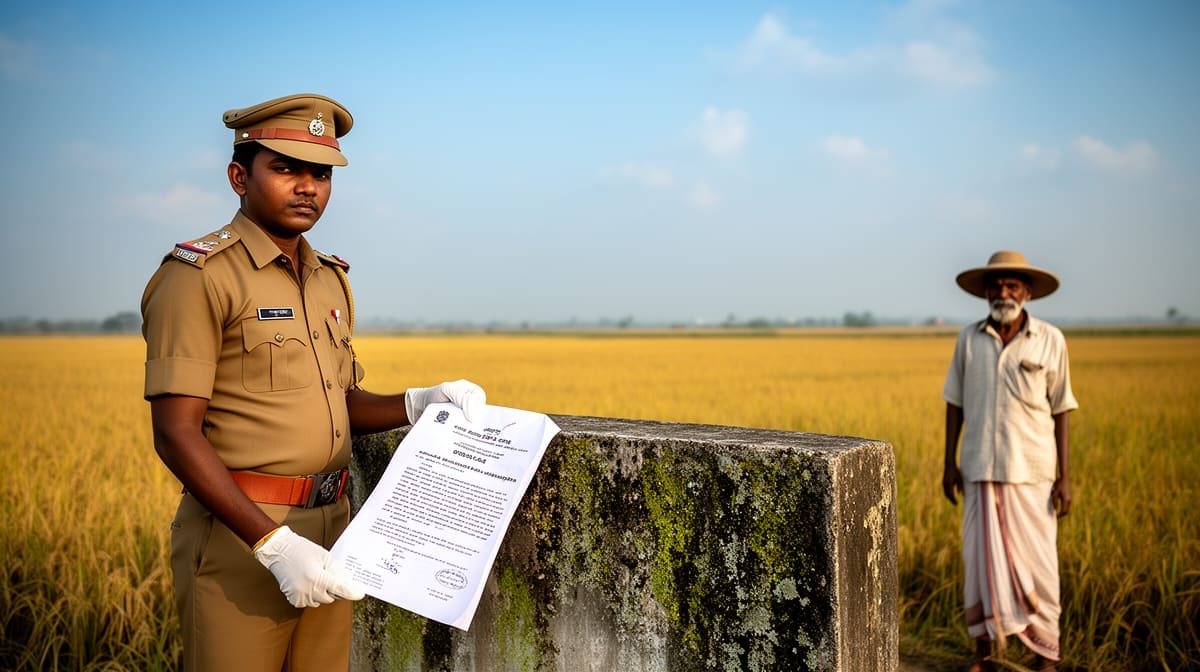
The Madras High Court has held that a plaintiff who obtains an interim injunction confirmed by appellate courts is entitled to police aid for enforcement when forcibly dispossessed, and the trial court cannot decline such relief by re-litigating possession. The judgment reinforces that court orders must have practical effect and cannot remain merely on paper.
Background & Facts
The Dispute
The petitioners, R. Venkatesh Rao and R. Jayakumar, brothers residing at Senthamangalam Village in Ulundurpet Taluk, Villupuram District, filed Original Suit No. 84 of 2018 before the Additional District Munsif Court, Ulundurpet, seeking permanent injunction against seven defendants led by N. Kaliyan and his family members from Deviyananthal Village in the same taluk. The suit concerned agricultural land where the plaintiffs alleged they were in possession and cultivation.
Key Facts
- The plaintiffs filed O.S. No. 84 of 2018 seeking permanent injunction over suit properties
- Pending suit, they filed I.A. No. 434 of 2018 under Order XXXIX Rules 1 & 2 of the Code of Civil Procedure, 1908 seeking temporary injunction
- The Trial Court allowed the interlocutory application by order dated December 13, 2018, with a specific finding that the plaintiffs were in possession of the suit property
- The first defendant preferred Civil Miscellaneous Appeal No. 1 of 2019 before the Sub Court, Ulundurpet
- The Sub Court dismissed the appeal and confirmed the interim injunction by order dated October 28, 2021
- Thereafter, the defendants harvested paddy crops cultivated by the plaintiffs and attempted to attack them with deadly weapons, violating the interim injunction
- The plaintiffs filed I.A. No. 236 of 2019 under Order XXXIX Rule 2A read with Section 151 CPC seeking civil arrest of defendants and attachment of harvested crops - this application remains pending
- The plaintiffs were forcefully dispossessed on January 16, 2019 by the defendants
- Consequently, the plaintiffs filed I.A. No. 2 of 2022 seeking police aid to enforce the interim injunction order
- The defendants filed a counter affidavit claiming they were in continuous possession even before the interim injunction order
- The Trial Court dismissed I.A. No. 2 of 2022 by order dated March 3, 2023, holding plaintiffs not entitled to police aid
- Meanwhile, the first defendant filed Civil Revision Petition No. 4374 of 2026 challenging the Sub Court's order in C.M.A. No. 1 of 2019
- This Court disposed of C.R.P. No. 4374 of 2026 by order dated August 14, 2026, confirming the Sub Court's order of October 28, 2021
Procedural History
- 13.12.2018: Trial Court allows I.A. No. 434 of 2018, grants temporary injunction with finding plaintiffs in possession
- 28.10.2021: Sub Court, Ulundurpet dismisses C.M.A. No. 1 of 2019, confirms interim injunction
- 16.01.2019: Plaintiffs forcibly dispossessed by defendants
- 2019: I.A. No. 236 of 2019 filed for civil arrest and attachment of crops (pending)
- 2022: I.A. No. 2 of 2022 filed seeking police aid to enforce interim injunction
- 03.03.2023: Trial Court dismisses I.A. No. 2 of 2022
- 14.08.2026: Madras High Court disposes C.R.P. No. 4374 of 2026, confirms Sub Court order
- 26.10.2026: Present Civil Revision Petition decided
Relief Sought
The petitioners sought setting aside of the Trial Court's order dated March 3, 2023 dismissing I.A. No. 2 of 2022, allowance of the said interlocutory application, and direction to jurisdictional police to extend police aid to enforce the interim injunction and restore their possession of the suit property.
The Legal Issue
The central question was whether a plaintiff who has obtained an interim injunction confirmed by appellate courts, and who alleges forcible dispossession during the pendency of the suit, is entitled to police aid under the inherent powers of the court to enforce the injunction, or whether the trial court may decline such relief by re-examining the question of possession already settled by the injunction order.
Arguments Presented
For the Petitioners
The learned counsel for the revision petitioners submitted that the Trial Court granted temporary injunction in I.A. No. 434 of 2018 with a specific finding that the plaintiffs were in possession. This order was confirmed by the Sub Court in C.M.A. No. 1 of 2019 and later by this Court in C.R.P. No. 4374 of 2026. The interim injunction had thus reached finality. Despite this, the defendants trespassed and forcibly dispossessed the plaintiffs on January 16, 2019. The plaintiffs were therefore entitled to police aid to enforce the court's order. The Trial Court erred in dismissing I.A. No. 2 of 2022 and failed to appreciate that court orders must be enforced, not rendered merely symbolic.
For the Respondents
The learned counsel for the respondents contended that the defendants were in actual possession and enjoyment of the suit property even before the interim injunction was passed. The averment that plaintiffs were dispossessed during the pendency of the suit was incorrect. The Trial Court, after considering all facts and circumstances, rightly dismissed I.A. No. 2 of 2022. There was no warrant for interference by the High Court.
The Court's Analysis
The Court examined the procedural history and noted that the interim injunction granted in I.A. No. 434 of 2018 contained a specific finding that the plaintiffs were in possession of the suit property. This finding was affirmed by the Sub Court in C.M.A. No. 1 of 2019. The first defendant's challenge to this order via C.R.P. No. 4374 of 2026 was also rejected by this Court on August 14, 2026. Consequently, the interim injunction had attained finality.
"If really the defendants are in actual possession of the suit property, they ought to have preferred an appeal over the Order passed in C.M.A. No.1 of 2019 but they failed to do so. On the other hand, the first defendant preferred a Civil Revision Petition in C.R.P. No. 4374 of 2026 before this Court, and the same was disposed of by order dated August 14, 2026, confirming the order dated October 28, 2021, passed by the learned Subordinate Judge, Ulundurpet, in C.M.A. No. 1 of 2019. Hence, the Order of interim injunction reached finality."
The Court held that in the eyes of law, the plaintiffs are in possession of the suit property and have an interim injunction against the defendants. The defendants are bound to obey the court's order. The plaintiffs' specific allegation of forcible dispossession on January 16, 2019 entitled them to seek police aid for enforcement. The Trial Court failed to appreciate these facts and erred in dismissing the application. The Court emphasized that otherwise, court orders would remain merely on paper, setting a bad precedent.
The Court exercised its revisional jurisdiction under Article 227 of the Constitution of India, 1950 to correct the error. It found no reason to interfere with the concurrent findings of the Trial Court and Sub Court on the question of possession, which had been settled through the interim injunction proceedings.
The Verdict
The Civil Revision Petition was allowed. The order dated March 3, 2023 passed by the Trial Court in I.A. No. 2 of 2022 was set aside. I.A. No. 2 of 2022 was allowed. The jurisdictional police were directed to extend police aid to enforce the interim injunction passed in I.A. No. 434 of 2018 and restore the plaintiffs' possession of the suit property. The Trial Court was directed to take necessary steps for enforcement. No order as to costs was made, and parties were directed to cooperate for expeditious disposal of the suit. The connected Civil Miscellaneous Petition No. 21261 of 2023 was closed.
What This Means For Similar Cases
Interim Injunctions Attain Finality When Confirmed by Appellate Courts
Once an interim injunction with a specific finding on possession is confirmed by the first appellate court and any further challenge is rejected by the High Court, the order reaches finality. Parties cannot re-agitate the question of possession in subsequent enforcement proceedings. Practitioners should ensure that interim orders with favorable findings are promptly appealed if adverse, and that confirmation orders are cited as binding in enforcement applications.
Police Aid Is Available to Enforce Court Orders Against Forcible Dispossession
- A plaintiff who establishes forcible dispossession in violation of a subsisting interim injunction is entitled to police aid under the court's inherent powers
- The trial court cannot decline enforcement by re-litigating possession already determined in the injunction proceeding
- Courts must ensure their orders have practical effect and do not remain merely symbolic
Procedural Vigilance Protects Substantive Rights
- Defendants who fail to challenge interim injunctions through proper appellate channels lose the right to contest possession later
- Filing revision petitions instead of appeals may not operate as a stay, and confirmation of the interim order binds the parties
- Practitioners should advise clients that violation of interim injunctions carries enforcement consequences including police assistance and potential contempt proceedings