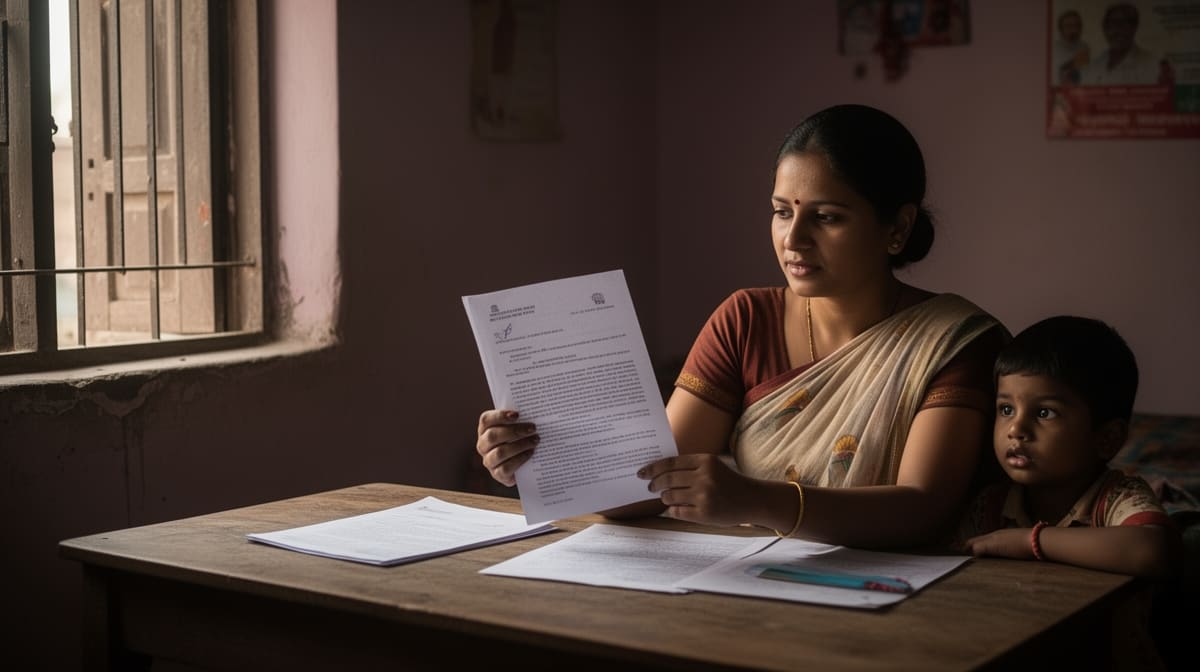
In a rare exercise of constitutional oversight, the Kerala High Court has directed a Family Court to dispose of a pending maintenance petition within four months, recognizing the existential urgency faced by a destitute woman and her minor daughter. This judgment carves a narrow but significant exception to the Supreme Court’s general prohibition against constitutional courts imposing time limits on subordinate courts, grounding the exception in the fundamental right to survival.
Background & Facts
The Dispute
The petitioner, Shahana M.A., a 37-year-old Muslim woman residing in Thrissur, Kerala, filed Maintenance Case No. 549/2022 before the Family Court seeking maintenance from her husband, Naseeb K.M., and his mother, Naba Fathima. The petitioner alleges that despite multiple court orders directing payment of interim maintenance, the respondents have consistently defaulted, leaving her and her 17-year-old daughter without adequate means for food, shelter, or medical care.
Key Facts
- The petitioner filed the maintenance petition on 15.02.2022.
- On 03.11.2023, the Family Court passed an order directing the respondents to pay interim maintenance of Rs. 15,000 per month.
- Despite the order, no payments were made as of the filing of the writ petition.
- The petitioner filed a contempt petition (MP No. 1700/2022) for non-compliance, which remained pending.
- A further application (MP No. 480/2024) seeking enforcement of the maintenance order was also pending.
- The petitioner’s daughter is a minor dependent, and the petitioner has no independent source of income.
- The petitioner has made repeated representations to the Family Court without any resolution.
Procedural History
- 15.02.2022: Maintenance Case No. 549/2022 filed before Family Court, Thrissur.
- 03.11.2023: Family Court ordered interim maintenance of Rs. 15,000 per month.
- 05.12.2023: First contempt petition (MP No. 1700/2022) filed for non-payment.
- 18.03.2024: Second enforcement application (MP No. 480/2024) filed.
- 09.06.2026: Writ petition under Article 227 filed before Kerala High Court seeking direction for time-bound disposal.
The Parties' Positions
The petitioner contended that the prolonged delay in disposal of the maintenance case has rendered the interim order ineffective, exposing her and her daughter to destitution. She argued that the Family Court’s inaction violates her fundamental rights under Article 21 of the Constitution.
The respondents did not file any written response to the writ petition, and no counter-affidavit was submitted.
Relief Sought
The petitioner sought a direction to the Family Court to dispose of M.C. No. 549/2022 within a fixed time frame, given the life-sustaining nature of the relief sought.
The Legal Issue
Can a constitutional court under Article 227 impose a time limit for disposal of a pending maintenance case when the litigant is a destitute woman and her minor child, despite the Supreme Court’s general prohibition against such interference?
Arguments Presented
For the Petitioner
The petitioner’s counsel relied on the principle that Article 21 guarantees the right to life with dignity, which includes the right to subsistence. He argued that the Family Court’s failure to enforce its own interim maintenance order for over two years constitutes a violation of this right. He cited Shakti Vahini v. Union of India to emphasize that the state has a positive obligation to protect vulnerable women from economic abandonment. He further contended that the Supreme Court’s caution in Allahabad High Court Bar Association was not meant to shield systemic inaction in cases involving survival.
For the Respondent
No arguments were presented by the respondents, as no written response was filed.
The Court's Analysis
The Court acknowledged the binding precedent laid down by the Supreme Court in Allahabad High Court Bar Association v. State of U.P. (2024) 6 SCC 267, which cautioned against constitutional courts prescribing time limits for disposal of cases, emphasizing judicial autonomy and equitable access to justice.
"Not every litigant can easily afford to file proceedings in the constitutional Courts. Those litigants who can afford to approach the constitutional Courts cannot be allowed to take undue advantage by getting an order directing out-of-turn disposal of their cases while all other litigants patiently wait in the queue for their turn to come."
However, the Court distinguished the present case on the ground that it involved not merely procedural delay, but a direct threat to the right to life and dignity of two vulnerable individuals. The Court observed that the interim maintenance order had been in force for over two years, yet no payment had been made, rendering the judicial remedy illusory.
The Court held that when a subordinate court’s inaction effectively nullifies a statutory right to maintenance - a right explicitly recognized under Section 125 CrPC and the Muslim Women (Protection of Rights on Divorce) Act, 1986 - the constitutional court is not merely interfering, but fulfilling its duty to prevent a violation of Article 21.
The Court emphasized that the exception carved out here is not a general rule, but a narrowly tailored remedy for cases where delay translates into deprivation of basic survival needs.
The Verdict
The writ petition was allowed. The Family Court, Thrissur, is directed to dispose of M.C. No. 549/2022 within four months from the date of receipt of a copy of this judgment. The Court further directed that the respondents shall pay all pending interim maintenance arrears within 15 days of the judgment, and any future maintenance shall be paid monthly without delay. Costs of Rs. 10,000 are imposed on the respondents.
What This Means For Similar Cases
Survival-Based Maintenance Cases May Warrant Judicial Intervention
- Practitioners may now cite this judgment to seek time-bound disposal in maintenance cases where the petitioner is destitute, especially where interim orders are ignored.
- Courts must distinguish between routine delays and delays that amount to denial of subsistence - the latter triggers Article 227 jurisdiction.
Article 227 Is Not a Tool for Forum Shopping, But a Shield for the Vulnerable
- This judgment reinforces that Article 227 is not meant to override judicial hierarchy, but to prevent its abuse when fundamental rights are at stake.
- Writ petitions under Article 227 in maintenance matters are now more likely to be entertained if supported by evidence of non-compliance and destitution.
Enforcement of Interim Orders Is a Constitutional Imperative
- Failure to enforce interim maintenance orders for over 18 months may now constitute grounds for invoking constitutional jurisdiction.
- Courts must treat maintenance arrears as urgent, not ancillary, and prioritize enforcement.