The Punjab and Haryana High Court has reaffirmed the extraordinary jurisdiction under Article 227 of the Constitution to intervene when appellate courts refuse to expedite hearings in civil appeals involving imminent risk of irreversible harm to property rights. This judgment clarifies that procedural delays cannot override substantive justice when construction on disputed land threatens to frustrate the very purpose of litigation.
Background & Facts
The Dispute
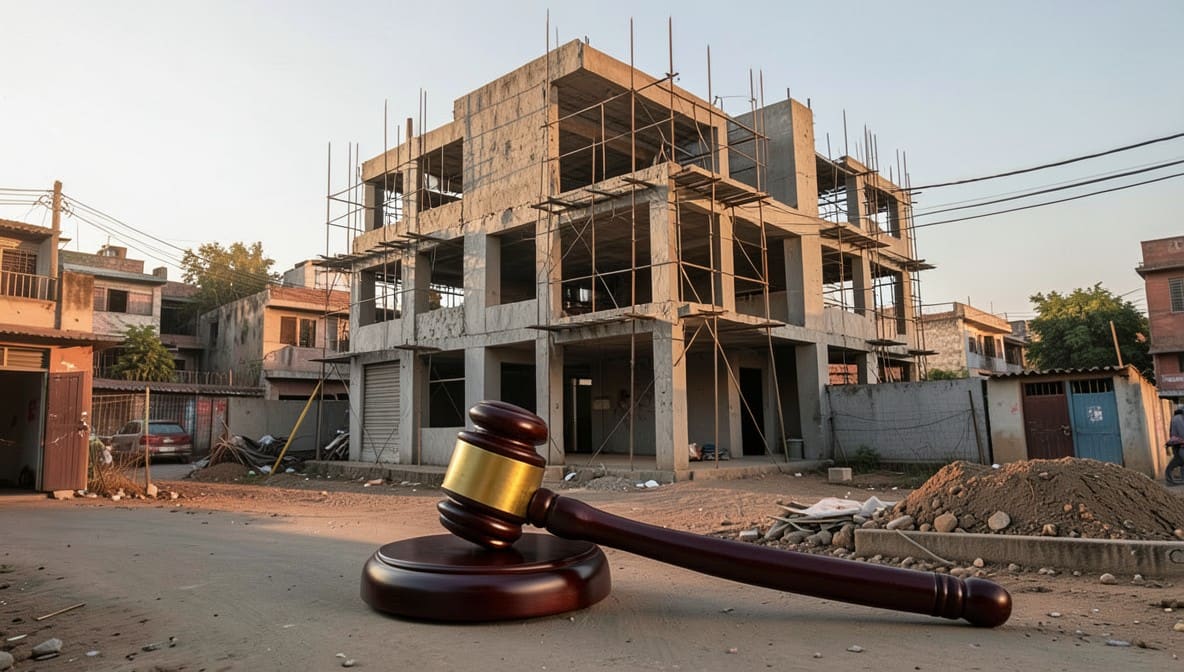
The petitioners, owners of a share in a joint agricultural property, filed a suit for partition against respondents, who were co-owners. Along with the suit, they filed an application for interim injunction seeking to restrain respondents from undertaking any construction on the disputed land. The respondents, particularly defendant No.1, commenced construction on a valuable front portion of the property adjoining a public road (rasta), raising concerns that the structure, once completed, would render partition impractical and cause irreparable loss.
Key Facts
- The suit for partition was filed in the Court of Civil Judge (Junior Division), Tauru
- The interim injunction application was filed on or before 15.02.2026
- The Trial Court, by order dated 20.02.2026, permitted respondents to continue construction but with a critical condition: any structure raised would be at the respondent’s own risk and cost, and must be removed if the land was ultimately allotted to the petitioners in the final partition
- The construction activity continued unabated on the front portion of the property, which is of high commercial value due to its adjacency to the rasta
- The petitioners filed an appeal against the Trial Court’s order on 25.02.2026
- The First Appellate Court fixed the hearing of the appeal for 22.04.2026
- On 03.03.2026, the petitioners filed an application for early hearing of the appeal and urgent consideration of the interim injunction, citing imminent and irreparable harm
- The application was dismissed by the Additional District Judge, Nuh, on 06.03.2026
Procedural History
- 15.02.2026: Interim injunction application filed before the Trial Court
- 20.02.2026: Trial Court order permitting construction subject to final partition outcome
- 25.02.2026: Appeal filed before the First Appellate Court (Additional District Judge, Nuh)
- 03.03.2026: Application for early hearing and urgent interim relief filed
- 06.03.2026: First Appellate Court dismissed the application for early hearing
- 18.03.2026: Writ petition under Article 227 filed before the Punjab and Haryana High Court
The Parties' Positions
The petitioners contended that the Trial Court’s conditional permission to construct did not negate the risk of irreparable harm, as removal of an erected structure would be economically unfeasible and practically impossible without destroying the property’s value. They argued that the Appellate Court’s refusal to hear the matter urgently amounted to a de facto denial of effective appellate remedy.
The respondents did not file a written response but relied on the Trial Court’s order as sufficient protection, asserting that the condition of removal at respondent’s cost rendered any harm compensable.
Relief Sought
The petitioners sought:
- Setting aside of the order dated 06.03.2026 dismissing the application for early hearing
- Direction to the First Appellate Court to pre-pone the hearing of the appeal and decide the interim injunction application within the next working week
- Preservation of the status quo pending final adjudication
The Legal Issue
Can the High Court exercise its supervisory jurisdiction under Article 227 to direct an appellate court to expedite hearing of a civil appeal where the delay risks irreparable harm to property rights, even if the Trial Court has granted conditional permission to construct?
Arguments Presented
For the Petitioner
Counsel for the petitioners relied on the principle that Article 227 empowers the High Court to ensure that subordinate courts act within the bounds of their jurisdiction and do not cause irreparable prejudice. He argued that the Trial Court’s order, while conditional, did not provide effective protection because removal of a constructed structure is not a meaningful remedy when the property’s market value and utility are permanently diminished. He cited S.P. Gupta v. Union of India to underscore that judicial remedies must be effective, not illusory.
For the Respondent
The respondents did not file a written submission. The First Appellate Court, in its order, relied on the Trial Court’s condition as sufficient safeguard and held that the matter did not qualify as an "Action Plan Case" under the High Court’s internal guidelines for expediting old cases. It concluded that no exceptional circumstances warranted early hearing.
The Court's Analysis
The Court rejected the notion that the Trial Court’s conditional order rendered the petitioners’ grievance non-justiciable. It observed that the Appellate Court’s refusal to hear the matter urgently amounted to a pre-judgment of the appeal’s outcome, effectively foreclosing the petitioners’ right to appellate redress.
"The condition that construction shall be at the respondent’s own risk does not equate to protection of the petitioner’s interest when the very subject matter of the dispute - the land - is being altered in a manner that cannot be undone without massive loss."
The Court emphasized that the High Court’s Action Plan for disposal of pending cases was an internal administrative tool and could not be used to deny urgent relief in cases where the facts demanded it. It held that every civil appeal, particularly those involving property rights and potential destruction of subject matter, must be heard with due regard to the urgency of the situation.
The Court further noted that the Appellate Court’s reasoning ignored the distinction between compensable harm and irreparable injury. Once construction is completed on a specific front portion adjoining a public road, the property’s character, accessibility, and marketability are permanently altered - a loss that cannot be quantified or remedied by monetary compensation or eventual removal.
The Verdict
The petition succeeded. The High Court set aside the order dated 06.03.2026 dismissing the application for early hearing. The First Appellate Court was directed to pre-pone the hearing of the appeal to a date within the next working week of March 2026 and to decide the interim injunction application expeditiously. All other pending miscellaneous applications were directed to stand disposed of as no purpose would be served by their continuation.
What This Means For Similar Cases
Interim Relief Cannot Be Deferred When Harm Is Irreversible
- Practitioners must immediately move for urgent hearing in partition or injunction suits where construction is underway on disputed land
- The mere existence of a "subject to final order" condition from the Trial Court is insufficient to defeat an application for early appellate hearing
- Courts must distinguish between theoretical remedies and practical impossibility of restoration
Article 227 Is Not Limited to Jurisdictional Errors
- The High Court’s supervisory power extends to preventing procedural injustice that defeats substantive rights
- Administrative guidelines like "Action Plan Cases" cannot override the duty to prevent irreparable harm
- A refusal to hear an urgent appeal may itself constitute a failure of judicial duty warranting intervention
Procedural Fairness Demands Timely Adjudication
- Delay in hearing appeals involving property rights violates the principle of natural justice
- Appellate courts must assess urgency on a case-by-case basis, not by rigid categorization
- The burden shifts to the respondent to demonstrate why delay is justified when the subject matter is being altered