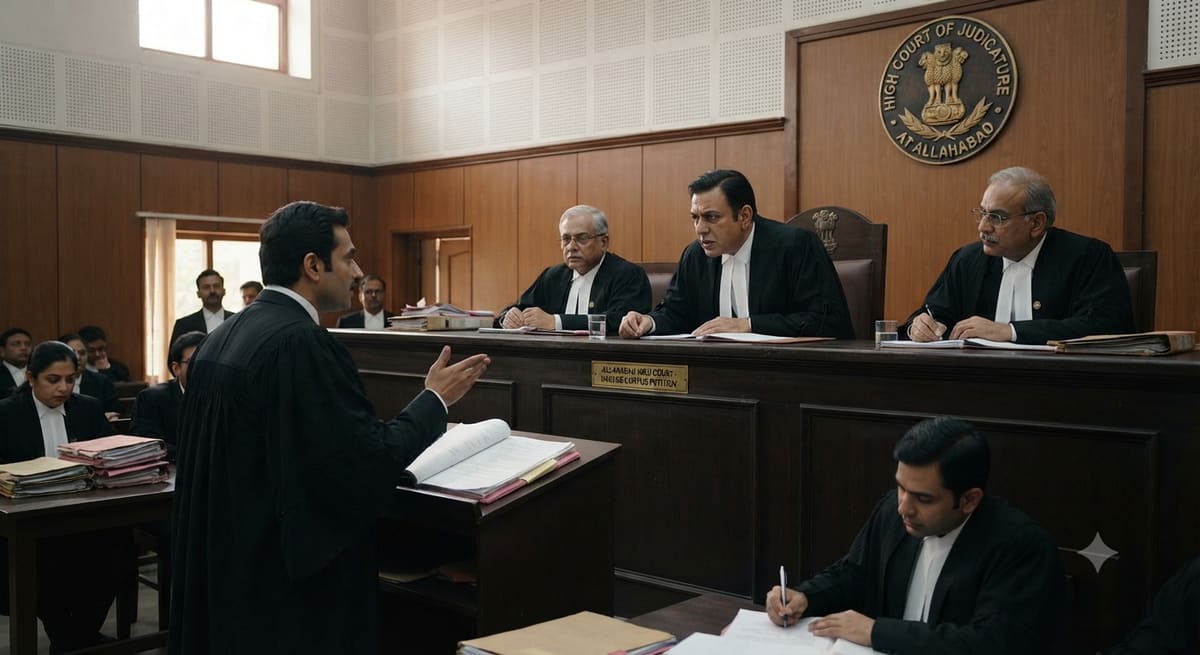
The Bombay High Court has clarified that the territorial jurisdiction for filing a writ petition under Articles 226 and 227 of the Constitution is determined by the location of the appellate authority, not the origin of the underlying dispute. This ruling resolves a growing conflict between procedural convenience and statutory jurisdiction in multi-tiered administrative adjudication.
Background & Facts
The Dispute
The petitioners, proprietors of a firm that defaulted on a loan from Janata Sahakari Bank, faced enforcement proceedings under the Securitisation and Reconstruction of Financial Assets and Enforcement of Security Interest Act, 2002. The secured assets were located in Ichalkaranji, Kolhapur, and the loan was sanctioned from a branch in the same district. After the bank assigned the debt to Respondent No.1, proceedings were initiated before the Debts Recovery Tribunal (DRT) in Pune, which has jurisdiction over Kolhapur.
Procedural History
- 2023: DRT Pune set aside a sale certificate and directed a fresh sale process.
- 2024: DRAT Mumbai, the appellate tribunal, remanded the matter to DRT Pune, holding the earlier order non-speaking.
- 2025: Petitioners filed a writ petition in the Bombay High Court’s Principal Seat challenging the DRAT’s order.
- August 2025: Circuit Bench at Kolhapur was established under amended Rule 3A of the Bombay High Court Appellate Side Rules, granting it jurisdiction over six districts including Kolhapur.
- January 2026: Petitioners moved to transfer the writ petition to the Kolhapur Circuit Bench, arguing that the cause of action arose in Kolhapur.
Relief Sought
The petitioners sought transfer of the writ petition to the Kolhapur Circuit Bench, contending that Rule 3A ousted the Principal Seat’s jurisdiction. They also invoked the doctrine of forum convenience and the Chief Justice’s role as Master of the Roster.
The Legal Issue
The central question was whether the establishment of the Kolhapur Circuit Bench under Rule 3A of the Bombay High Court Appellate Side Rules ousts the Principal Seat’s jurisdiction to entertain a writ petition under Articles 226 and 227, where the appellate authority (DRAT) is located in Mumbai and the original authority (DRT) is in Pune.
Arguments Presented
For the Petitioner
The petitioners relied on Ambika Industries v. Commissioner of Central Excise to argue that the locus of the original dispute - here, Kolhapur - should determine jurisdiction. They emphasized that Rule 3A mandates that all writ petitions arising from Kolhapur must be heard by the Circuit Bench. They cited Shri Shivneri Sahakari Bank v. Rupee Co-operative Bank as binding precedent within the Bombay High Court, where a similar transfer was ordered. They further contended that as dominus litis, they had the right to choose the forum of convenience.
For the Respondent
The respondents argued that the DRAT’s order, passed in Mumbai, constitutes a substantial part of the cause of action. They relied on Nasrudin v. State Transport Appellate Tribunal and M/s. Kusum Ignots & Alloys v. Union of India, which hold that the seat of the appellate authority attracts jurisdiction under Article 226. They distinguished Shri Shivneri on the ground that the original authority in that case was located in Kolhapur, unlike here where DRT Pune is outside Kolhapur’s jurisdiction. They also cited Volvo Group India v. Union of India to affirm that the Principal Seat retains jurisdiction when the appellate authority is within its territorial limits.
The Court's Analysis
The Court undertook a comprehensive review of Supreme Court precedents on the doctrine of merger and the evolving concept of cause of action under Article 226. It held that the order of the appellate authority does not merely supplement the original order - it merges with it, thereby becoming the operative impugned order.
"When an order is passed by a court or tribunal... a part of cause of action arises at that place. Even in a given case, when the original authority is constituted at one place and the appellate authority is constituted at another, a writ petition would be maintainable at both the places."
The Court emphasized that the Supreme Court in Nasrudin and Kusum Ignots had consistently held that the location of the appellate authority is a valid and substantial basis for jurisdiction. The Ambika Industries judgment did not overrule these precedents but reinforced that even a partial cause of action suffices. The Court further noted that the jurisdiction under Articles 226 and 227 is overlapping, and the supervisory power under Article 227 is explicitly vested in the High Court where the tribunal is situated.
The Court rejected the petitioners’ reliance on Shri Shivneri Sahakari Bank, distinguishing it factually: in that case, the original authority was located in Kolhapur, whereas here, the DRT is in Pune. The Court also clarified that Rule 3A governs the allocation of cases within the High Court’s internal roster but cannot override constitutional jurisdiction principles established by the Supreme Court. The Master of the Roster power, while real, is administrative and cannot be invoked to create or extinguish jurisdiction.
Finally, the Court held that forum convenience cannot override jurisdictional boundaries once litigation has commenced. The petitioners had voluntarily approached DRAT in Mumbai and filed the writ petition in Bombay, thereby acquiescing to the forum.
The Verdict
The petitioners’ request for transfer was rejected. The Bombay High Court held that the Principal Seat retains jurisdiction to hear the writ petition because the appellate authority (DRAT) is located within its territorial limits, and its order constitutes a substantial part of the cause of action. The petition shall continue to be heard at the Principal Seat in Mumbai.
What This Means For Similar Cases
Appellate Authority’s Seat Is Jurisdictional Anchor
- Practitioners must now identify the location of the appellate tribunal - not the original authority - as the primary jurisdictional trigger for writ petitions under Articles 226 and 227.
- Filing a writ petition at the seat of the appellate authority is not merely convenient - it is legally sufficient and often decisive.
Rule 3A Does Not Override Constitutional Jurisdiction
- Internal High Court rules governing bench allocation cannot override the constitutional principles of cause of action under Article 226.
- Lawyers cannot rely on state-specific procedural rules to oust jurisdiction where the Supreme Court has established a clear constitutional test.
Forum Convenience Is Not a Jurisdictional Tool
-
Choosing a forum for convenience after initiating proceedings in another jurisdiction will not justify transfer.
-
Once a petition is filed and litigated before a particular court, the doctrine of forum convenience cannot be invoked to shift venue unless the court exercises its administrative powers.
-
Actionable Takeaway: Always verify the location of the appellate authority before filing a writ petition. If the appellate body is in Mumbai, Delhi, or Chennai, file there - even if the original dispute arose elsewhere.
-
Caution: Do not assume that local Circuit Benches automatically absorb jurisdiction over all matters originating in their districts. The nature of the impugned order matters more than the origin of the underlying facts.