The Calcutta High Court has reaffirmed that writ jurisdiction under Article 226 of the Constitution is not a substitute for civil remedies when a money claim hinges on disputed factual issues. This judgment clarifies the limits of judicial intervention in contractual disputes involving public authorities, reinforcing the principle that factual adjudication belongs to civil courts or tribunals.
Background & Facts
The Dispute
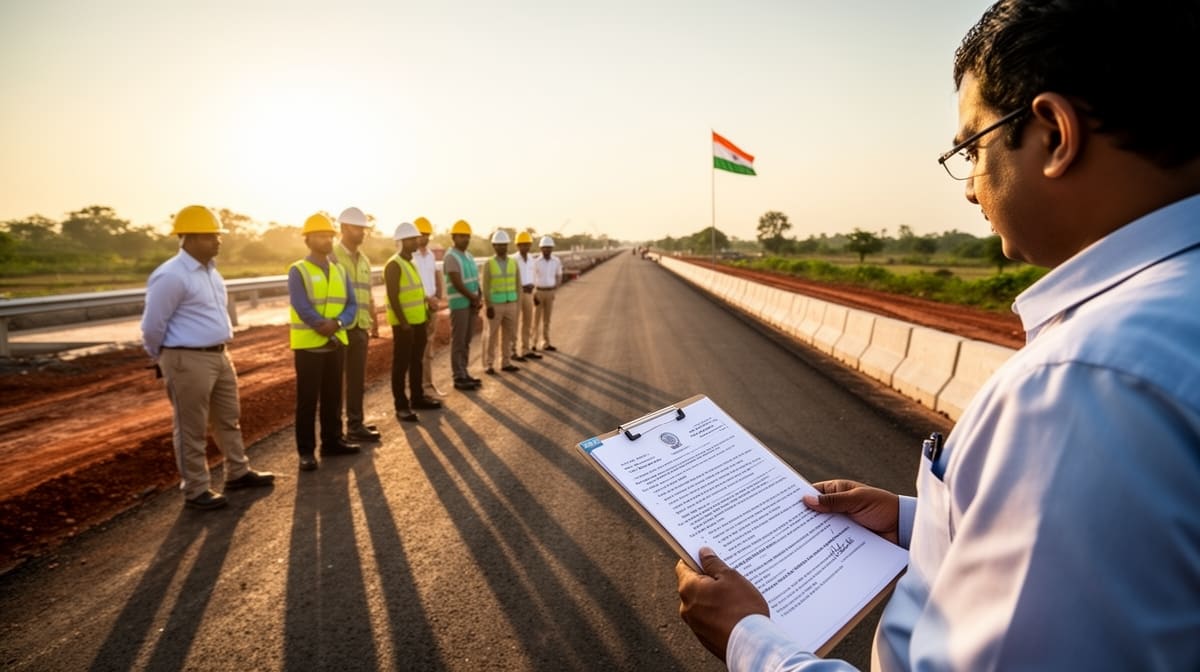
The appellant, Brajagopal Saha, participated in a public tender floated by the Block Development Office, Jalpaiguri, for execution of infrastructure works. He was issued a work order and completed the work to the satisfaction of local authorities. Despite this, he was not paid. His claim for payment of Rs. 12,45,000 was rejected on the ground that the work order lacked prior administrative and financial sanction from competent authorities.
Key Facts
- The work order was issued on or about 15.11.2023
- The appellant completed 100% of the work by 17.01.2024, as recorded in a written acknowledgment by the Block Development Officer
- A letter dated 17.02.2024 from the Block Development Officer confirmed completion and requested payment
- No payment was made despite repeated representations
- The appellant filed WPA 1466 of 2024 on 10.07.2024 seeking payment
- The Single Judge, by order dated 14.08.2024, directed the authorities to consider and dispose of the representation within four weeks
- The authorities failed to comply, prompting the appellant to file CPAN 9 of 2025 for contempt
- On 18.02.2025, the authorities issued a reasoned order rejecting the claim, citing absence of administrative and financial sanction records
- The appellant then filed WPA 653 of 2025 challenging the 18.02.2025 order
- The Single Judge dismissed the writ petition on 13.01.2026
- The Block Development Officer was added as a respondent in WPA 653 of 2025 but did not file any affidavit or contest the proceedings
Procedural History
- 15.11.2023: Work order issued to the appellant
- 17.01.2024: Written record confirming 100% completion of work
- 17.02.2024: Block Development Officer’s letter acknowledging completion and requesting payment
- 10.07.2024: WPA 1466 of 2024 filed seeking payment
- 14.08.2024: Single Judge directed authorities to decide representation within four weeks
- 14.12.2024: Deadline for compliance expired without action
- 05.01.2025: CPAN 9 of 2025 filed for contempt
- 18.02.2025: Authorities issued reasoned order rejecting claim due to lack of sanction
- 25.03.2025: WPA 653 of 2025 filed challenging the 18.02.2025 order
- 13.01.2026: Single Judge dismissed WPA 653 of 2025
- 15.02.2026: FMA/7/2026 filed before the Circuit Bench at Jalpaiguri
The Parties' Positions
Appellant: Argued that the work was completed, acknowledged in writing, and the claim was admitted. Relied on ABL International Ltd. v. ECGC to contend that writ jurisdiction is maintainable where the claim is undisputed. Asserted that the Block Development Officer’s acknowledgment binds the State.
Respondents: Contended that the work order was issued without prior administrative and financial sanction, rendering it ultra vires. Stated that no records exist to substantiate approval, and the appellant’s claim cannot override statutory financial procedures.
Relief Sought
The appellant sought a direction to the State to pay Rs. 12,45,000 with interest at 12% per annum from 18.02.2025, costs, and a declaration that the rejection order was illegal.
The Legal Issue
Can a writ petition under Article 226 of the Constitution be maintained to enforce a money claim against a public authority when the underlying facts - particularly the validity of the work order and existence of prior sanction - are in dispute?
Arguments Presented
For the Appellant
The appellant’s counsel relied on ABL International Ltd. v. Export Credit Guarantee Corporation of India Ltd. to argue that where a claim is admitted by the authority through conduct or written acknowledgment, the writ court may intervene. He emphasized that the Block Development Officer’s letter dated 17.02.2024 constituted an admission of completion and liability. He further submitted that the State cannot disown the act of its officer, especially when no action was taken against him despite his participation as a respondent.
For the Respondent
The State contended that the work order was void ab initio for lack of sanction under the West Bengal Financial Rules. No record of administrative or financial approval existed in the office. The acknowledgment by the Block Development Officer was an unauthorized act, and the State cannot be bound by ultra vires conduct. The dispute involved factual questions of sanction, authority, and compliance with financial procedures - matters beyond the scope of Article 226.
The Court's Analysis
The Court examined the nature of the dispute and the scope of writ jurisdiction under Article 226. It acknowledged that ABL International Ltd. permits writ relief in money claims where the liability is clear and undisputed. However, the Court distinguished the present case on the ground that the very foundation of the claim - the validity of the work order - is contested.
"There are disputed questions of facts involved. The dispute is whether there was any prior administrative and financial approval granted to the concerned Block Development Officer to float the tender in the first place."
The Court noted that the State’s rejection order was based on the absence of sanction records, a factual assertion not rebutted by documentary proof from the appellant. The fact that the Block Development Officer did not contest the proceedings did not validate the work order or create a binding admission by the State. The Court emphasized that writ courts are not forums for re-appreciating evidence or resolving factual disputes between private parties and public authorities.
The Court further observed that the appellant had already availed of the writ remedy once, and the authorities had complied with the direction to issue a reasoned order. The current challenge was to the sufficiency of that order, which involved factual adjudication. The Court held that such disputes must be resolved through a civil suit or appropriate tribunal, not under Article 226.
The Verdict
The appeal was dismissed. The Court upheld the order dated 13.01.2026 dismissing WPA 653 of 2025. The appellant is not entitled to monetary relief through writ jurisdiction due to the presence of disputed factual issues. The Court clarified that this judgment does not bar the appellant from pursuing his claim in a civil court or other competent forum.
What This Means For Similar Cases
Writ Jurisdiction Cannot Resolve Factual Disputes
- Practitioners must avoid filing writ petitions under Article 226 for money claims where the validity of the contract, sanction, or authority is contested
- Even if an officer acknowledges completion, the State’s internal financial compliance requirements prevail unless proven otherwise
- Written acknowledgments by subordinate officers without sanction do not constitute binding admissions by the State
Civil Remedy Is the Proper Forum
- Claims arising from public contracts with disputed facts must be pursued through civil suits under Order VII Rule 1 CPC
- Tribunals such as the State Public Works Tribunal or District Consumer Forum may be appropriate depending on the nature of the contract
- Delay in filing civil suits cannot be excused by prior writ proceedings unless the writ court explicitly preserved the right to sue
Administrative Acts Cannot Override Financial Rules
- Public officers cannot bind the State financially without prior sanction under applicable financial rules
- Courts will not validate ultra vires acts merely because they were performed in good faith or resulted in completed work
- The absence of disciplinary action against an officer does not validate the underlying transaction