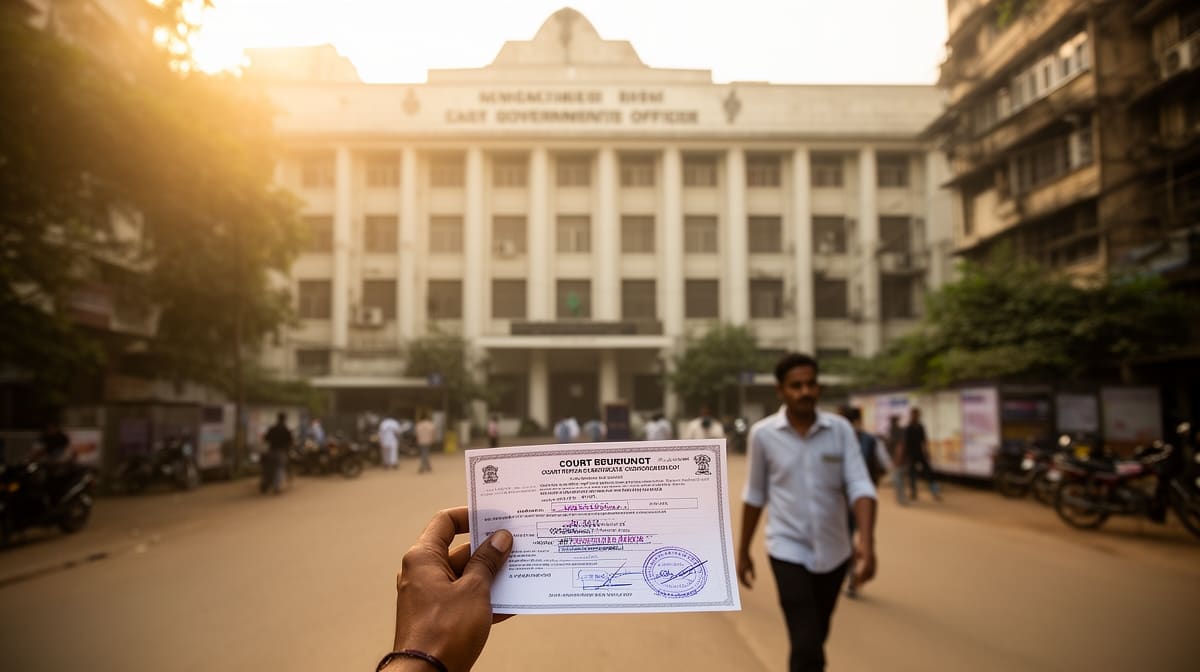
The Jharkhand High Court has invalidated a discriminatory provision in the Court Fees (Jharkhand Amendment) Act, 2022, which imposed no upper limit on fees for probate and letters of administration while capping fees for all other suits at Rs. 3 Lakhs. The judgment reaffirms that unequal treatment without rational justification violates the foundational principle of equality under Article 14 of the Constitution.
Background & Facts
The Dispute
The petitioner challenged the constitutional validity of Article 3 of Schedule-I of the Court Fees (Jharkhand Amendment) Act, 2022, which prescribes a 10% ad-valorem court fee on suits seeking probate of a will or letters of administration with or without a will annexed, without any ceiling or maximum limit. In contrast, Article 1 of the same Schedule imposes a maximum cap of Rs. 3 Lakhs on court fees for all other civil suits, regardless of the value of the subject matter in dispute.
Key Facts
- The Court Fees (Jharkhand Amendment) Act, 2022, substituted Schedule-I and II of the Court Fees Act, 1870, effective from its enactment.
- Under Article 1 of Schedule-I, court fees for civil suits are calculated on an ad-valorem basis with a maximum cap of Rs. 3 Lakhs for suits exceeding Rs. 1 Crore.
- Under Article 3 of Schedule-I, court fees for probate or letters of administration are levied at 10% of the value of the estate, with a minimum of Rs. 500, but with no upper limit.
- The petitioner, a resident of Hazaribagh, was faced with a potential court fee exceeding Rs. 10 Lakhs on a probate application involving an estate valued at over Rs. 1 Crore.
- No empirical data or legislative history was produced to justify the differential treatment.
- The State did not dispute that the fee structure applied uniformly to all petitioners seeking probate or letters of administration, irrespective of the complexity or nature of the case.
Procedural History
- 19.03.2026: Writ Petition (C) No. 456 of 2026 filed before the High Court of Jharkhand.
- 19.03.2026: Court admitted the petition and heard arguments from both parties.
- 19.03.2026: Court disposed of the petition finally, with consent of parties, noting that respondents 3 to 11 were proforma parties and would not be affected by the outcome.
The Parties' Positions
For the Petitioner
- Argued that the absence of a ceiling on probate fees, while capping fees for all other suits at Rs. 3 Lakhs, constitutes hostile discrimination under Article 14.
- Contended that there is no intelligible differentia between probate proceedings and other civil suits that justifies such disparity.
- Relied on precedents from Bombay, Guwahati, Calcutta, and Patna High Courts, as well as the Supreme Court in P.M. Ashwathanarayana Setty v. State of Karnataka.
- Emphasized that court fees are a revenue measure, not a regulatory tool, and must not operate as a barrier to access to justice.
For the Respondent (State)
- Argued that probate proceedings involve a special testamentary jurisdiction requiring enhanced judicial time, administrative supervision, record maintenance, and legal responsibility.
- Claimed that probate is not a routine civil suit but a solemn judicial determination conferring legal sanctity on a will.
- Asserted that the classification is based on a reasonable differentia and falls within legislative policy, warranting minimal judicial scrutiny.
- Submitted that the difference in treatment is justified because a will is an exception to the general law of succession.
Relief Sought
The petitioner sought a declaration that Article 3 of Schedule-I of the Court Fees (Jharkhand Amendment) Act, 2022, to the extent it imposes no ceiling on court fees for probate or letters of administration, is unconstitutional, ultra vires, null and void. The petitioner further sought that the maximum court fee payable for such proceedings be capped at Rs. 3 Lakhs, consistent with the ceiling applicable to other civil suits.
The Legal Issue
The central question was whether the absence of a ceiling on court fees for suits seeking probate of a will or letters of administration, while imposing a maximum limit of Rs. 3 Lakhs on all other civil suits, constitutes hostile discrimination in violation of Article 14 of the Constitution.
Arguments Presented
For the Petitioner
The petitioner relied on the established doctrine that Article 14 prohibits arbitrary classification and requires both an intelligible differentia and a rational nexus with the object of the law. He argued that probate proceedings and other civil suits are functionally similar in that both involve adjudication of property rights and succession claims. The State’s claim of enhanced judicial burden was unsupported by data. He cited P.M. Ashwathanarayana Setty v. State of Karnataka, Jyoti Nikul Jariwala v. State of Maharashtra, Prafulla Govinda Baruah v. State of Assam, Subrata Das v. Collector of 24 Parganas, and Kishore Kumar Kataruka v. State of Bihar to demonstrate a consistent judicial trend striking down such discriminatory provisions. He emphasized that court fees are a fiscal instrument, not a regulatory one, and must not create unequal access to justice.
For the Respondent
The State contended that probate proceedings are fundamentally distinct from ordinary civil suits because they involve verification of a will’s authenticity, testamentary capacity, public citation, and adjudication of objections. It argued that these proceedings require greater judicial oversight, administrative resources, and permanent record-keeping, justifying higher fees without a cap. The State further claimed that the levy is tied to the conferment of a statutory privilege - legal enforceability of a will - and thus constitutes a different category of service. It maintained that such legislative classification is entitled to deference under the doctrine of separation of powers.
The Court's Analysis
The Court began by affirming that Article 14 does not prohibit classification but requires that any classification satisfy a twin test: (i) the classification must be founded on an intelligible differentia, and (ii) the differentia must have a rational nexus with the object sought to be achieved by the law. The Court held that the State had failed to discharge its burden of justifying the differential treatment.
"The discrimination brought about by the statute, in our opinion, fails to pass the constitutional muster as rightly pointed out by the High Court."
The Court rejected the State’s assertion that probate proceedings are inherently more complex or resource-intensive. It noted that the counter-affidavit, sworn by an Under Secretary, contained unsubstantiated claims about judicial time and administrative burden, with no empirical evidence to support them. The Court observed that many civil suits under Article 1 - such as those involving complex title disputes, partnership dissolutions, or high-value property claims - may be equally or more demanding than uncontested probate matters.
The Court further held that the mere fact that a will is an exception to the general law of succession does not justify a fee disparity. The legal effect of a will is irrelevant to the nature of the proceeding before the court, which remains a civil adjudication. The Court emphasized that the State had not demonstrated how the absence of a ceiling on probate fees served any legitimate objective, such as revenue generation, deterrence, or administrative efficiency.
The Court then turned to binding precedent. It extensively relied on P.M. Ashwathanarayana Setty v. State of Karnataka, where the Supreme Court upheld the Bombay High Court’s decision striking down an identical provision in the Maharashtra Court Fees Act. The Supreme Court had held that there was no rational basis for singling out probate proceedings for unlimited fees when all other suits were capped. The Court also cited the decisions of the Guwahati, Calcutta, and Patna High Courts, all of which had followed the same reasoning.
The Court concluded that the differential treatment was not merely unequal - it was arbitrary. The State had not shown why a person seeking probate of a Rs. 10 Crore estate should pay Rs. 1 Crore in fees, while a person litigating a Rs. 50 Crore property dispute pays only Rs. 3 Lakhs. The absence of a ceiling rendered the provision capricious and violative of Article 14.
The Verdict
The writ petition was allowed. The Court declared that Article 3 of Schedule-I of the Court Fees (Jharkhand Amendment) Act, 2022, to the extent it imposes no ceiling on court fees for suits seeking probate of a will or letters of administration with or without a will annexed, is ultra vires, illegal, null and void. The Court directed that until a suitable amendment is enacted by the legislature, the maximum court fee payable for such proceedings shall not exceed Rs. 3 Lakhs, consistent with the ceiling applicable to other civil suits under Article 1 of Schedule-I. No costs were awarded.
What This Means For Similar Cases
Probate Fees Are Not Exempt from Equality Norms
- Practitioners must now challenge any state law imposing unlimited court fees on probate or letters of administration without a rational basis.
- The burden of justifying such differential treatment now rests squarely on the State, which must provide empirical data, not speculative claims.
- Courts will no longer accept policy arguments as substitutes for constitutional justification under Article 14.
Uniform Ceiling Applies Across Civil Proceedings
- All civil suits, regardless of subject matter, must be treated uniformly if they fall under the same fee schedule.
- The Rs. 3 Lakh ceiling established for civil suits now applies by analogy to probate and letters of administration proceedings in Jharkhand.
- States with similar provisions (e.g., Uttar Pradesh, Madhya Pradesh, Odisha) may face challenges based on this precedent.
Access to Justice Cannot Be Price-Blocked
- High court fees that effectively bar access to probate proceedings may be struck down as violating the right to legal remedy under Article 21.
- Legal aid and pro bono services should be expanded to ensure that indigent heirs are not excluded from succession processes due to fee barriers.
- Law commissions and state legislatures must review all fee structures for consistency with constitutional equality.