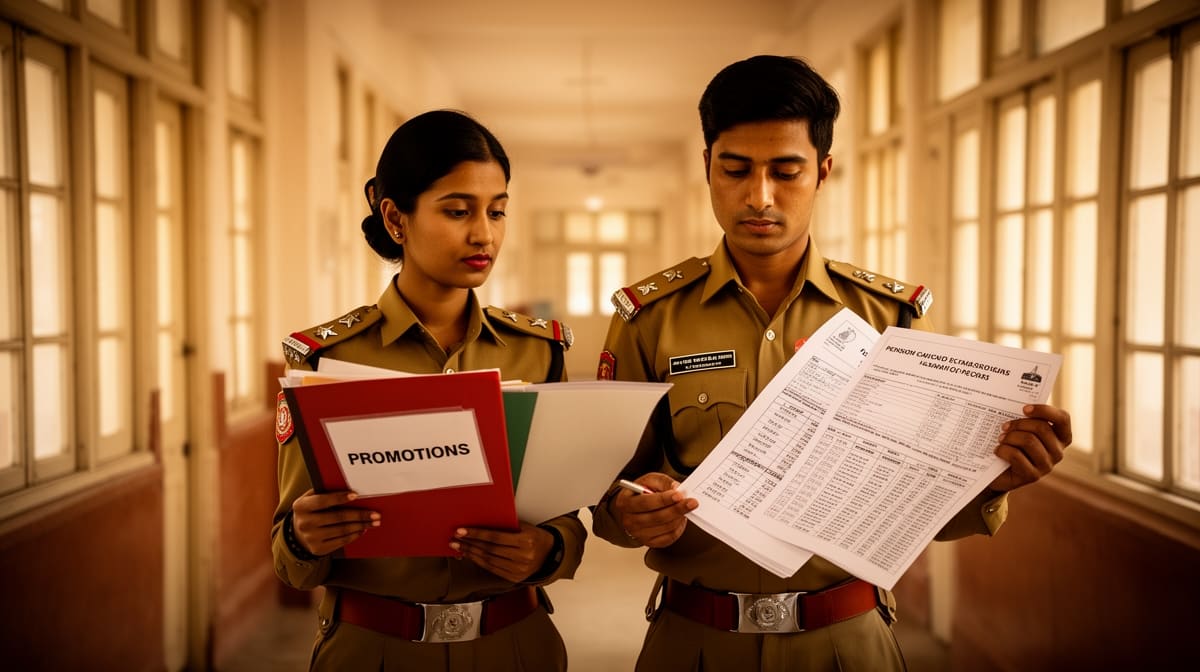
The Gauhati High Court has affirmed that personnel of the Assam Police Radio Organisation (APRO) cannot be denied equal Grade Pay granted to equivalent ranks in other units under the Director General of Police, holding that such discrimination violates the constitutional guarantee of equality under Article 14. The judgment mandates immediate implementation of revised pay scales for ASIs and Head Constables in APRO, aligning them with their counterparts across the Assam Police force.
Background & Facts
The Dispute
The petitioners, serving as Assistant Sub-Inspectors (ASI) and Head Constables in the Assam Police Radio Organisation (APRO), challenged the State’s refusal to grant them the enhanced Grade Pay of Rs. 7400 and Rs. 6800 respectively, which were extended to equivalent ranks in the Armed Branch (AB) and Unarmed Branch (UB) of the Assam Police under the 7th Assam Pay and Productivity Commission (7th APPC) recommendations. Despite APRO being an integral part of the Assam Police under the Director General of Police and the Home Department, the Finance Department denied the enhancement on the ground that the 7th APPC and the Anomaly Committee had not made specific recommendations for APRO personnel.
Key Facts
- APRO personnel are recruited with minimum qualification of 10+2 (Science with Physics, Chemistry, Mathematics), identical to that required for ASI and Head Constable posts in other police units.
- APRO personnel undergo 39 weeks of mandatory Police Basic Drill & Discipline Training, same as AB/UB personnel.
- The nature of duties involves sophisticated wireless communication systems, law and order monitoring, interception of signals, and emergency communication during natural disasters.
- In 2013, the Gauhati High Court, in WP(C) 6712/2010, directed the State to redesignate Constable (WO/WT) as Head Constable (WO/WT) and grant revised pay scale of Rs. 2890-5725 with Grade Pay Rs. 2100 w.e.f. 01.01.2006, which was implemented.
- The 7th APPC Report (submitted 18.11.2016) recommended Grade Pay of Rs. 2900 for ASI and Rs. 2700 for Havildar/Head Constable across the Home Department, without distinguishing between sub-organisations.
- Notification dated 15.06.2018 granted Grade Pay Rs. 7400 to ASI (UB/AB) and Rs. 6800 to Head Constable (UB/AB) w.e.f. 01.04.2016.
- APRO personnel were excluded from this enhancement despite holding equivalent ranks.
- A communication dated 02.03.2026 from the Assistant Inspector General of Police confirmed that all other units under DGP (District Police, River Police, Special Branch, etc.) received the enhanced Grade Pay, but APRO was the sole exception.
- The Finance Department, in its affidavit, admitted that no specific recommendation was made for APRO but failed to explain why other units received the benefit without specific recommendations.
- The petitioners’ service conditions, training, responsibilities, and functional roles are indistinguishable from those of AB/UB personnel.
Procedural History
- 18.12.2013: Gauhati High Court, in WP(C) 6712/2010, directed redesignation of Constable (WO/WT) as Head Constable (WO/WT) and grant of revised pay scale w.e.f. 01.01.2006.
- 05.09.2014: Court disposed of WP(C) 4376/2014 on similar grounds.
- 07.02.2018: Government issued order redesignating Constable (WO/WT) as Head Constable (WO/WT).
- 15.06.2018: Notification issued granting enhanced Grade Pay Rs. 7400 (ASI) and Rs. 6800 (HC) to AB/UB ranks w.e.f. 01.04.2016.
- 20.12.2019: Joint Secretary, Home (B) Department, issued order rejecting APRO’s claim, citing absence of specific recommendation by 7th APPC or Anomaly Committee.
- 21.11.2020: Government amended ROP Rules 2010 and 2017 to reflect redesignation as Head Constable (WO/WT) but did not enhance Grade Pay to Rs. 6800 or Rs. 7400.
- 12.06.2021: WP(C) 6540/2021 and WP(C) 3381/2021 filed before Gauhati High Court.
- 12.03.2026: Judgment reserved.
- 09.06.2026: Judgment pronounced.
The Parties' Positions
For the Petitioners
- APRO is an integral wing of the Assam Police under the DGP, sharing identical recruitment, training, duties, and responsibilities with AB/UB units.
- The 7th APPC recommendations were made for ranks under the Home Department, not for specific sub-organisations; therefore, the benefit must extend to all units under DGP.
- The exclusion of APRO is arbitrary, irrational, and violative of Article 14.
- The Court’s earlier judgment in WP(C) 6712/2010 established equivalence of APRO ranks with other police ranks.
- The judgment in Union of India v. D.G.O.F. Employees Association (2023 INSC 995) supports judicial intervention where discrimination is evident despite identical service conditions.
For the Respondent
- The 7th APPC and Anomaly Committee did not make specific recommendations for APRO personnel.
- Pay fixation is an executive function and courts must exercise restraint.
- The principle of "equal pay for equal work" requires complete identity in recruitment, qualifications, duties, and responsibilities, which is not established.
- Granting parity may trigger cascading demands from other departments.
- Reliance on State of Haryana v. Charanjit Singh, S.C. Chandra v. State of Jharkhand, and other precedents to argue against judicial interference.
Relief Sought
The petitioners sought:
- Grant of Grade Pay Rs. 7400 to ASI Grade I and Grade II of APRO w.e.f. 01.04.2016.
- Grant of Grade Pay Rs. 6800 to Head Constable (WO/WT) of APRO w.e.f. 01.04.2016.
- Payment of arrears with interest.
- Quashing of the order dated 20.12.2019.
The Legal Issue
The central question was whether the State’s refusal to extend the enhanced Grade Pay recommended by the 7th Assam Pay and Productivity Commission to Assistant Sub-Inspectors and Head Constables in the Assam Police Radio Organisation - while granting it to identical ranks in all other units under the Director General of Police - constitutes arbitrary discrimination violative of Article 14 of the Constitution, despite the absence of a specific recommendation for APRO.
Arguments Presented
For the Appellant/Petitioner
The petitioners relied on the D.G.O.F. Employees Association judgment to argue that courts may intervene when pay parity is denied despite historical equivalence and identical functional roles. They emphasized that the 7th APPC recommendations were framed for "ranks under the Home Department," not for specific sub-organisations, and that the exclusion of APRO was not based on any rational classification. They cited the Court’s own prior observation in WP(C) 6712/2010 that the State was "indulging in semantics" and avoiding decisions to prevent chain reactions. The petitioners contended that the absence of a specific recommendation for APRO could not justify differential treatment when all other units received the benefit without such specificity.
For the Respondent/State
The State, through the Finance Department, argued that pay fixation is a purely executive function and courts must not interfere. It relied on multiple Supreme Court judgments (State of Haryana v. Charanjit Singh, S.C. Chandra v. State of Jharkhand, State of Bihar v. Teachers Struggle Committee) to assert that "equal pay for equal work" requires complete identity in recruitment, qualifications, duties, and responsibilities - which, it claimed, were not established. It further argued that granting parity to APRO would open floodgates for similar claims from other departments, creating fiscal instability. The State maintained that the 7th APPC’s silence on APRO was intentional and that the Finance Department could not act without explicit recommendation.
The Court's Analysis
The Court rejected the State’s contention that the absence of a specific recommendation for APRO justified exclusion. It observed that the 7th APPC recommendations were framed at the level of "ranks under the Home Department," not sub-organisations, and that the same recommendations were implemented across all other units under the DGP - including District Police, River Police, and Special Branch - despite no specific mention of those units in the report. The Court noted that the Finance Department itself admitted that no specific recommendation was made for any sub-unit under the DGP, yet all except APRO received the enhanced Grade Pay.
"There is no document or decision brought on record to indicate, let alone justify, a proposition that the 7th APPC or the Anomaly Committee had intended to deny the ranks in the APRO the benefit of the recommendations."
The Court held that the differential treatment was not based on any intelligible differentia or rational nexus with the object of the pay revision. It emphasized that APRO personnel share identical recruitment standards, training duration, functional responsibilities, and hierarchical status with AB/UB personnel. The Court distinguished the cited precedents, noting that they dealt with claims of "equal pay for equal work" between dissimilar categories, whereas this case involved implementation of a uniform pay structure recommended for a category of ranks, with selective exclusion of one unit.
The Court further criticized the order dated 20.12.2019 for ignoring subsequent justifications submitted by the APRO administration, including reports dated 24.08.2017, 28.06.2018, and 20.12.2018, which detailed the equivalence of duties and responsibilities. The Court found this to be a case of non-application of mind and arbitrary decision-making.
The Court affirmed that while pay fixation is an executive function, judicial review is available where there is palpable discrimination violating Article 14. It held that the State’s conduct amounted to irrational classification, rendering the exclusion of APRO personnel unconstitutional.
The Verdict
The petitioners succeeded. The Court set aside the order dated 20.12.2019 and directed the State to grant Grade Pay of Rs. 7400 to Assistant Sub-Inspectors and Rs. 6800 to Head Constables (WO/WT) of the Assam Police Radio Organisation with effect from 01.04.2016. Arrears arising from this enhancement shall be paid within two months of the payment of the principal amount. The order shall be complied with within two months from the date of receipt of a certified copy of this judgment. There shall be no order as to costs.
What This Means For Similar Cases
Pay Parity Cannot Be Denied on Administrative Silence
- Practitioners must now argue that if a pay commission recommends enhancements for a category of ranks across a department, selective exclusion of one unit without rational justification violates Article 14.
- The absence of a specific recommendation for a sub-unit does not justify denial if other units receive the benefit under the same recommendation.
- Administrative inaction or delay in recommending parity cannot be used to perpetuate discrimination.
Judicial Review Applies to Implementation, Not Formulation
- Courts will not interfere with the formulation of pay scales by expert commissions.
- However, courts will intervene when implementation is discriminatory, irrational, or selective, even if the commission did not explicitly mention every sub-unit.
- The D.G.O.F. Employees Association precedent now stands as a key authority for challenging selective implementation of pay recommendations.
Functional Equivalence Trumps Organisational Label
-
The nature of duties, training, qualifications, and responsibilities - not the organisational name - determine parity.
-
Where two units under the same command perform identical functions, differential pay treatment is prima facie arbitrary.
-
This principle applies to all government departments with multiple wings (e.g., Forensic Labs, Civil Defence, Border Police) where pay structures are centrally determined.
-
Practitioners should collect and present: (a) identical recruitment criteria, (b) identical training protocols, (c) identical functional duties, and (d) identical hierarchical placement to establish equivalence.
-
Any claim of fiscal burden or cascading effect must be rebutted with evidence of uniformity in service conditions.