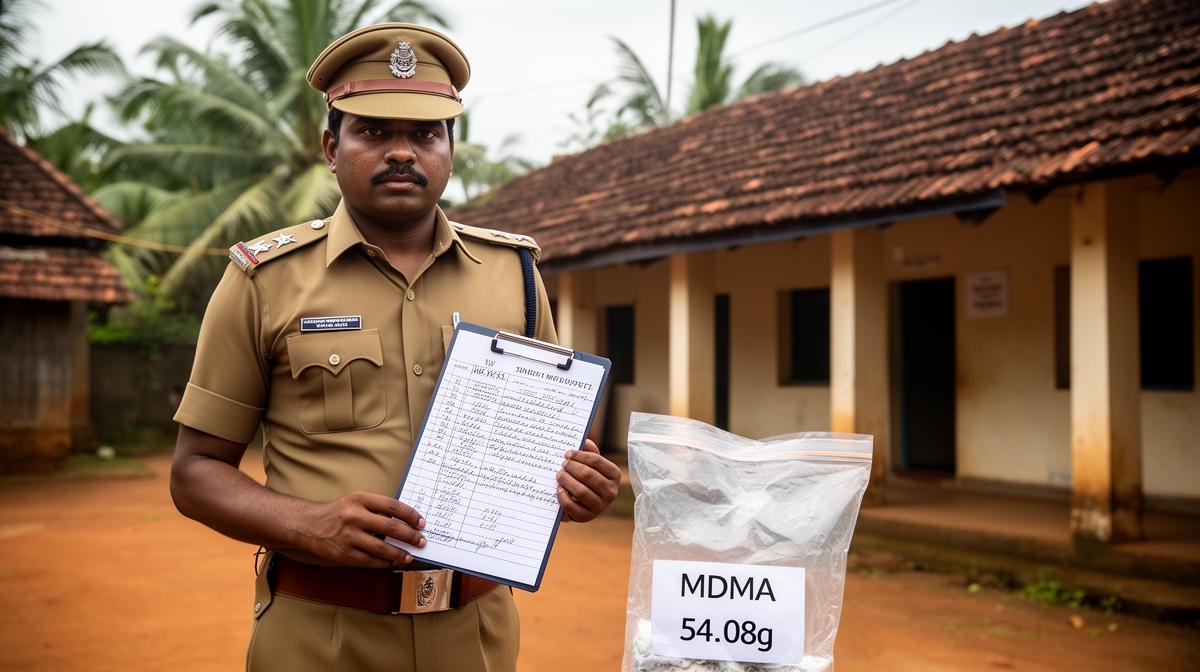
The Kerala High Court has held that an arrest under the Narcotic Drugs and Psychotropic Substances Act, 1985 is invalid if the accused is not furnished with written grounds of arrest, including the specific quantity of contraband seized. The judgment reinforces that compliance with Article 22(1) of the Constitution and Section 47 of the Bharatiya Nagarik Suraksha Sanhita, 2023 is mandatory, not procedural, and non-compliance vitiates the entire arrest and remand process.
The Verdict
The applicant, accused in an NDPS case involving possession of 298.06 grams of MDMA and 6.8 grams of ganja, was granted regular bail after the Kerala High Court held her arrest illegal due to non-communication of written grounds of arrest. The court ruled that failure to inform the arrestee of the specific quantity of contraband, as required under binding Supreme Court precedents, violates Article 22(1) of the Constitution and Section 47 of the BNSS. The arrest and subsequent remand were declared nonest, and bail was granted with standard conditions.
Background & Facts
The applicant, Ayesha Gaffar Sayed, was arrested on 30 January 2025 in connection with Crime No. 33/2025 of Mattancherry Police Station, Ernakulam. She was accused alongside others of possessing 298.06 grams of MDMA and 6.8 grams of dried ganja on 31 January 2025. The charges were framed under Sections 8(c), 22(c), 20(b)(ii)(A), 23(c), 27A, and 29(1) of the NDPS Act, along with Section 111(1) of the Indian Penal Code. The applicant was denied bail by the Additional Sessions Court on 23 August 2025, prompting this application under Section 483 of the BNSS.
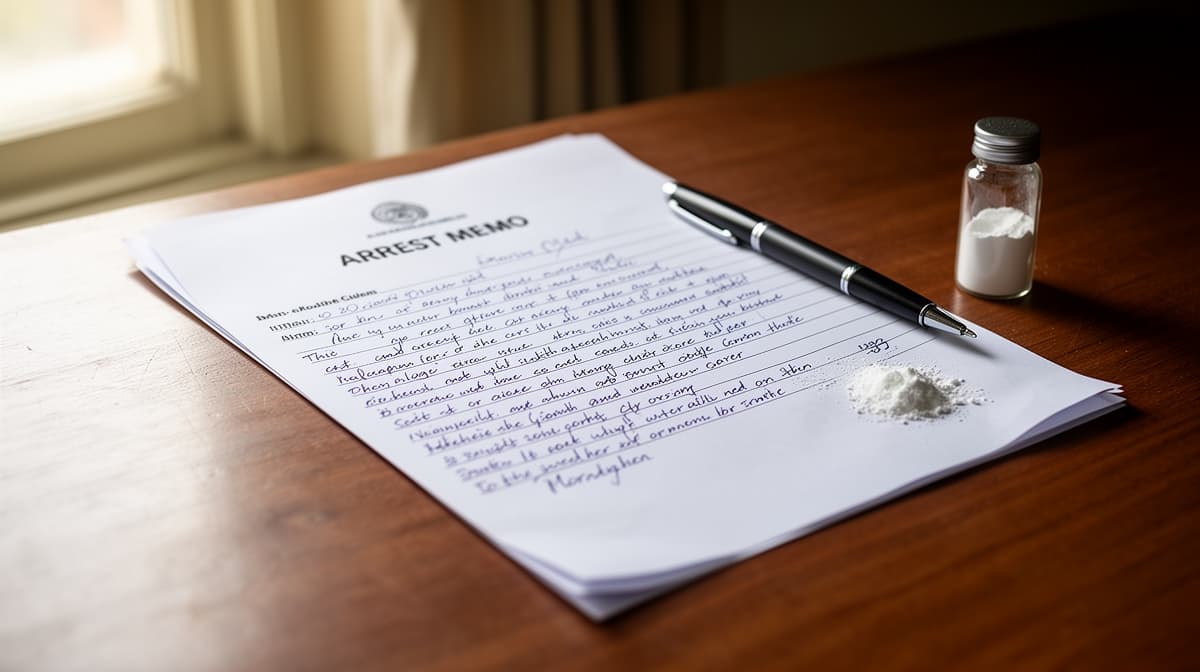
The prosecution’s case relied on recovery of narcotics and alleged involvement in trafficking. However, the arrest memo recorded only the penal provisions invoked, with no mention of the quantity of contraband seized or any written communication of grounds of arrest. The applicant challenged the legality of her arrest, arguing that the failure to inform her of the specific grounds violated her fundamental rights. The case diary contained no evidence of oral or written communication of the grounds of arrest to the applicant at the time of arrest or before her production before the Magistrate.
The Legal Issue
The central legal question was whether the failure to communicate the grounds of arrest in writing, including the specific quantity of contraband in an NDPS case, renders the arrest illegal and mandates release on bail under Article 22(1) of the Constitution and Section 47 of the BNSS.
Arguments Presented
For the Petitioner
The petitioner’s counsel argued that Article 22(1) and Section 47 of the BNSS impose a mandatory duty on arresting officers to communicate the full grounds of arrest immediately. Citing Supreme Court decisions in Pankaj Bansal, Prabir Purkayastha, and Mihir Rajesh Shah, they contended that written communication is now the norm, and absence of such communication - even if oral grounds were allegedly given - constitutes a fundamental rights violation. In NDPS cases, they emphasized, the quantity of contraband is determinative of bailability and must be explicitly communicated. The failure to do so, they argued, deprives the accused of the ability to challenge the legality of the arrest or prepare a defense, thereby rendering the arrest void.
For the Respondent
The Public Prosecutor contended that all procedural formalities under Chapter V of the BNSS were followed. He argued that the arrest memo referenced the relevant sections of the NDPS Act and that the charge sheet later filed contained full details. He relied on State of Karnataka v. Sri Darshan to suggest that substantial compliance suffices unless demonstrable prejudice is shown. He further argued that the applicant’s detention was lawful and that granting bail on technical grounds would undermine the seriousness of NDPS offences.
The Court's Analysis
The court undertook a comprehensive review of recent Supreme Court jurisprudence on the right to be informed of grounds of arrest. It noted that in Pankaj Bansal (2024), the Court held that furnishing written grounds of arrest is mandatory and without exception. In Prabir Purkayastha (2024), the Court reiterated that this right flows from Article 22(1) and any infringement vitiates the arrest. The court then turned to Vihaan Kumar (2025), which clarified that while oral communication is permissible, the burden of proving compliance rests squarely on the investigating agency.
"The requirement of informing the person arrested of the grounds of arrest is not a formality but a mandatory constitutional requirement."
The court emphasized that in NDPS cases, the quantity of contraband is not merely evidentiary but jurisdictional - it determines whether the offence is bailable or non-bailable under Section 27 of the NDPS Act. Therefore, as held in Yazin S. and Vishnu N.P. of this Court, the quantity must be part of the communicated grounds. The arrest memo, which listed only the sections of law, failed this essential requirement.
The court rejected the respondent’s reliance on Sri Darshan, distinguishing it on facts: that case involved bail cancellation after chargesheet filing, whereas here, the arrest itself was defective from inception. The court then cited Mihir Rajesh Shah (2025), which established that written communication must occur within two hours prior to production before the Magistrate. Since no such communication was recorded, the arrest was held to be illegal.
"Non-compliance with Article 22(1) will be a violation of the fundamental right of the accused guaranteed by the said Article. It will also amount to a violation of the right to personal liberty guaranteed by Article 21 of the Constitution."
The court concluded that the arrest and remand were void ab initio and could not be validated by subsequent filing of the charge sheet. The burden of proving compliance was not discharged by the prosecution.
What This Means For Similar Cases
This judgment establishes a binding precedent in Kerala for all arrests under the NDPS Act and other statutes. Practitioners must now treat the communication of written grounds of arrest - not merely the recitation of penal sections - as a non-negotiable condition precedent to lawful detention. In NDPS cases, the quantity of contraband must be explicitly stated in writing at the time of arrest or within two hours before production before the Magistrate. Failure to do so will render the arrest illegal and necessitate immediate release.
For defence counsel, this ruling provides a powerful ground for bail applications and habeas corpus petitions where arrest documentation is incomplete. Prosecutors must now ensure that arrest memos are meticulously drafted to include the exact quantity, nature, and location of seized contraband. Courts will no longer accept general references to sections or post-facto justifications. The judgment also reinforces that the filing of a chargesheet cannot cure a defective arrest - this principle now extends beyond UAPA and PMLA to all criminal cases.
The ruling further underscores the importance of maintaining contemporaneous records of arrest communication. Investigating officers must now document the time, mode, and content of grounds communicated, preferably in writing and in the language understood by the arrestee. This will be critical in resisting future challenges to the legality of detention.