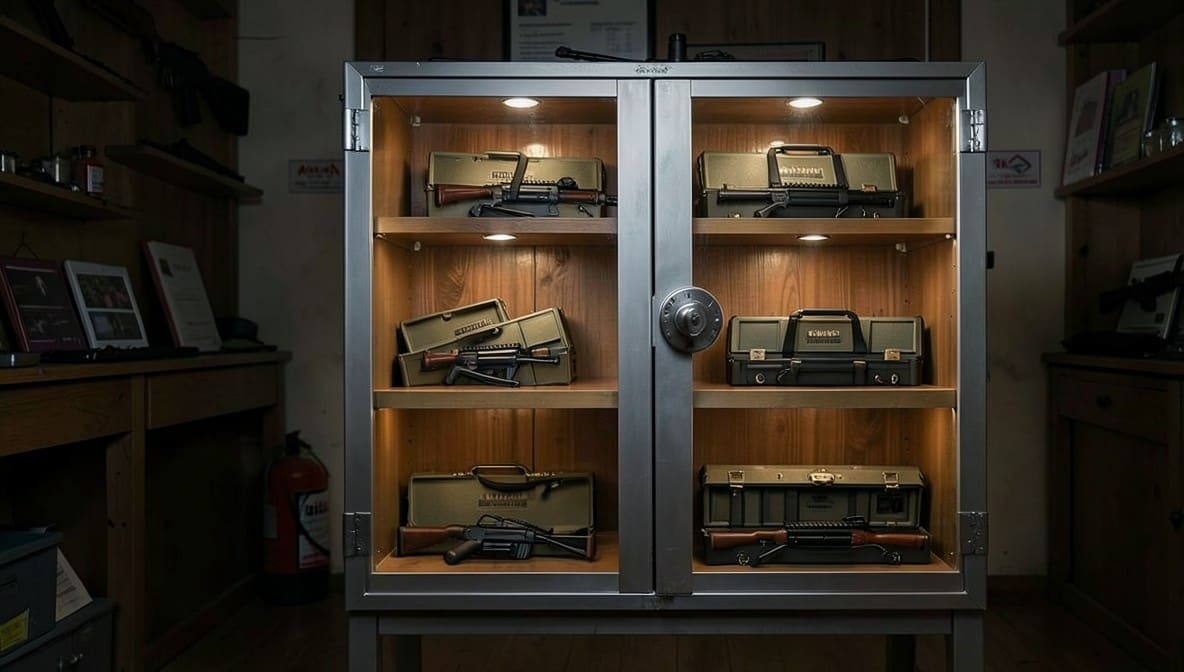
The Punjab and Haryana High Court has clarified that the mere registration or pendency of FIRs against an arms licence holder cannot serve as a standalone ground for denying renewal or revoking an existing licence. This ruling reinforces the principle that licensing decisions under the Arms Act, 1959 must be grounded in specific, reasoned assessments of public safety, not procedural pendency.
Background & Facts
The Dispute
The petitioner, Avtar Singh, held two valid arms licences: Arms Licence No. DM/SAS/DUP/KHRR/0116/23 and the older Licence No. 1317/PS Kharar/DM/SAS Nagar. These licences permitted possession of specified firearms and were periodically renewed. On 15.12.2017, the petitioner applied for renewal of both licences and paid the requisite fee. The Competent Authority, Additional District Magistrate, Sahibzada Ajit Singh Nagar, Mohali, rejected the renewal application by order dated 03.05.2019 (Annexure P-1), suspending and revoking the licences. The petitioner appealed this decision to the Divisional Commissioner, Rupnagar, whose order dated 05.11.2019 (Annexure P-2) dismissed the appeal on identical grounds.
Key Facts
- The petitioner’s arms licences were originally issued and renewed in compliance with statutory requirements.
- The renewal application was submitted on 15.12.2017 with full payment.
- The sole reason cited for denial was the registration of three FIRs against the petitioner:
- FIR No. 126 dated 10.09.2015
- FIR No. 153 dated 06.11.2016
- FIR No. 128 dated 21.07.2017
- As of the date of the writ petition, two of the three FIRs (Nos. 126 and 153) had been quashed by competent courts.
- The third FIR (No. 128) remained pending.
- Neither the Competent Authority nor the Appellate Authority recorded any specific finding that renewal of the licence would endanger public peace or safety.
- No evidence of misuse, criminal conduct, or threat assessment was presented.
Procedural History
- 15.12.2017: Petitioner applied for renewal of arms licences and deposited fees.
- 03.05.2019: Additional District Magistrate, Mohali, rejected renewal and revoked licences solely on grounds of pending FIRs (Annexure P-1).
- 05.11.2019: Divisional Commissioner, Rupnagar, dismissed appeal (Annexure P-2), affirming the revocation.
- 2022: Writ Petition (CWP-14631-2022(O&M)) filed before the Punjab and Haryana High Court.
- 20.04.2026: Judgment delivered by Justice Deepinder Singh Nalwa.
Relief Sought
The petitioner sought quashing of the orders dated 03.05.2019 and 05.11.2019, restoration of his arms licences, and a direction to the Competent Authority to reconsider the renewal application on merits, in accordance with law.
The Legal Issue
The central question was whether the mere pendency of FIRs, without any finding of threat to public safety, constitutes a lawful ground for suspension or revocation of an arms licence under Section 17(3)(b) of the Arms Act, 1959.
Arguments Presented
For the Petitioner
Learned counsel argued that the impugned orders were arbitrary and violative of natural justice. He contended that the licensing authority failed to apply its mind to the statutory requirement under Section 17(3)(b), which permits revocation only if the authority is satisfied that the licence holder poses a risk to public peace or safety. He relied on Neeraj Jindal v. State of Punjab (CWP No. 20627 of 2020, decided on 26.08.2022), where this Court held that FIR pendency alone cannot be the basis for denial. He emphasized that two FIRs had already been quashed, and the remaining one was unsubstantiated by any adverse finding.
For the Respondent
The State counsel submitted that Section 17(3)(b) grants broad discretionary power to the licensing authority to revoke a licence if it deems it necessary for public safety. He argued that the existence of multiple FIRs, even if untried, justifies precautionary revocation. He did not dispute the Neeraj Jindal precedent but contended it was distinguishable on facts.
The Court's Analysis
The Court examined the language and intent of Section 17(3)(b) of the Arms Act, 1959, which permits suspension or revocation only if the licensing authority is satisfied that the licence holder’s continued possession of arms is prejudicial to public peace or safety. The Court noted that the impugned orders contained no such satisfaction. The authorities did not record any evidence of threat, past misconduct, or risk assessment. The sole basis cited was the registration of FIRs.
"It is well settled that mere pendency of FIRs cannot be made the sole ground for refusal of renewal or suspension/revocation of an arms licence in light of the relevant rules."
The Court reaffirmed its own precedent in Neeraj Jindal, holding that the licensing authority must exercise its discretion based on objective, case-specific grounds - not on the mere existence of criminal complaints. The Court observed that FIRs are investigative tools, not adjudicatory findings, and their registration does not equate to guilt or danger. To permit revocation on this basis alone would render the statutory requirement of "public safety" meaningless and open the door to arbitrary action.
The Court further noted that the petitioner had complied with all procedural requirements, including timely application and payment. The revocation was therefore not only legally unsound but procedurally unjust.
The Verdict
The writ petition was allowed. The orders dated 03.05.2019 and 05.11.2019 were quashed. The Competent Authority, Additional District Magistrate, Sahibzada Ajit Singh Nagar, Mohali, was directed to reconsider the petitioner’s application for renewal of arms licences and pass a fresh order within one month of receipt of a certified copy of this judgment. The authority must record specific findings on whether renewal would prejudice public peace or safety, in accordance with Section 17(3)(b) of the Arms Act, 1959.
What This Means For Similar Cases
FIR Pendency Is Not a Proxy for Risk
- Practitioners must challenge revocation orders that rely solely on FIRs without any independent assessment of threat.
- Licensing authorities must document concrete reasons - such as violent conduct, weapon misuse, or credible intelligence - not mere allegations.
- Quashed FIRs must be explicitly excluded from consideration; their inclusion renders the order legally unsustainable.
Discretion Must Be Reasoned, Not Mechanical
- The phrase "deems it necessary for public safety" under Section 17(3)(b) requires active judicial review.
- Blanket policies denying licences based on FIR count violate Article 14 of the Constitution.
- Petitioners may invoke Neeraj Jindal as binding precedent in all Punjab and Haryana jurisdictions.
Procedural Compliance Is a Shield
- Timely renewal applications with fee payment establish good faith.
- Absence of prior violations or disciplinary history strengthens the case for renewal.
- Authorities cannot shift burden to the applicant to prove innocence; the burden lies on the State to justify revocation.