The Allahabad High Court has granted bail to an accused in an Arms Act case after CCTV footage conclusively contradicted the case diary’s assertion that he was armed with a firearm. The judgment underscores the primacy of objective digital evidence over subjective police entries and reinforces the principle that bail should not be denied merely due to the nature of the offence when custodial interrogation is unnecessary.
Background & Facts
The Dispute
The applicant, Pawan Kumar, is accused in Crime No. 21 of 2026 under Sections 103(1), 238A B.N.S. and Section 3/25/27 of the Arms Act, at Police Station Babrala, District Sambhal. The case arises from an incident on 30.01.2026, during which a quarrel erupted between Pawan Kumar’s family and the first informant’s side over a petty dispute. During the altercation, a firearm was discharged, resulting in the death of Premwati Devi, Pawan’s mother, who was struck accidentally while attempting to intervene.
Key Facts
- The incident occurred on 30.01.2026.
- Pawan Kumar lodged an FIR on 31.01.2026, alleging that he and Subhash were attacked, and that Subhash fired the shot that killed his mother.
- Pawan Kumar sustained an incised wound on his head and was hospitalized.
- On 07.02.2026, Kishan Pal submitted an application to the S.H.O. Babrala stating that the parties were merely scuffling and that Pawan fired a shot in the air to scare them, leading to the accidental death of his mother.
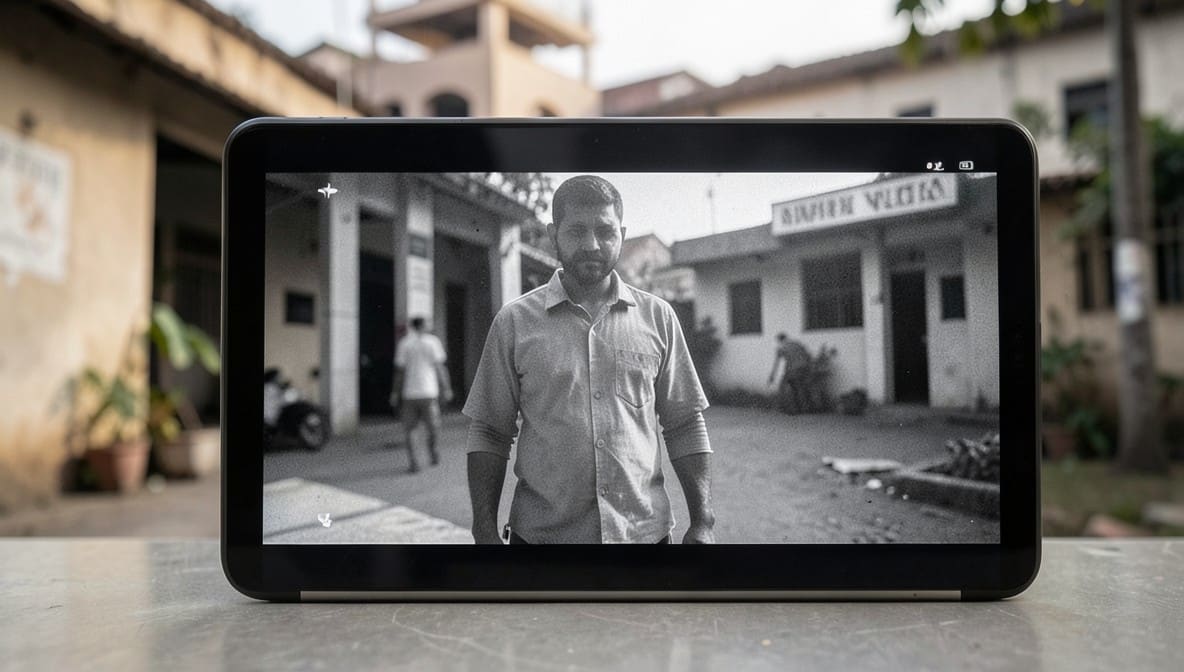
- The initial case diary recorded that CCTV footage showed Pawan armed with a country-made pistol.
- On 17.04.2026, the Investigating Officer appeared before the High Court in person and produced the actual CCTV footage, which clearly showed Pawan was not holding any firearm.
- The Investigating Officer conceded that the earlier entry in the case diary regarding the firearm was incorrect.
- The prosecution has not provided any explanation for Pawan’s own injuries, creating doubt over the prosecution’s narrative.
- Pawan Kumar has been in custody since 24.02.2026.
- The charge sheet has been filed, indicating the investigation is complete.
Procedural History
- 30.01.2026: Incident occurs.
- 31.01.2026: FIR lodged by Pawan Kumar.
- 07.02.2026: Kishan Pal’s application submitted to S.H.O. Babrala.
- 24.02.2026: Pawan Kumar arrested and taken into custody.
- 17.04.2026: Investigating Officer appears before High Court with CCTV footage.
- 24.04.2026: Judgment delivered by the High Court.
Relief Sought
Pawan Kumar seeks bail during the pendency of trial, arguing that:
- There is no incriminating material against him.
- The CCTV footage disproves the allegation of armed possession.
- Custodial interrogation is no longer required as the charge sheet is filed.
- He is a law-abiding citizen with no prior criminal record.
- He will not tamper with evidence or influence witnesses.
The Legal Issue
The central question was whether bail can be granted under the Arms Act when the prosecution’s key allegation - that the accused was armed - is directly refuted by objective CCTV evidence, and when custodial interrogation is no longer necessary after the filing of the charge sheet.
Arguments Presented
For the Appellant/Petitioner
Sri Ram Babu Sharma, counsel for the applicant, submitted that:
- The CCTV footage, verified by the Investigating Officer, conclusively shows Pawan was not armed with any firearm.
- The initial case diary entry was erroneous and cannot sustain the charge under Section 25/27 Arms Act.
- The prosecution has failed to explain Pawan’s own injuries, undermining the credibility of its version.
- The charge sheet has been filed, eliminating any need for custodial interrogation.
- Pawan has no criminal antecedents and has been in custody for over 30 days.
- He will fully cooperate with the trial and not interfere with witnesses.
- Reliance was placed on Kapil Wadhawan v. CBI (2025 SCC OnLine SC 3038) and Maya Tiwari v. State of U.P. (2024 SCC Online All 6765) for the principle that bail should be the rule, not the exception, especially where custody is not required.
For the Respondent/State
Learned counsel for the first informant and the Additional Government Advocate did not dispute the facts presented by the applicant. They opposed bail on general grounds of the seriousness of the offence under the Arms Act but offered no rebuttal to the CCTV evidence or the absence of custodial need.
The Court's Analysis
The Court conducted a meticulous review of the record, particularly focusing on the discrepancy between the case diary and the actual CCTV footage. The Court noted that the Investigating Officer himself appeared before the Court and confirmed that the earlier assertion - that Pawan was seen armed - was incorrect. This admission, the Court held, fundamentally undermines the prosecution’s case.
"The CCTV footage, produced in open court by the Investigating Officer, clearly shows that the applicant was not armed with any firearm. The earlier entry in the case diary is therefore unreliable and cannot form the basis for denying bail."
The Court emphasized that the filing of the charge sheet removes any justification for continued custody, as there is no longer a need for custodial interrogation. The Court also noted the absence of any explanation for the applicant’s own injuries, which further casts doubt on the prosecution’s version of events.
The Court applied the principles laid down in Kapil Wadhawan v. CBI, which reiterates that bail should be granted unless there are compelling reasons to deny it, and in Maya Tiwari v. State of U.P., which directs courts to consider overcrowded jails and the heavy pendency of cases as factors favoring bail.
The Court held that the nature of the offence, while serious, does not override the absence of incriminating evidence and the lack of custodial necessity. The applicant’s conduct, including his cooperation with the investigation and absence of prior criminal history, further supported the grant of bail.
The Verdict
The applicant, Pawan Kumar, was granted bail. He is directed to furnish a personal bond of Rs. 50,000 and two sureties each in the like amount, to the satisfaction of the trial court. He must comply with four conditions: (i) no intimidation or tampering with evidence; (ii) full cooperation in trial without seeking adjournments; (iii) no commission of any crime during bail; and (iv) attendance as per bond terms. The trial court must issue the release order through the Bail Order Management System (BOMS) and verify identity, Aadhaar, and mobile details of the applicant and sureties. The applicant may be released on a computer-generated copy of this order, with a certified copy to be filed within 15 days. The District Jail Moradabad must receive a copy of the order via e-prison portal within 24 hours.
What This Means For Similar Cases
CCTV Evidence Can Overturn Police Narratives
- Practitioners must insist on production of original CCTV footage in bail hearings where police reports allege possession of weapons.
- Any discrepancy between case diary entries and digital evidence must be brought to the court’s attention immediately.
- Courts are now more likely to reject speculative allegations unsupported by objective evidence.
Custodial Interrogation Ceases After Charge Sheet Filing
- Once the charge sheet is filed, the legal basis for continued custody under Section 167 CrPC is extinguished.
- Bail applications must highlight this point to counter prosecution arguments based on "ongoing investigation."
- Courts must treat post-charge sheet custody as prima facie unlawful unless exceptional circumstances exist.
Bail Is Not Denied Solely on Offence Severity
- The gravity of an offence under the Arms Act does not automatically justify denial of bail.
- Courts must weigh: (a) strength of evidence, (b) need for custody, (c) accused’s conduct, and (d) jail overcrowding.
- Kapil Wadhawan and Maya Tiwari now form a binding framework for bail decisions in non-violent or questionable Arms Act cases.
Procedural Compliance Is Mandatory
- Courts must verify identity, Aadhaar, and mobile details of accused and sureties before accepting bonds.
- Release orders must be transmitted via BOMS and e-prison portals within 24 hours to ensure timely liberty.
- Failure to comply with these directives may attract contempt proceedings.