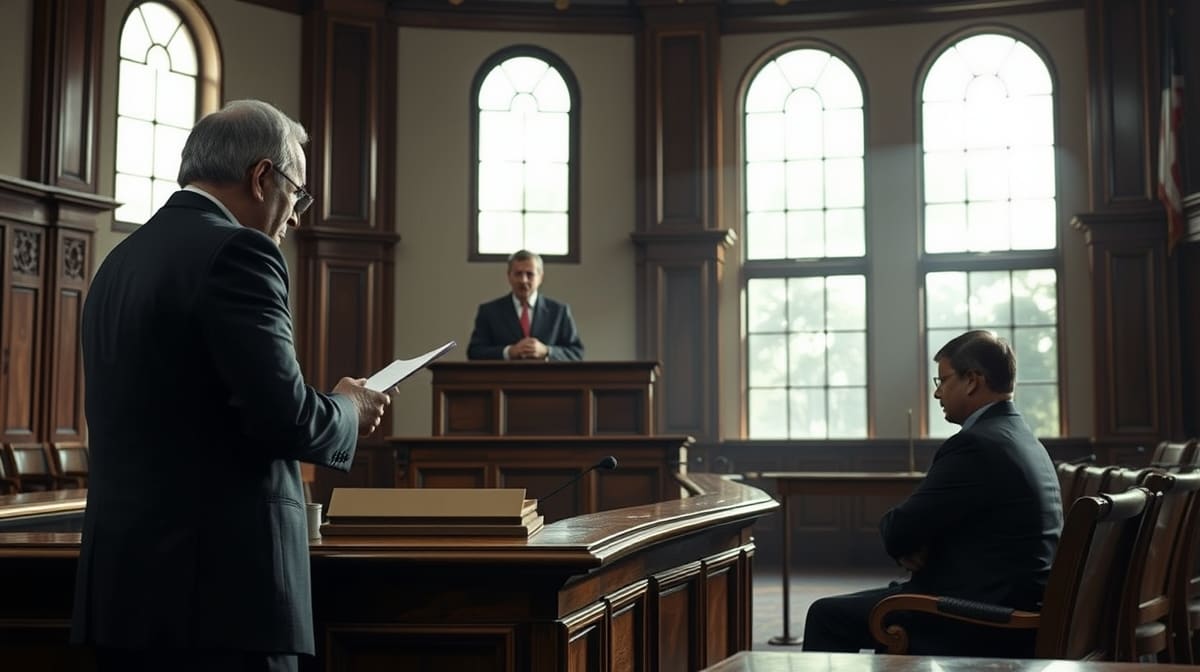
The Allahabad High Court has reaffirmed that the mere recovery of a weapon from an accused, without corroborative forensic or eyewitness evidence linking them to the crime, does not justify denial of bail. In a significant ruling, the Court emphasized that pre-trial detention must not be automatic even in serious offences, particularly where custodial interrogation is no longer required and the accused has no prior criminal record.
Background & Facts
The Dispute
The applicant, Israr @ Mota, is accused in Crime No. 4 of 2026 registered at Police Station Haldaur, District Bijnor, under Sections 103(1), 238, and 3(5) of the Bharatiya Nyaya Sanhita (BNS) and Sections 3, 25, and 27 of the Arms Act, 1959. The case arises from the alleged murder of a deceased individual by firearm. The prosecution claims that the co-accused, Mustafa, lured the deceased away from his home under false pretenses. Subsequently, the first informant learned of the death and suspected Mustafa and two others, including the applicant, of involvement.
Key Facts
- The postmortem report confirmed the deceased died from a single firearm injury.
- On the pointing out of co-accused Mustafa, a Santro car with blood stains on the seat was recovered.
- On the pointing out of the applicant, Israr @ Mota, a country-made 12-bore pistol was recovered.
- There is no eyewitness testimony placing the applicant in the company of the deceased at the time of the incident.
- No Forensic Science Laboratory (FSL) report has been produced establishing that the recovered pistol caused the fatal injury.
- The applicant submitted an affidavit disclosing a single prior criminal case, which he explained.
- The charge sheet has been filed, indicating the investigation is complete and no further custodial interrogation is required.
- The applicant has been in judicial custody since 07.01.2026.
Procedural History
- 07.01.2026: Applicant arrested and taken into custody.
- [Date unspecified]: Charge sheet filed in Crime No. 4 of 2026.
- 12.05.2026: Criminal Misc. Bail Application No. 15176 of 2026 filed before the Allahabad High Court.
- 12.05.2026: Hearing conducted before Hon’ble Justice Arun Kumar Singh Deshwal.
The Parties' Positions
Relief Sought
The applicant sought release on bail during the pendency of trial, arguing that his involvement is not substantiated by direct evidence, that custodial interrogation is unnecessary, and that his prolonged detention without trial violates his right to liberty.
The Legal Issue
The central question was whether the recovery of a country-made pistol from the applicant, without forensic confirmation of its use in the crime or any eyewitness testimony linking him to the incident, is sufficient to deny bail in a case under the BNS and Arms Act, particularly when the charge sheet has been filed and custodial interrogation is no longer required.
Arguments Presented
For the Appellant/Petitioner
Learned counsel for the applicant argued that the prosecution’s case rests on circumstantial evidence with critical gaps: no eyewitness places the applicant with the deceased; the recovered weapon has no FSL report linking it to the fatal injury; and the primary suspect, Mustafa, is the one whose disclosure led to the recovery of the vehicle with blood stains. The applicant has no history of violent crime, has cooperated with the investigation, and the charge sheet has been filed, eliminating any need for further custody. Reliance was placed on Kapil Wadhawan v. CBI and Maya Tiwari v. State of U.P. to underscore that bail should be the norm, not the exception, especially where the accused is not a flight risk or a threat to society.
For the Respondent/State
The learned A.G.A. and counsel for the first informant opposed bail, contending that the recovery of a firearm from the applicant under Section 27 of the Arms Act is a serious circumstance that militates against bail. They argued that possession of an illegal weapon in a homicide case raises grave concerns about public safety and the potential for witness tampering. However, they conceded that no eyewitness placed the applicant at the scene and that no FSL report connected the recovered pistol to the crime.
The Court's Analysis
The Court undertook a structured evaluation of the bail application under the principles laid down in Kapil Wadhawan v. CBI and Maya Tiwari v. State of U.P., emphasizing that bail is a fundamental right and not a privilege to be granted only when the prosecution’s case is weak. The Court noted that while the recovery of a firearm is a relevant factor, it cannot be the sole or decisive ground for denial of bail, particularly when the prosecution has failed to establish a direct link between the weapon and the offence.
"The recovery of a country-made pistol on the pointing out of the applicant, without any FSL report confirming its use in causing the fatal injury, cannot be treated as conclusive evidence of participation in the homicide."
The Court further observed that the absence of any eyewitness testimony placing the applicant with the deceased or the co-accused at the time of the incident significantly weakens the prosecution’s case against him. The Court also highlighted that the charge sheet has been filed, indicating the investigation is complete and custodial interrogation is no longer necessary. The Court acknowledged the applicant’s clean record apart from one prior case, his cooperation with authorities, and the fact that he has been in custody for over four months without trial.
The Court also took judicial notice of the overcrowding in jails and the pendency of criminal cases, noting that prolonged pre-trial detention without compelling justification violates the constitutional guarantee under Article 21. The Court concluded that the applicant does not pose a threat to witnesses or the investigation, and there is no material to suggest he will abscond.
The Verdict
The applicant, Israr @ Mota, was granted bail. He is directed to furnish a personal bond of Rs. 50,000 and two sureties each in the like amount, to the satisfaction of the trial court. The applicant must comply with all conditions: no contact with witnesses, no criminal activity, full cooperation in trial proceedings, and attendance as required. The trial court is directed to transmit the release order via the Bail Order Management System (BOMS) within 24 hours. The applicant may be released on the basis of a computer-generated copy of this order, with a certified copy to be filed within 15 days. The jail superintendent and court are directed to verify identity, Aadhaar, and mobile number of the applicant and sureties before release.
What This Means For Similar Cases
Recovery Alone Is Not Enough to Deny Bail
- Practitioners must argue that recovery of a weapon under Section 27 of the Arms Act, without forensic corroboration linking it to the crime, cannot be the sole basis for opposing bail.
- In cases under BNS and Arms Act, courts must distinguish between possession and participation.
- Absence of eyewitnesses or FSL reports must be highlighted as material factors favoring bail.
Custodial Interrogation No Longer a Ground for Denial After Charge Sheet
- Once the charge sheet is filed, the justification for continued custody under the pretext of investigation ceases to exist.
- Courts must apply the Kapil Wadhawan principle: bail should be granted unless there is a real risk of tampering, flight, or threat to public order.
- Delay in trial cannot be used to justify prolonged pre-trial detention.
Procedural Compliance Is Non-Negotiable
- Courts must ensure compliance with In Re: Suo Motu Writ Petition (Crl.) No. 4 of 2021: bail orders must be transmitted to jails via BOMS within 24 hours.
- Verification of Aadhaar and mobile numbers of accused and sureties is now mandatory for bail release.
- Certified copies of bail orders must be filed within 15 days; provisional release via computer-generated copies is valid.