The Bombay High Court has clarified that an arbitration clause in a main contract cannot be enforced against a subcontractor unless there is a specific, unambiguous reference to that clause in the subcontract. This ruling reinforces the principle that consent to arbitrate must be explicit, not inferred from general contractual references.
Background & Facts
The Dispute
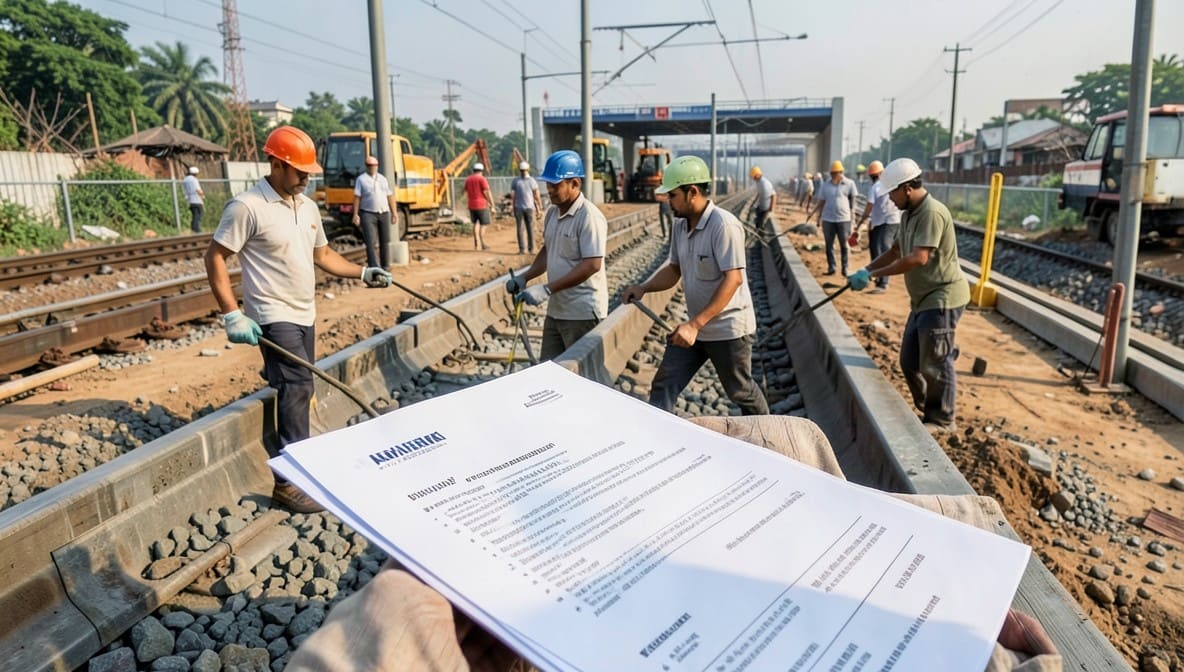
The dispute arose between Apurvakriti Infrastructure Private Limited (Applicant), a subcontractor, and Tata Projects Limited (Respondent No. 1), the main contractor, concerning non-payment of outstanding amounts under a Work Order dated 2 March 2015. The Applicant undertook the construction of ballastless track work for the Belapur-Pendhar corridor of the Navi Mumbai Metro Rail Project Line 1 (NMML1) at a contract value of Rs. 58,27,00,000. The main contract was awarded by the City and Industrial Development Corporation of Maharashtra Limited (CIDCO) to the AnTaCs consortium, of which Tata Projects Limited was a partner.
Key Facts
- The Applicant was engaged as a sub-contractor under a Work Order dated 2 March 2015 issued by Respondent No. 1.
- The Work Order incorporated by reference multiple documents, including CIDCO’s Tender No. C.A. No. 02/CIDCO/RP/SE (TP-III)/2012-13, its General Conditions of Contract (GCC), Special Conditions of Contract (SCC), technical specifications, drawings, and corrigenda.
- The GCC executed between CIDCO and Respondent No. 1 contained Clause 31.3, which provided for arbitration of disputes.
- The Work Order did not contain an independent arbitration clause.
- The Applicant issued a Demand Letter dated 8 May 2025 for outstanding payments.
- Upon non-payment, the Applicant issued a notice invoking arbitration under Clause 31.3 of the GCC on 26 September 2025.
- Respondent No. 1 did not respond to the second notice.
- The Applicant filed the present Commercial Arbitration Application under Section 11 of the Arbitration and Conciliation Act, 1996 on 23 February 2026.
Procedural History
- 02.03.2015: Work Order issued by Respondent No. 1 to Applicant.
- 04.12.2023: Work Completion Certificate issued by Respondent No. 1 to Applicant.
- 08.05.2025: First Demand Letter sent by Applicant.
- 06.08.2025: Respondent No. 1 replied, stating amicable settlement talks were ongoing.
- 26.09.2025: Second arbitration notice issued by Applicant invoking Clause 31.3 of GCC.
- 23.02.2026: Commercial Arbitration Application (No. 23 of 2026) filed before Bombay High Court.
- 12.06.2026: Arguments concluded; judgment reserved.
- 17.06.2026: Judgment pronounced.
Relief Sought
The Applicant sought appointment of an arbitrator under Section 11 of the Arbitration and Conciliation Act, 1996 to adjudicate the payment dispute, relying on the incorporation of Clause 31.3 of the GCC into the Work Order.
The Legal Issue
The central question was whether an arbitration clause in a main contract between CIDCO and Tata Projects Limited can be enforced against a subcontractor like the Applicant through a general reference to the main contract’s terms and conditions, without any specific mention of arbitration in the subcontract.
Arguments Presented
For the Appellant/Petitioner
The Applicant relied on M. R. Engineers and Contractors Pvt. Ltd. v. Som Datt Builders Ltd. (2009) 7 SCC 696 and Hirani Developers v. Nehru Nagar Samruddhi CHS Ltd. (2026 SCC Online SC 854) to argue that the Work Order’s explicit incorporation of CIDCO’s GCC, SCC, technical specifications, and tender documents constituted sufficient reference to incorporate the arbitration clause. It further cited Inox Wind Limited v. Thermocables Limited (2018) 2 SCC 519 to contend that general references to standard industry forms - such as CIDCO’s GCC - are sufficient for incorporation. The Applicant also invoked Ajay Madhusudan Patel v. Jyotindra S. Patel (2024) 9 S.C.R. 894 and ASF Buildtech v. Shapoorji Pallonji (2025 INSC 616) to argue that the existence of an arbitration agreement is a prima facie issue for the arbitral tribunal under Section 16, not the referral court.
For the Respondent/State
Respondent No. 1 contended that the Work Order contained no express or specific reference to Clause 31.3 of the GCC. It relied on NBCC v. Zillion Infra Projects (2024) 7 SCC 174 and Inox Wind Limited to argue that the present case fell under Category 3 of the two-contract scenario, where a specific reference to arbitration is mandatory. It emphasized that mere incorporation of technical and performance terms does not imply consent to arbitrate, especially when the subcontractor is not a signatory to the main contract. The Respondent further cited Dascon Sourav v. CLE Private Limited (2024 SCC OnLine Cal 3590) and Hindustan Petroleum v. BCL Secure Premises (2026) 3 SCC 711 to reinforce that arbitration is a matter of consent, not implication.
The Court's Analysis
The Court undertook a detailed examination of Section 7(5) of the Arbitration and Conciliation Act, 1996, and the Supreme Court’s jurisprudence on incorporation by reference. It held that while general references to a contract may incorporate performance-related terms, they are insufficient to incorporate an arbitration clause unless the reference is specific and intentional.
"The arbitration clause from another contract can be incorporated into the contract (where such reference is made), only by a specific reference to arbitration clause."
The Court observed that the Work Order’s incorporation of CIDCO’s GCC was limited to technical specifications, scope, and performance obligations. Clause 31.3 of the GCC, which provides for arbitration, was neither mentioned by number nor referenced in any provision of the Work Order. The Court distinguished this from cases involving standard industry forms (Category 1 under Inox Wind), noting that CIDCO’s GCC was not a generic industry standard but a bespoke government contract.
The Court further rejected the Applicant’s reliance on Ajay Madhusudan Patel and ASF Buildtech, holding that Section 16 jurisdiction applies only when a prima facie arbitration agreement exists. Since no such agreement was established between the parties, the referral court could not defer the issue to the tribunal. The Court emphasized:
"The absence of a specific reference to arbitration in the subcontract means there is no arbitration agreement between the parties. The tribunal cannot create jurisdiction where none exists by consent."
The Court concluded that the Applicant’s attempt to invoke arbitration through a general reference to the GCC was legally untenable under the settled principles of contract interpretation and the requirement of mutual consent under the Arbitration Act.
The Verdict
The Commercial Arbitration Application was dismissed. The Court held that no arbitration agreement existed between the Applicant and Respondent No. 1, as Clause 31.3 of the GCC was not specifically incorporated into the Work Order. The Applicant’s claim for appointment of an arbitrator under Section 11 was rejected. No costs were awarded.
What This Means For Similar Cases
Specific Reference to Arbitration Is Mandatory
- Practitioners must ensure that arbitration clauses from main contracts are explicitly referenced in subcontracts - by clause number, title, or specific language.
- General phrases like "terms and conditions of the main contract" or "as per CIDCO specifications" are insufficient to incorporate arbitration.
- Drafting checklists for subcontracts must include a standalone arbitration clause or a direct reference to the arbitration clause of the main contract.
Non-Signatories Cannot Be Forced Into Arbitration by Default
- Subcontractors who are not signatories to main contracts cannot be compelled to arbitrate unless they have expressly agreed to do so.
- Parties relying on incorporation by reference must demonstrate clear, unambiguous intent to include arbitration - not just performance terms.
- This ruling strengthens the principle that arbitration is consensual and cannot be inferred from commercial convenience.
Strategic Implications for Dispute Resolution Planning
- Contractors should include arbitration clauses in all subcontracts, even if the main contract contains one.
- Subcontractors should scrutinize all incorporated documents and seek explicit inclusion of dispute resolution mechanisms before signing.
- In litigation, parties opposing arbitration must challenge the specificity of reference early, as courts will not presume consent.