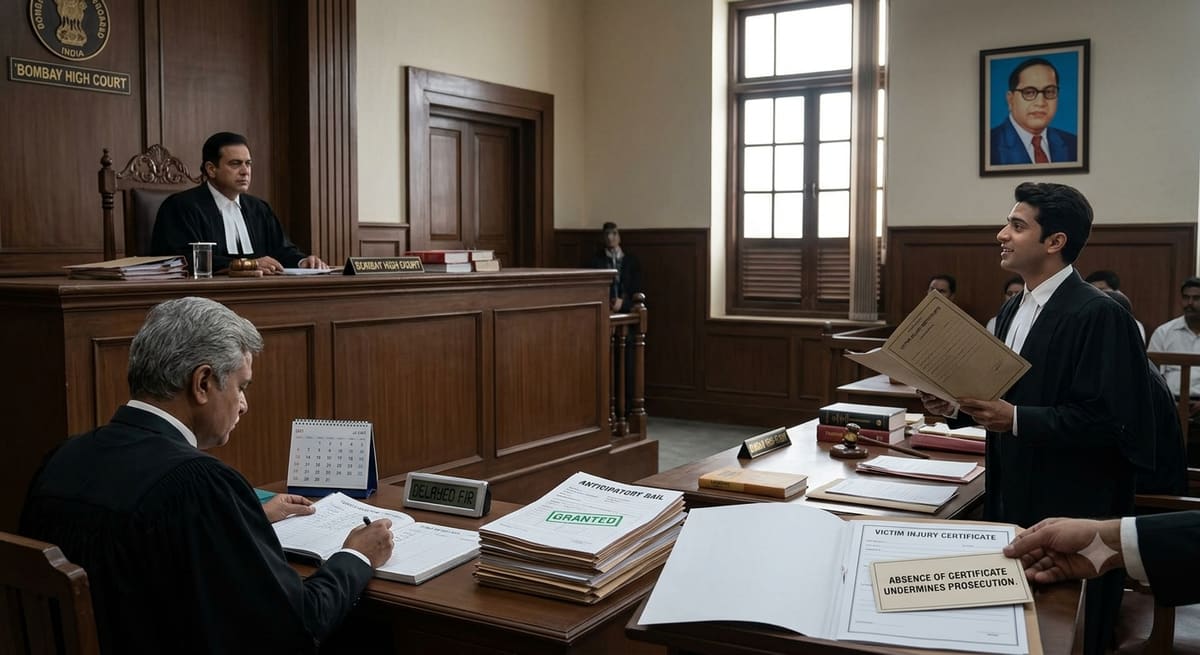
The Bombay High Court has reaffirmed that a voluntary affidavit from the victim denying any offence can decisively undermine the foundation for denying anticipatory bail, even where the accused has a prior criminal record. This ruling underscores the primacy of direct evidence over speculative concerns in bail jurisprudence.
Background & Facts
The Dispute
The applicant, Dhanraj Baliram Chate, seeks anticipatory bail in connection with Crime No. 224/2025 registered at Dharur Police Station, District Beed, under Sections 137(2), 140(2), and 3(5) of the Bharatiya Nyaya Sanhita, 2023. The prosecution alleges that the applicant and co-accused abducted Krushna, the victim, for ransom of Rs. 80,000.
Key Facts
- The First Information Report (FIR) was lodged by Krushna’s mother on 19.06.2025.
- Krushna, the alleged victim, filed an affidavit before the Sessions Court in Bail Application No. 145/2025 stating that no offence was committed by the applicant or co-accused.
- The affidavit explicitly attributed the FIR to a misconception on the part of his mother.
- The Sessions Court accepted the affidavit as voluntary but rejected the anticipatory bail application on the ground that a previous crime was pending against the applicant.
- The applicant has been cooperating with the investigation since being granted interim liberty on 22.07.2025 and has not misused the same.
Procedural History
- 19.06.2025: FIR registered at Dharur Police Station, District Beed.
- Before 22.07.2025: Applicant filed application for anticipatory bail before Sessions Court.
- 22.07.2025: Sessions Court granted interim liberty to the applicant pending final decision.
- 22.07.2025: Applicant appeared before police and fully cooperated in investigation.
- Date unspecified (prior to 16.06.2026): Sessions Court rejected anticipatory bail application, relying on pending prior case despite accepting victim’s affidavit.
- 16.06.2026: Present application filed before Bombay High Court, Aurangabad Bench.
The Parties' Positions
The applicant contends that the victim’s voluntary affidavit, accepted by the Sessions Court, negates the existence of any cognizable offence. He argues that the rejection of bail on the sole ground of a prior pending case is legally unsustainable when the very basis of the current allegation is withdrawn by the victim.
The State opposes the application, emphasizing the seriousness of the alleged offence under the Bharatiya Nyaya Sanhita and the potential for flight or tampering, despite the affidavit.
Relief Sought
The applicant seeks grant of anticipatory bail under Section 438 of the Code of Criminal Procedure, with conditions to ensure cooperation with investigation and non-interference with witnesses.
The Legal Issue
Can anticipatory bail be denied solely on the ground of a prior pending criminal case when the victim has filed a voluntary affidavit unequivocally denying the commission of the alleged offence?
Arguments Presented
For the Applicant
Learned counsel for the applicant relied on the Sessions Court’s own acceptance of the victim’s affidavit as voluntary. He argued that once the victim, the central witness to the alleged crime, states that no offence occurred, the prosecution’s case collapses at its inception. Citing Arnesh Kumar v. State of Bihar, he contended that courts must not mechanically deny bail based on the nature of the offence or prior history when the factual foundation is negated by direct evidence. The applicant’s consistent cooperation with investigation since 22.07.2025 further negated any risk of flight or tampering.
For the Respondent
The State argued that the gravity of the offence under Sections 137(2), 140(2), and 3(5) of the Bharatiya Nyaya Sanhita - relating to kidnapping and ransom - demands caution. It submitted that the victim’s affidavit may be influenced or coerced, and that the existence of a prior criminal case against the applicant justifies a restrictive approach to bail, irrespective of the affidavit.
The Court's Analysis
The Court observed that the Sessions Court had explicitly accepted the victim’s affidavit as voluntary. This acceptance is not a mere procedural formality but a judicial determination of credibility. The Court held that when the person who is the alleged victim of a crime states under oath that no offence was committed, the prosecution’s case loses its essential ingredient: the existence of a cognizable offence.
"Once the affidavit is accepted as voluntary, contents of the same cannot be ignored. Affidavit indicates that no offence has been committed by either present Applicant or the co-accused."
The Court rejected the notion that a prior pending case can serve as an independent ground to deny anticipatory bail when the current allegation is negated by the victim’s own testimony. It emphasized that bail jurisprudence must be grounded in the actual facts of the case, not in speculative or cumulative criminal history. The Court noted that the applicant had not misused the interim liberty granted on 22.07.2025 and had fully cooperated with the investigation, further reinforcing the absence of risk.
The Court distinguished cases where bail is denied due to the nature of the offence or prior conduct, noting that those principles apply only when the allegations themselves remain substantively unchallenged. Here, the allegations were directly and voluntarily repudiated by the victim.
The Verdict
The applicant succeeded. The High Court allowed the anticipatory bail application in terms of the interim order dated 22.07.2025, except for clause (ii) of the operative order, which was modified. The applicant is granted anticipatory bail for the offences under Sections 137(2), 140(2), and 3(5) of the Bharatiya Nyaya Sanhita, 2023, subject to the following conditions: he shall cooperate fully with the investigation, appear before the police as required, and not tamper with evidence or influence witnesses. The bail shall remain in force until the conclusion of the trial.
What This Means For Similar Cases
Victim’s Affidavit Can Defeat Prosecution’s Prima Facie Case
- Practitioners must immediately file and urge the acceptance of victim affidavits denying offence in anticipatory bail applications under Section 438 CrPC.
- Courts cannot treat such affidavits as irrelevant or secondary to the FIR; they are direct evidence that may negate the very foundation of the case.
Prior Criminal Record Cannot Override Direct Evidence of No Crime
- A history of prior offences cannot be used as a standalone ground to deny bail when the current allegation is withdrawn by the victim.
- The burden shifts to the prosecution to demonstrate why the victim’s affidavit is unreliable - mere suspicion is insufficient.
Cooperation with Investigation Strengthens Bail Claim
- Applicants who have voluntarily appeared before police and cooperated with investigation should highlight this conduct as evidence of non-fleeing intent.
- Courts must consider post-interim conduct as a factor in final bail decisions, not merely the initial allegations.