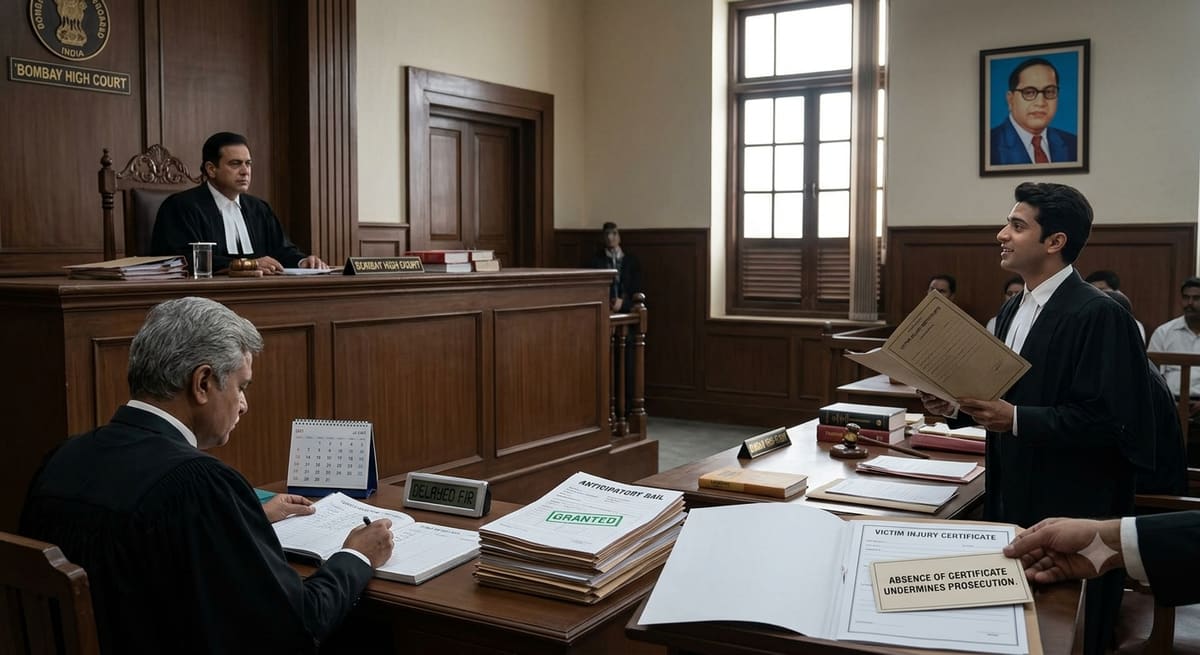
The Bombay High Court has reaffirmed that delay in filing an anticipatory bail application, by itself, cannot be a ground for denial if there is no evidence of mala fide intent or prejudice to the investigation. This clarification reinforces the constitutional right to personal liberty under Article 21 and aligns with established precedents on the liberal grant of anticipatory bail.
Background & Facts
The Dispute
The applicants in six consolidated anticipatory bail applications face allegations under Sections 420, 406, 34, and 120B of the Indian Penal Code, relating to alleged cheating and criminal breach of trust in commercial transactions. The allegations involve failure to deliver goods or refund advance payments after receiving funds from complainants. None of the applicants are accused of violence, weapon use, or threat to public order.
Procedural History
- December 2025: Applicants filed anticipatory bail applications before the Bombay High Court after arrest warrants were issued.
- 23 December 2025: The Court granted ad-interim protection to all applicants pending final hearing.
- 5 February 2026: The State opposed bail on grounds of delay in filing, citing that applications were filed weeks after FIRs were registered.
- The State did not allege any attempt to flee, tamper with evidence, or intimidate witnesses.
Relief Sought
The applicants seek permanent anticipatory bail under Section 438 of the Code of Criminal Procedure, arguing that the allegations are civil in nature, they are cooperative, and their arrest is unnecessary for investigation.
The Legal Issue
The central question was whether delay in filing an anticipatory bail application, without any showing of mala fide intent or prejudice to the investigation, can justify denial of relief under Section 438 CrPC.
Arguments Presented
For the Petitioner
The applicants relied on Arnesh Kumar v. State of Bihar and Sushil Sharma v. State of NCT of Delhi to argue that anticipatory bail is a constitutional safeguard under Article 21. They contended that delay alone, especially where the accused are not absconding and the investigation is not compromised, cannot override the presumption of innocence. They emphasized that the allegations involve commercial disputes, not heinous crimes, and that all applicants have consistently appeared before authorities.
For the Respondent
The State argued that the delay of several weeks in filing the applications indicated an attempt to evade arrest and undermined the integrity of the investigation. It cited State of Maharashtra v. Suresh to assert that courts must scrutinize delay as a factor indicating lack of urgency or possible collusion. However, the State did not produce any evidence of evidence tampering, witness intimidation, or risk of flight.
The Court's Analysis
The Court examined the purpose of Section 438 CrPC and held that its objective is to prevent arbitrary arrest, not to penalize delay. The Court distinguished between legitimate delay due to legal advice or procedural formalities and deliberate evasion. It noted that the State had not demonstrated any adverse impact on the investigation due to the delay.
"The mere fact that an application for anticipatory bail was filed after the registration of the FIR does not, by itself, justify denial of relief, particularly when the accused are not absconding and there is no allegation of tampering with evidence or influencing witnesses."
The Court emphasized that Section 438 must be interpreted liberally, consistent with the principles laid down in Gurbaksh Singh Sibbia v. State of Punjab. It rejected the notion that delay creates a presumption of guilt or mala fide. The Court further held that the nature of the allegations - non-violent, commercial in character - weighed heavily in favor of granting bail.
The Verdict
The applicants won. The Court held that delay in filing an anticipatory bail application cannot be a standalone ground for denial if there is no evidence of mala fide intent or prejudice to the investigation. The ad-interim protection granted on 23 December 2025 was made permanent.
What This Means For Similar Cases
Delay Alone Is Not a Bar to Anticipatory Bail
- Practitioners must argue that delay, without more, cannot override the presumption of innocence under Article 21
- Courts must examine the reason for delay and its actual impact on investigation, not treat it as a procedural default
- In commercial crime cases, delay is often due to negotiation or legal assessment, not evasion
Burden Shifts to the State to Show Prejudice
- The State must prove specific prejudice - such as destruction of evidence, witness intimidation, or risk of flight - to oppose bail on grounds of delay
- General assertions of "delay" without supporting facts are insufficient
- Courts should not allow procedural technicalities to override substantive liberty rights
Non-Violent Offences Favor Liberal Bail Granting
- Anticipatory bail is more readily available in cases involving economic offenses without elements of violence or public disorder
- The Court’s reasoning reinforces that Section 438 CrPC is not a privilege but a constitutional safeguard
- Lawyers should highlight the non-heinous nature of allegations and the accused’s cooperative conduct in all bail applications