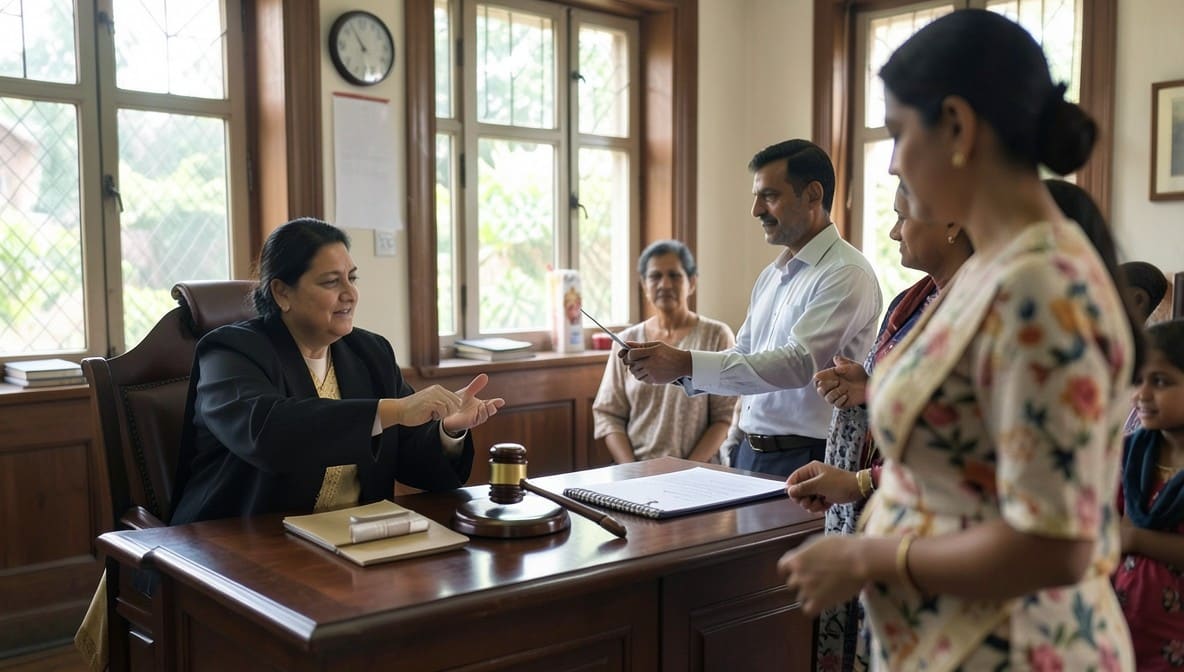
The Bombay High Court has clarified that procedural amendments to applications under the Protection of Women from Domestic Violence Act, 2005, to reflect changes in the status of the shared household or to add relatives as respondents are lawful when they serve the purpose of effective adjudication of domestic violence claims. This ruling reinforces the Act’s remedial character and limits appellate interference with trial court discretion on procedural matters.
Background & Facts
The Dispute
The petitioner, Surekha Keshav Kumbhar, sought a residence order under Section 19 of the Protection of Women from Domestic Violence Act, 2005 after being allegedly driven out of the matrimonial home. Her initial application lacked specific details about the shared household’s location and boundaries. After the trial court granted liberty to lead evidence on this relief, she filed applications to amend her petition to include these details and to add her husband’s nephew, Yogesh, as a respondent.
Procedural History
- 09.10.2024: Trial Court dismissed the residence application under Section 19 but granted liberty to both parties to lead evidence at final hearing.
- 21.11.2024: Respondent-husband executed a sale deed transferring the shared household to his nephew, Yogesh.
- 12.06.2025: Trial Court allowed amendment applications under Order 6 Rule 17 CPC to incorporate property details and add Yogesh as respondent.
- 03.12.2025: Appellate Court set aside the trial court’s order, holding that the amendments introduced a property dispute beyond the scope of the DV Act and were not maintainable under Section 29.
- 26.02.2026: Bombay High Court heard writ petitions challenging the appellate order.
Relief Sought
The petitioner sought quashing of the appellate order and restoration of the trial court’s order permitting amendment. She argued that the amendments were procedural, consequential, and necessary to substantiate her claim for residence under Section 19.
The Legal Issue
The central question was whether an application to amend a DV Act petition to include details of the shared household or to add a relative of the husband as respondent constitutes a substantive change that renders the appeal maintainable under Section 29, or whether it remains a purely procedural order immune from appellate challenge.
Arguments Presented
For the Petitioner
The petitioner relied on Abhijit Bhikaseth Auti v. State of Maharashtra to argue that appeals under Section 29 are not maintainable against procedural orders like amendments. She contended that the amendments merely clarified pleadings to align with evidence permitted under the trial court’s earlier order. She further cited Kunapareddy @ Nookala Shanka Balaji v. Kunapareddy Swarna Kumari to assert that denying amendment powers would defeat the DV Act’s remedial purpose. She emphasized that Yogesh, as a relative of the husband, falls within the definition of respondent under Section 2(q), and his inclusion was necessary to adjudicate the alleged fraudulent transfer.
For the Respondent
The respondent argued that the amendments introduced a property dispute outside the DV Act’s scope, invoking Satish Chandr Ahuja v. Sneha Ahuja to claim that the petitioner had an alternate remedy in civil court. He contended that the amendment violated Order II Rule 2 CPC by reviving a relinquished claim and breached the proviso to Order VI Rule 17 CPC by seeking amendment after trial commencement. He further asserted that Yogesh lacked a domestic relationship with the petitioner and thus could not be added as a respondent under Section 2(q).
The Court's Analysis
The Court examined the nature of the amendments and the scope of Section 29 and Section 26 of the DV Act. It held that the amendments were not substantive but consequential, aimed at enabling the petitioner to lead evidence on residence rights already permitted by the trial court’s order dated 09.10.2024.
"The amendment sought by the petitioner-wife was only giving details of the shared household in the main application, which she did not raise in the earlier application... Thus, to lead evidence regarding shared household... it was necessary to amend the main application as well as prayer clause."
The Court distinguished between adjudicating property rights and using property details to substantiate a domestic violence claim. It held that Section 26 explicitly permits concurrent remedies, and the existence of a civil suit does not bar proceedings under the DV Act. The Court further observed that Section 2(q) includes relatives of the husband as potential respondents, and the existence of a domestic relationship is a matter for evidence, not a threshold bar to joinder.
The Court reaffirmed the principle from Abhijit Bhikaseth Auti that appeals under Section 29 cannot lie against procedural orders such as amendments. It rejected the appellate court’s reasoning that the amendment transformed the DV proceeding into a property dispute, noting that the relief sought remained one of residence and protection, not ownership.
The Verdict
The petitioner won. The Bombay High Court quashed the appellate order and confirmed the trial court’s decision permitting amendment. The Court held that amendments to DV Act applications to incorporate factual details of the shared household or to add relatives as respondents are permissible if they are procedural, consequential, and do not alter the nature of the relief sought.
What This Means For Similar Cases
Amendments Are Procedural, Not Substantive
- Practitioners may now confidently seek amendments to DV applications to update property details, add relatives as respondents, or align pleadings with newly discovered facts.
- Such amendments cannot be challenged via appeal under Section 29 - only writ jurisdiction is available.
- Trial courts must be permitted to exercise discretion under Order VI Rule 17 CPC to ensure substantive justice.
Relatives Can Be Added as Respondents Under Section 2(q)
- The mere fact that a relative is not co-resident does not disqualify them as a respondent.
- The existence of a domestic relationship is a question of fact to be determined at trial, not a prerequisite for joinder.
- Adding a relative who has benefited from the alienation of shared household property is a legitimate step to ensure effective relief.
Concurrent Remedies Are Not Mutually Exclusive
- Filing a civil suit for property rights does not oust the jurisdiction of the DV Court.
- The DV Act’s purpose is protective, not proprietary; courts must not conflate the two.
- Petitioners may pursue both civil and DV remedies simultaneously without fear of being barred under Order II Rule 2 CPC.