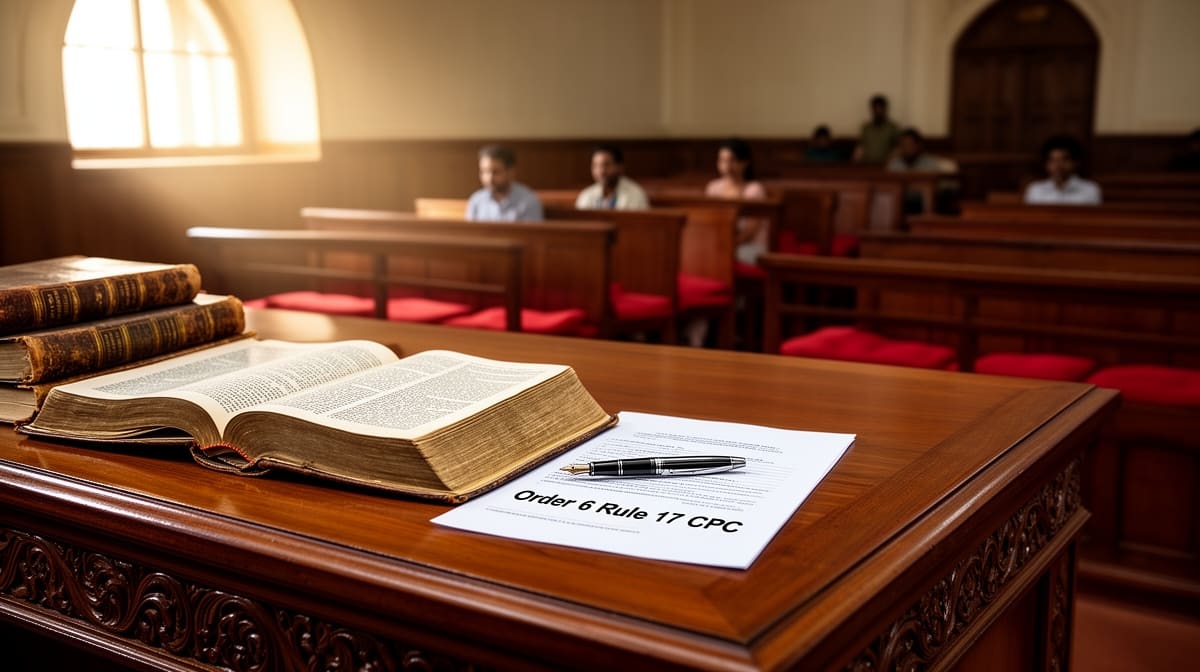
The Bombay High Court has reaffirmed that courts must adopt a liberal and justice-oriented approach when considering amendments to written statements under Order 6 Rule 17 of the Code of Civil Procedure, even where such amendments involve withdrawing prior admissions. This ruling clarifies a long-standing ambiguity in civil litigation practice and reinforces the principle that procedural technicalities must not override substantive justice.
Background & Facts
The Dispute
The petitioner, Shantabai, and the respondent, Vithal Malekar, are parties to a civil suit concerning title and possession of ancestral land in Parbhani. The respondent filed Regular Civil Suit No. 22 of 2011 seeking declaration, injunction, and recovery of possession. The petitioner filed a written statement along with a counterclaim (R.C.S. No. 344 of 2011), admitting certain facts regarding the plaintiff’s residence and ownership of the property.
Procedural History
- 2011: Respondent files civil suit; petitioner files written statement with counterclaim.
- 2013: Petitioner files application under Order 6 Rule 17 CPC seeking to amend the written statement by deleting admissions and withdrawing the counterclaim.
- 22 July 2013: Civil Judge Senior Division rejects the amendment application solely on the ground that the petitioner had made admissions in the original written statement.
- 2013: Petitioner files writ petition under Article 227 challenging the rejection order.
Relief Sought
The petitioner seeks quashing of the order rejecting the amendment and permission to amend the written statement by deleting admissions and withdrawing the counterclaim, arguing that such amendments are permissible under settled principles of civil procedure.
The Legal Issue
The central question was whether Order 6 Rule 17 of the CPC permits a party to amend a written statement to withdraw prior admissions, and whether such withdrawal automatically renders the amendment impermissible.
Arguments Presented
For the Petitioner
The petitioner’s counsel relied on Sushil Kumar Jain v. Manoj Kumar and landmark judgments including B.K. Narayana Pillai v. Parameswaran Pillai, Rajesh Kumar Aggarwal v. K.K. Modi, and Baldev Singh v. Manohar Singh. It was argued that amendments to written statements are governed by a more liberal standard than amendments to plaints, as prejudice to the opposite party is less likely. The court must not assess the merits of the proposed amendment at the stage of granting leave, and inconsistent pleas are permissible in written statements.
For the Respondent
The respondent contended that the proposed amendments sought to fundamentally alter the nature of the case by withdrawing vital admissions and introducing a new narrative. Relying on Heeralal v. Kalyan Mal, the respondent argued that withdrawal of admissions in partition suits is impermissible and that such amendments would cause prejudice and delay. The trial court’s rejection was justified as a safeguard against abuse of process.
The Court's Analysis
The Court undertook a comprehensive review of the jurisprudence on amendments under Order 6 Rule 17 CPC, distinguishing between amendments to plaints and written statements. It emphasized that while amendments to plaints require stricter scrutiny to prevent surprise and prejudice, amendments to written statements are inherently more flexible because they are defensive in nature.
"There has to be more liberal approach while permitting amendment to written statement. Though there are series of judgments, the few landmark that would be named viz. B.K. Narayana Pillai v. Parameswaran Pillai... courts are more liberal in permitting such amendments."
The Court held that the trial court erred in rejecting the application solely on the ground of prior admissions. It clarified that inconsistent pleas are permissible in written statements, and the court’s role at the amendment stage is not to determine the truth or falsity of the proposed content, but to assess whether the amendment would cause irreparable prejudice. The deletion of admissions does not equate to introducing a new cause of action; it merely refines the defence.
The Court further noted that the counterclaim, which was also sought to be withdrawn, was a separate pleading and its deletion did not affect the core issues in the suit. The trial court’s mechanical application of Heeralal was misplaced, as that case dealt with withdrawal of admissions in partition suits involving title, not general possession claims.
The Verdict
The petitioner succeeded. The Court held that Order 6 Rule 17 CPC permits amendment of written statements even to withdraw admissions, provided no irreparable prejudice is caused. The order rejecting the amendment was set aside, and the petitioner was granted leave to amend.
What This Means For Similar Cases
Withdrawal of Admissions Is Not Fatal to Amendment
- Practitioners may now confidently seek to amend written statements to retract earlier admissions without fear of automatic rejection.
- Courts must not treat admissions as immutable; the focus must shift to whether the amendment causes real prejudice, not whether it contradicts prior statements.
Inconsistent Defences Are Permissible
- Lawyers can now plead multiple, even contradictory, defences in written statements without violating procedural norms.
- This empowers litigants to adapt their defence as evidence emerges, aligning with the spirit of substantive justice over technical compliance.
Prejudice, Not Timing, Is the Key Test
- Delay in seeking amendment is not a ground for rejection unless actual prejudice is demonstrated.
- Courts must conduct a fact-specific inquiry into whether the opposite party will be unfairly disadvantaged - not merely whether the amendment is late or inconvenient.