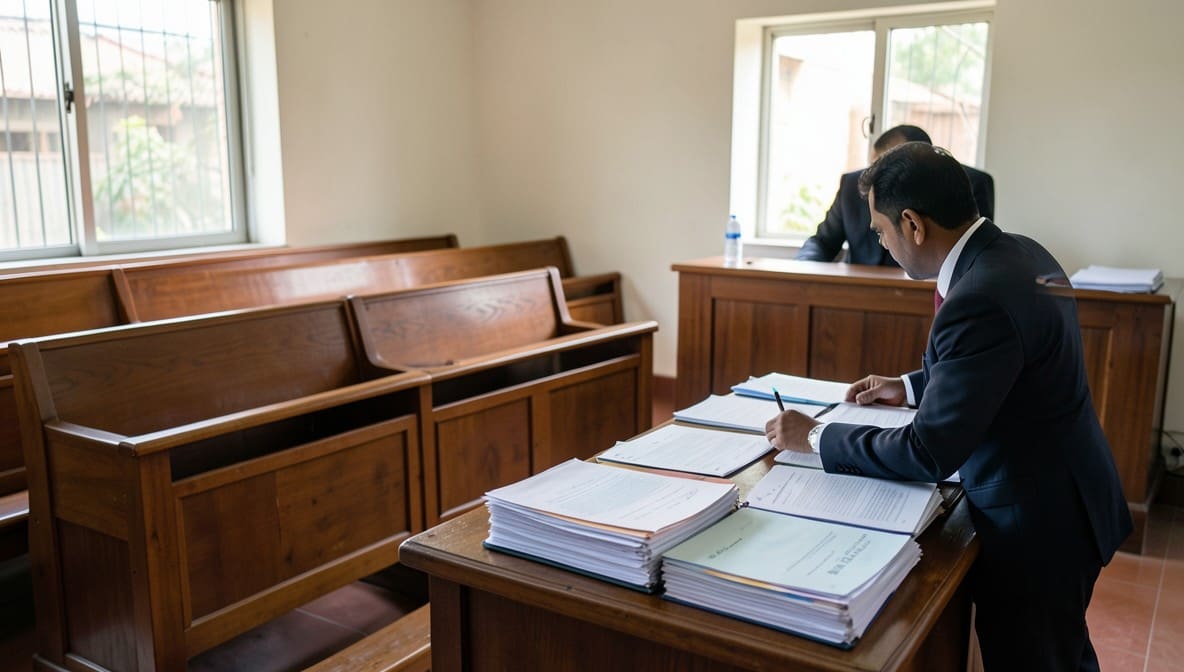
The Bombay High Court has reaffirmed that courts cannot permit amendments to pleadings after the commencement of trial unless the party demonstrates due diligence in failing to raise the matter earlier. This judgment clarifies the strict threshold imposed by the 2002 amendment to Order VI Rule 17 of the Code of Civil Procedure, reinforcing procedural discipline in civil litigation.
Background & Facts
The Dispute
The petitioners, seven agricultural landowners from Pategaon, Aurangabad, challenged the order dated 15.07.2015 passed by the Co-operative Court, Aurangabad, which rejected their application under Order VI Rule 17 of the Code of Civil Procedure (CPC) to amend their written statement in a dispute concerning ownership of land bearing Gut No. 154. The dispute arose between the petitioners and the respondent society, Saraswati Sahakari Gruh Nirman Sanstha, which claimed ownership over the same land based on a sale deed dated 04.11.1987 relating to Gut No. 153.
Key Facts
- The respondent society filed a dispute under Section 91 of the Maharashtra Co-operative Societies Act, 1960 in Case No. CCA-115 of 2009, seeking declaration of ownership and possession over land measuring 5 H 77 R.
- The petitioners, as respondents in the said dispute, initially filed a written statement on 05.02.2010, denying the society’s claim and asserting their own title based on a sale deed dated 25.07.2000 relating to Gut No. 154.
- The society adduced its evidence-in-chief on 24.10.2013.
- On 28.04.2015, the petitioners filed Application Exhibit-50 seeking to amend their written statement to introduce new factual contentions challenging the foundation of the society’s title.
- The proposed amendment sought to allege that the society’s claim over Gut No. 154 was baseless, lacking legal documentation, and that the society had improperly extended its claim beyond the land it had purchased.
- The petitioners claimed they had only recently discovered these facts, despite having been parties to the proceedings since 2009.
Procedural History
- 04.11.1987: Respondent society purchased land from Ramrao Panditrao Rawas via sale deed relating to Gut No. 153.
- 25.07.2000: Petitioners purchased land from Sakharam Satpute and Bajirao Gore via sale deed relating to Gut No. 154.
- 2009: Respondent society filed dispute under Section 91 of the Maharashtra Co-operative Societies Act, 1960 (Case No. CCA-115 of 2009).
- 05.02.2010: Petitioners filed written statement denying society’s claim.
- 24.10.2013: Respondent society completed its evidence-in-chief.
- 28.04.2015: Petitioners filed Application Exhibit-50 seeking amendment to written statement.
- 15.07.2015: Co-operative Court rejected the amendment application on grounds of lack of due diligence.
- 12.08.2015: Writ Petition No. 8179 of 2015 filed before Bombay High Court, Aurangabad Bench.
- 01.04.2026: Judgment reserved.
- 06.04.2026: Judgment pronounced.
The Parties' Positions
Petitioners: Argued that the amendment was necessary to expose the society’s claim as unfounded and to enable effective cross-examination. They claimed the new facts were only discovered after the society’s evidence was recorded and that no prejudice would arise from allowing the amendment.
Respondent Society: Contended that the petitioners had ample opportunity to raise these issues before trial commenced, had delayed for over five years, and failed to explain why the facts were not known earlier despite possession and documentation being in their control.
Relief Sought
The petitioners sought quashing of the Co-operative Court’s order dated 15.07.2015 and a direction to allow amendment of the written statement under Order VI Rule 17 CPC.
The Legal Issue
Can a party seek amendment to its pleadings after the commencement of trial under Order VI Rule 17 CPC without demonstrating due diligence in failing to raise the matter earlier?
Arguments Presented
For the Petitioner
The petitioners relied on the principle that amendments should be allowed to determine the real question in controversy between parties, citing Vidyabai v. Padmalatha and Chander Kanta Bansal v. Rajinder Singh Anand. They argued that the proposed amendment was not a change in cause of action but a clarification to rebut the society’s claim, which had only become apparent after the society’s evidence was recorded. They emphasized that no prejudice would result since the society had not yet closed its case.
For the Respondent
The respondent argued that the petitioners had been parties to the dispute since 2009, had access to all documents, and had filed a written statement in 2010 without raising these contentions. The delay of over five years, coupled with the absence of any explanation for the lapse, amounted to a clear failure of due diligence. The respondent cited Samuel v. Gattu Mahesh to argue that the omission was not a typographical error but a failure of substantive due diligence, which the law does not permit.
The Court's Analysis
The Court undertook a detailed examination of the legal framework governing amendments under Order VI Rule 17 CPC, particularly the proviso introduced in 2002, which imposes a strict condition: no amendment shall be allowed after the commencement of trial unless the party establishes that despite due diligence, the matter could not have been raised earlier.
"Due diligence means doing everything reasonable, not everything possible. It means such diligence as a prudent man would exercise in the conduct of his own affairs."
The Court noted that the petitioners’ application was conspicuously silent on why, despite having possession of the sale deed since 2000 and being parties to the dispute since 2009, they failed to raise the challenge to the society’s title until after the society had completed its evidence-in-chief in 2013. The Court rejected the argument that the facts were newly discovered, observing that the petitioners had been in possession of the land and the documents for over a decade.
The Court emphasized that the 2002 amendment was introduced to prevent tactical delays and surprise pleadings. It cited Samuel v. Gattu Mahesh to hold that mere ignorance or oversight does not constitute due diligence. The Court further noted that the petitioners had previously sought adjournments to cross-examine the society’s witnesses, indicating awareness of the issues but deliberate delay in raising them formally.
The Court concluded that the Co-operative Court’s rejection of the amendment was not only legally sound but also necessary to uphold procedural fairness. The burden of proving due diligence lies squarely on the party seeking amendment, and its absence is fatal to the application.
The Verdict
The writ petition was dismissed. The order dated 15.07.2015 of the Co-operative Court rejecting the amendment application under Order VI Rule 17 CPC was upheld. The rule was discharged, and Civil Application No. 8979 of 2018 was disposed of. No costs were awarded.
What This Means For Similar Cases
Due Diligence Is Not Optional
- Practitioners must document and articulate specific reasons why a factual or legal point could not have been raised before trial, even if the matter seems obvious in hindsight.
- Mere assertion of "new discovery" without supporting evidence of prior efforts to investigate or consult documents will not satisfy the due diligence test.
- Courts will not permit amendments that appear tactical or delayed, especially when the party had access to the relevant facts for years.
Post-Trial Amendments Are Exceptional
- Amendments after evidence-in-chief are now treated as the exception, not the rule.
- Any application under Order VI Rule 17 CPC filed after trial begins must include a sworn affidavit detailing the steps taken to identify the issue earlier and why it was overlooked despite reasonable care.
- Failure to meet this threshold will result in automatic dismissal, regardless of the merits of the proposed amendment.
Strategic Implications for Litigation
- Counsel must conduct comprehensive pre-trial reviews of pleadings and evidence to avoid last-minute amendments.
- In co-operative disputes and land matters, where title documents are central, early legal review is critical to avoid procedural disqualification.
- The judgment reinforces that procedural compliance is not a technicality - it is a substantive requirement for access to judicial relief.