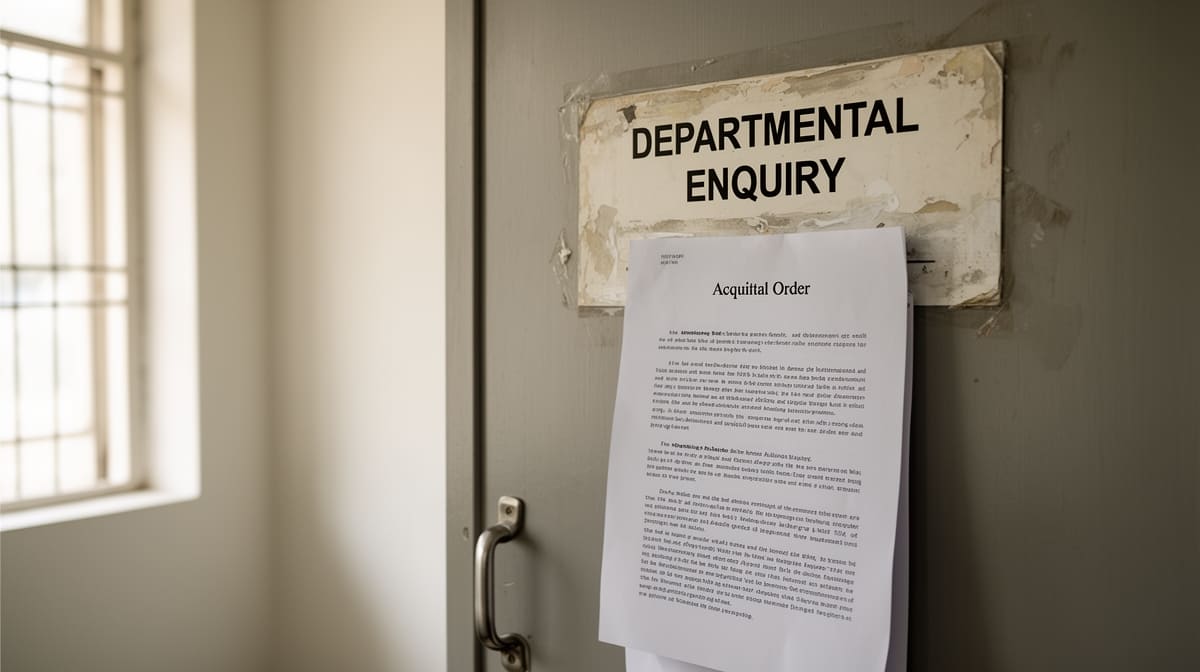
The Telangana High Court has held that imposing a pension penalty after a criminal acquittal on identical facts violates the principles of natural justice and equality under Article 14 of the Constitution. The judgment reinforces that departmental proceedings cannot proceed on the same allegations once a court has found the accused not guilty beyond reasonable doubt.
Background & Facts
The Dispute
The petitioner, Shaik Sarwar Pasha, a retired Inspector of Police, was implicated in a criminal case arising from the accidental discharge of his service revolver during a scuffle, resulting in the death of Sri Muvvala Tulasidas, a businessman, on 10.12.2001. The incident occurred in Khammam district. A criminal case was registered under Section 304-A IPC as Crime No. 175/2001. The petitioner was convicted by the II Additional Judicial Magistrate of First Class, Khammam, on 26.08.2009, and sentenced to six months rigorous imprisonment and a fine of Rs. 1,000/-. He appealed to the Principal Sessions Judge, Khammam.
Key Facts
- The petitioner was serving as Inspector of Police, Town Circle, Khammam, at the time of the incident on 10.12.2001.
- A departmental inquiry was initiated under Rule 20 of the Andhra Pradesh Civil Services (CC&A) Rules, 1991, on 10.12.2001.
- The Enquiry Officer, Additional Superintendent of Police (Administration), Warangal Rural, conducted an oral inquiry and submitted a report on 30.10.2010, holding the charge of gross dereliction of duty as proved.
- The petitioner retired on superannuation on 30.11.2004, while the departmental proceedings were still pending.
- The criminal appeal (Crl. Appeal No. 93 of 2009) was heard by the Principal Sessions Judge, Khammam, and on 08.10.2010, the conviction was set aside and the petitioner was acquitted on merits. The court held that the death was purely accidental, with no rash or negligent conduct on the petitioner’s part.
- On 01.08.2011, the Government issued a Show-Cause Notice (G.O. Memo No. 13744/Sec.I/A2/2011-1) proposing to withhold 50% of the petitioner’s pension for five years under Rule 9 of the Andhra Pradesh Revised Pension Rules, 1980.
- The petitioner submitted a detailed explanation on 22.09.2011, arguing that the acquittal in the criminal case rendered the disciplinary charge unsustainable.
- On 25.01.2012, the Government issued G.O.Ms. No. 12, Home (Services-I), imposing the penalty of withholding 50% of pension for five years.
- On 15.02.2012, the 3rd Respondent issued consequential orders (C.No.01/PR/2012, R.O.No.82/2012) implementing the penalty.
- On 18.07.2014, an amount of Rs. 3,00,000/-, paid as compensation to the deceased’s legal heirs, was recovered from the petitioner’s pensionary benefits via Memo No. 1498/L&O-1/A2/2003-2.
- The petitioner filed multiple representations between 2012 and 2021 seeking reversal of the penalty and recovery, all of which were ignored.
Procedural History
- 10.12.2001: Incident leading to criminal case and initiation of departmental proceedings.
- 26.08.2009: Conviction by II Additional Judicial Magistrate, Khammam.
- 08.10.2010: Acquittal by Principal Sessions Judge, Khammam, in Crl. Appeal No. 93 of 2009.
- 01.08.2011: Show-Cause Notice issued by Government.
- 22.09.2011: Petitioner submitted detailed explanation.
- 25.01.2012: G.O.Ms. No. 12 imposing 50% pension withholding for five years.
- 15.02.2012: Consequential orders issued by 3rd Respondent.
- 18.07.2014: Recovery of Rs. 3,00,000/- from pension.
- 2021: Writ Petition No. 13970 of 2023 filed before the Telangana High Court.
- 20.01.2026: Judgment delivered by the High Court.
The Parties' Positions
Petitioner: Argued that the criminal acquittal on merits rendered the disciplinary charge legally unsustainable. The penalty was imposed after retirement, without considering his explanation, and violated Article 14, 19, and 21. He sought setting aside of the penalty, refund of Rs. 3,00,000/-, and promotion on notional basis.
Respondents: Contended that departmental and criminal proceedings operate independently. The standard of proof differs, and the penalty was imposed after due process. They also raised the plea of delay and laches, noting the petition was filed in 2023 despite the order being passed in 2012.
Relief Sought
The petitioner sought:
- Setting aside of G.O.Ms. No. 12 dated 25.01.2012 and consequential orders dated 15.02.2012.
- Refund of Rs. 3,00,000/- recovered from pension.
- Declaration that the period of suspension (07.07.2001 to 30.11.2004) be treated as on-duty.
- Promotion to Deputy Superintendent of Police on notional basis from the date of eligibility.
- Recalculation of pension with interest.
The Legal Issue
Can a disciplinary authority impose a penalty of withholding pension under Rule 9 of the Andhra Pradesh Revised Pension Rules, 1980, based on charges that were the subject of a criminal case in which the public servant was acquitted on merits, without reconsidering the matter in light of the acquittal?
Arguments Presented
For the Petitioner
The petitioner’s counsel relied on G.M. Tank v. State of Gujarat (2006) 5 SCC 446, Paul v. State of Kerala (1999) 3 SCC 679, and Sunil Kumar Rai v. State of Bihar (2022) SCC Online SC 232. He argued that when the same facts, evidence, and witnesses form the basis of both criminal and departmental proceedings, and the criminal court acquits the accused after a full trial, the departmental charge collapses. The acquittal was not on technical grounds but on merits - the court found no rash or negligent conduct. The penalty order was passed mechanically, without addressing the petitioner’s explanation dated 22.09.2011, violating principles of natural justice. The delay in filing the writ petition was excusable as the petitioner had continuously pursued redressal through representations.
For the Respondent
The learned Assistant Government Pleader contended that departmental proceedings are not bound by the outcome of criminal trials, as the standard of proof differs - preponderance of probability versus beyond reasonable doubt. The Government had considered the explanation and followed due procedure. The penalty was imposed in the interest of administrative discipline. The delay of over a decade in approaching the Court was fatal, and the writ petition was barred by laches.
The Court's Analysis
The Court undertook a detailed review of the legal principles governing the interplay between criminal acquittals and departmental proceedings. It emphasized that while departmental inquiries are not bound by criminal court findings, they cannot ignore them when the charges are identical and the acquittal is on merits.
"The judicial pronouncement was made after a regular trial and on hot contest. Under these circumstances, it would be unjust and rather oppressive to allow the findings recorded in the departmental proceedings to stand."
The Court cited G.M. Tank to hold that when the charges, evidence, and witnesses in both proceedings are identical, and the criminal court acquits the accused after a full trial, the departmental charge is rendered unsustainable. The acquittal in this case was not on technical grounds but on substantive findings - the court explicitly held that the death was accidental and the petitioner did not act rashly or negligently.
The Court further relied on Sunil Kumar Rai, which clarified that expressions like "honourably acquitted" are not magic words; the substance of the judgment matters. Here, the Sessions Judge had concluded that the prosecution failed to prove the charge beyond reasonable doubt, effectively disproving the allegation of negligence.
The Court also noted that the impugned order dated 25.01.2012 was devoid of reasons. It did not mention the petitioner’s explanation dated 22.09.2011, nor did it engage with the acquittal verdict. This amounted to non-application of mind and violated Article 14 and natural justice.
Regarding the plea of delay, the Court held that where fundamental rights are at stake - particularly the right to livelihood and equality - delay alone cannot be a ground to deny relief. The petitioner had filed multiple representations between 2012 and 2021, demonstrating continuous pursuit of redressal. The Court cited Olga Tellis v. Bombay Municipal Corporation and Assam Mandal v. Union of India to affirm that fundamental rights cannot be extinguished by laches.
The Court also observed that the penalty was imposed after retirement, which further weakened the administrative necessity of the action. The recovery of Rs. 3,00,000/- was directly linked to the impugned penalty and thus could not stand.
The Verdict
The writ petition was allowed. The Court set aside G.O.Ms. No. 12 dated 25.01.2012 and the consequential orders dated 15.02.2012. The recovery of Rs. 3,00,000/- from the petitioner’s pension was ordered to be refunded. The matter was remitted to the 1st Respondent for fresh consideration of the disciplinary proceedings, with full opportunity to the petitioner to present his case, including his explanation dated 22.09.2011. The 1st Respondent was directed to pass a fresh order within four weeks, in conformity with the judgments of the Supreme Court and this Court. There shall be no order as to costs.
What This Means For Similar Cases
Acquittal on Merits Nullifies Departmental Charges
- Where criminal acquittal is based on substantive findings - not technicalities - and the charges are identical, departmental proceedings cannot proceed on the same allegations.
- Practitioners must argue that the acquittal, if on merits, constitutes a conclusive finding that the alleged misconduct did not occur.
- The burden shifts to the disciplinary authority to demonstrate a material difference in facts or evidence if it seeks to proceed.
Non-Application of Mind Invalidates Orders
- Orders that mechanically impose penalties without addressing the petitioner’s explanation or the criminal acquittal are void for non-application of mind.
- Any order that fails to engage with the substance of the acquittal violates Article 14 and natural justice.
- Practitioners should challenge such orders on grounds of arbitrariness and procedural illegality.
Delay Cannot Bar Fundamental Rights Claims
- Delay in filing writ petitions under Article 226 will not be a bar where the violation involves fundamental rights to livelihood, equality, and personal liberty.
- Continuous representations to authorities can negate the plea of laches.
- Courts will not allow procedural technicalities to defeat substantive justice in service matters.