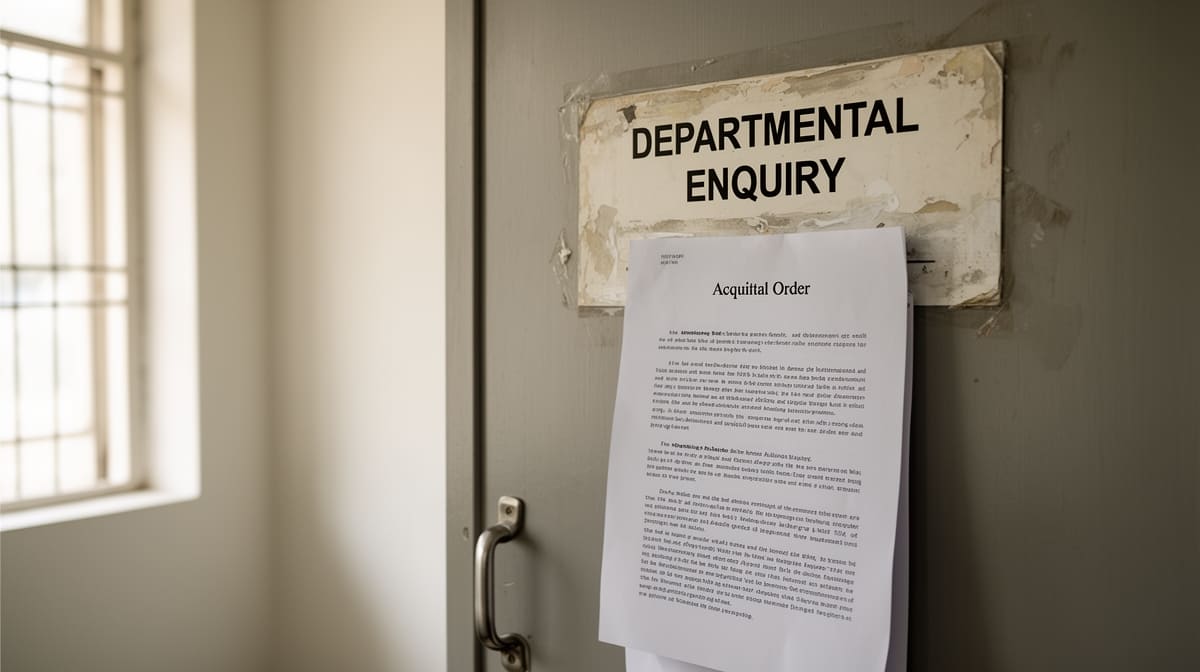
The Madhya Pradesh High Court has held that an administrative order setting aside property mutation on allegations of a forged will cannot stand after the petitioner’s criminal acquittal on the same issue. The judgment underscores the principle that administrative authorities must reconsider their findings in light of a judicial determination of innocence, particularly where the core allegation - forgery - is judicially negated.
Background & Facts
The Dispute
The dispute arose from a property mutation application filed by the private respondent before the Collector, Sagar, under Section 323 of the M.P. Municipalities Act, 1961. The private respondent alleged that the petitioner, Santosh Kumar Soni, obtained mutation of property records in his name through a forged Will, thereby unlawfully displacing the private respondent’s claim to the property.
Key Facts
- The petitioner and private respondent were claimants to immovable property situated in Garhakota, District Sagar.
- A Will dated 10.04.2008 was produced by the petitioner to claim succession rights.
- Mutation of the property in the petitioner’s name was recorded by the Municipal Council, Garhakota, on the basis of this Will.
- The private respondent challenged the mutation by filing an application under Section 323 of the M.P. Municipalities Act, 1961, on 12.07.2010.
- The Collector, Sagar, passed an order dated 16.09.2010, setting aside the mutation and declaring the Will to be forged.
- The Collector also directed initiation of criminal prosecution against the petitioner for forgery and fraud.
- Criminal proceedings were initiated, and the petitioner was tried before the II Additional Sessions Judge, Rehli, District Sagar.
- The trial court delivered a judgment dated 02.11.2022, acquitting the petitioner on the ground that the prosecution failed to prove beyond reasonable doubt that the Will was forged.
- The State Government, acting as appellate authority, upheld the Collector’s order dated 16.09.2010 by its order dated 15.12.2010.
- The petitioner filed the present writ petition on 20.12.2011, challenging the administrative orders.
Procedural History
- 10.04.2008: Will allegedly executed and submitted for mutation.
- 12.07.2010: Private respondent files application under Section 323 of the M.P. Municipalities Act, 1961.
- 16.09.2010: Collector sets aside mutation and declares Will forged; directs prosecution.
- 15.12.2010: State Government upholds Collector’s order on appeal.
- 02.11.2022: Trial Court acquits petitioner in criminal case for forgery, holding prosecution failed to prove forgery.
- 20.12.2011: Writ petition filed before the High Court.
- 23.06.2026: Judgment delivered by the High Court.
Relief Sought
The petitioner sought quashing of the Collector’s order dated 16.09.2010 and the State Government’s order dated 15.12.2010, and a direction to reconsider the mutation proceedings afresh in light of the acquittal.
The Legal Issue
The central question was whether an administrative order based on a finding of forgery can remain valid after the same allegation has been judicially negated by a criminal court’s acquittal, where the prosecution failed to prove the forgery beyond reasonable doubt.
Arguments Presented
For the Petitioner
The counsel argued that the criminal acquittal on the ground of insufficient proof of forgery rendered the administrative finding of forgery legally untenable. The acquittal, the counsel submitted, was not merely a failure of prosecution but a judicial determination that the Will was not proven to be forged. Reliance was placed on the principle that administrative authorities cannot hold a person guilty on the basis of allegations that a court of law has found unproven. The petitioner emphasized that the Collector’s order was based on the same evidence and allegations that were rejected in the criminal trial.
For the Respondent
The State did not dispute the acquittal or challenge the factual basis of the trial court’s judgment. The counsel for the State conceded that the acquittal had occurred but argued that the administrative order stood on independent grounds under the M.P. Municipalities Act and that the Collector’s findings were not bound by the criminal court’s verdict. However, no substantive legal argument was advanced to defend the continued validity of the order in light of the acquittal.
The Court's Analysis
The Court observed that the Collector’s order dated 16.09.2010 was premised entirely on the conclusion that the Will was forged. This finding formed the basis for both the setting aside of the mutation and the direction for criminal prosecution. The subsequent acquittal by the trial court, which explicitly held that the prosecution failed to prove forgery beyond reasonable doubt, fundamentally undermined the factual foundation of the administrative order.
"The criminal court, after a full-fledged trial, has acquitted the petitioner on the ground that the prosecution failed to prove the Will to be forged. This judicial determination cannot be ignored by the administrative authority."
The Court emphasized that while administrative proceedings and criminal trials operate under different standards of proof, the acquittal in a criminal case involving the same factual allegations - particularly one where the burden of proof is highest - must be treated as a decisive event that renders the prior administrative finding legally unsustainable. The Court held that the Collector’s order, being based on a finding of forgery that has now been judicially negated, cannot stand.
The Court further noted that the State Government, as appellate authority, had merely affirmed the Collector’s order without independently examining the impact of the acquittal. This failure to reassess the administrative decision in light of the criminal outcome amounted to a violation of the principles of natural justice and fair administrative action.
The Verdict
The writ petition was allowed. The Collector’s order dated 16.09.2010 and the State Government’s order dated 15.12.2010 were quashed. The matter was remitted to the Collector, Sagar, with a direction to reconsider the mutation dispute afresh within 90 days of production of the certified copy of this order. The Collector was directed to afford a fair hearing to both the petitioner and the private respondent and to take a decision strictly in accordance with law, without being bound by the earlier finding of forgery.
What This Means For Similar Cases
Administrative Orders Cannot Ignore Criminal Acquittals
- Practitioners must raise acquittal in criminal proceedings as a ground to challenge administrative findings based on the same allegations.
- Where a criminal court acquits on grounds of insufficient proof, the administrative authority cannot rely on the same evidence to sustain a finding of guilt.
Burden of Proof Matters Across Forums
- While administrative proceedings use a preponderance standard, a criminal acquittal based on failure to prove beyond reasonable doubt signals that the evidence is legally inadequate.
- Administrative authorities must reassess their findings when new judicial determinations contradict their prior conclusions.
Procedural Fairness Requires Reconsideration
- Merely affirming an earlier order without considering a subsequent acquittal violates principles of natural justice.
- Remand for fresh consideration is the appropriate remedy when an administrative decision is rendered legally untenable by a judicial outcome.