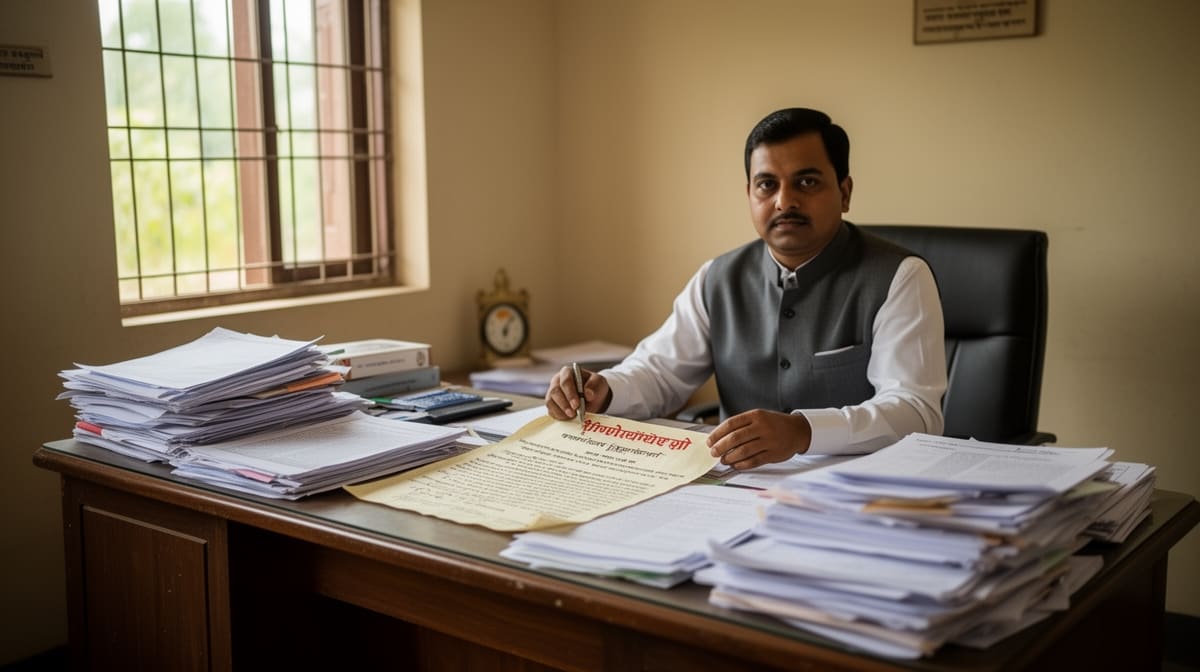
The Madhya Pradesh High Court has clarified that revenue authorities cannot adjudicate disputed claims of death occurring prior to consent recorded in land mutation proceedings. This ruling reinforces the principle that questions of fact involving death, testamentary intent, or fraud in land records must be resolved by civil courts, not administrative tribunals.
Background & Facts
The Dispute
The petitioners, Umrao Singh and others, challenged the order dated 13.01.2026 passed by the Additional Commissioner, which set aside the order of the SDO dated 12.11.2025 and upheld the Tehsildar’s order dated 28.06.2024. The dispute centered on the mutation of agricultural land in favor of the respondents, Rajpal Singh Thakur and others, based on an order dated 06.01.1992 passed by the Assistant Settlement Officer. The respondents claimed this order was passed with the consent of the petitioners’ father, Mahum Singh.
Key Facts
- The petitioners’ father, Mahum Singh, allegedly died in the year 1990.
- The respondents produced an order dated 06.01.1992, purportedly passed with the consent of Mahum Singh.
- The consent was allegedly recorded on 10.10.1991.
- The respondents filed a consequential application for mutation in 2024 - 32 years after the alleged order.
- The petitioners objected to the mutation, asserting that Mahum Singh had died in 1990 and could not have given consent in 1991.
- No documentary evidence of Mahum Singh’s death was produced by either party.
- The Tehsildar accepted the respondents’ application, holding that the petitioners failed to prove death by documentary evidence.
- The SDO set aside the Tehsildar’s order, observing that the 1992 order was likely passed without jurisdiction and that the consent appeared fabricated.
- The Additional Commissioner reversed the SDO’s order, acknowledging consent was recorded on 10.10.1991 but deliberately avoided addressing whether Mahum Singh was alive at that time.
Procedural History
- 10.10.1991: Alleged consent recorded by Assistant Settlement Officer.
- 06.01.1992: Order passed by Assistant Settlement Officer in favor of respondents.
- 1990: Alleged death of Mahum Singh, petitioners’ father.
- 2024: Respondents filed application for mutation based on the 1992 order.
- 28.06.2024: Tehsildar ordered mutation in favor of respondents.
- 12.11.2025: SDO set aside the Tehsildar’s order, calling the 1992 order suspicious and without jurisdiction.
- 13.01.2026: Additional Commissioner set aside the SDO’s order and restored the Tehsildar’s mutation order.
- 24.03.2026: Present writ petition filed before the High Court of Madhya Pradesh at Jabalpur.
Relief Sought
The petitioners sought quashing of the Additional Commissioner’s order dated 13.01.2026, restoration of the SDO’s order dated 12.11.2025, and a direction that the dispute over the father’s death and consent be referred to a civil court.
The Legal Issue
The central question was whether a revenue authority, under the Madhya Pradesh Land Revenue Code, has jurisdiction to determine whether a person was alive at the time consent was recorded for mutation, when that person’s death is alleged to have occurred decades earlier and no documentary proof exists.
Arguments Presented
For the Petitioner
The petitioners contended that the 1992 order was a nullity because Mahum Singh had died in 1990, making any consent recorded in 1991 impossible. They argued that the respondents’ delayed filing of the mutation application after 32 years raised a strong presumption of fraud on the revenue system. They relied on the principle that revenue authorities are not equipped to investigate historical facts involving death, especially where no death certificate or other documentary proof is available.
For the Respondent
The respondents argued that the petitioners failed to produce any documentary evidence of Mahum Singh’s death in 1990, and therefore, the presumption of life stood. They maintained that the 1992 order was valid and binding, and the mutation was a mere procedural consequence. They contended that the revenue authorities had the power to decide such disputes under the MPLR Code and that the petitioners’ delay in raising the objection was fatal.
The Court's Analysis
The Court observed that the entire dispute hinged on a factual controversy: whether Mahum Singh was alive on 10.10.1991 when consent was allegedly recorded. The Additional Commissioner, despite acknowledging this as the crux of the matter, deliberately avoided examining it, thereby committing a jurisdictional error.
"The Additional Commissioner has avoided to go into that controversy, which was the crux of the entire matter."
The Court emphasized that revenue courts are administrative bodies with limited jurisdiction, primarily concerned with updating land records based on undisputed facts. They are not judicial forums equipped to conduct evidentiary hearings into events occurring 35 years ago, particularly where the issue involves the death of a person and the authenticity of consent.
The Court relied on Section 111 of the Madhya Pradesh Land Revenue Code, which explicitly states that the jurisdiction of revenue courts in matters of mutation is superseded by the jurisdiction of civil courts when the dispute involves title, ownership, or inheritance. The Court cited the Full Bench decision in Anand Chaudhary v. State of Madhya Pradesh (WP No. 3499 of 2020), which held that civil courts alone have the authority to adjudicate disputes involving the validity of consent, death, or fraud in land records.
The Court further noted that the respondents’ 32-year delay in seeking mutation, coupled with the absence of any proof of the father’s survival beyond 1990, created a strong suspicion of collusion or fraud. However, the Court held that suspicion alone cannot be the basis for a revenue authority to grant mutation; nor can it be the basis to reject a claim without a proper evidentiary process - which only a civil court can provide.
The Verdict
The petition succeeded. The Court set aside the Additional Commissioner’s order dated 13.01.2026. The respondents are set at liberty to file a civil suit to establish their claim over the land, if advised. The Court explicitly directed that none of the observations made in its order or in the SDO’s order shall bind the civil court in any future proceedings. No monetary relief was granted, as the dispute pertains to title and not compensation.
What This Means For Similar Cases
Revenue Authorities Cannot Resolve Historical Death Disputes
- Practitioners must not rely on revenue courts to adjudicate whether a person was alive at the time of consent or transfer recorded decades ago.
- Any claim based on pre-1990s consent in land records, where death is alleged, must be challenged in civil court under Section 111 MPLR Code.
- Delay in filing mutation applications exceeding 20 - 30 years will attract judicial scrutiny for fraud, but cannot be resolved administratively.
Civil Court is the Exclusive Forum for Title Disputes
-
Land mutation applications cannot be used as a proxy for title litigation.
-
Even if a revenue officer suspects fraud, the remedy lies in dismissal without prejudice and referral to civil court - not in making factual findings on death.
-
Evidence such as death certificates, family records, or witness testimony must be adduced in civil proceedings, not before a Tehsildar or SDO.
-
Always file a civil suit where the validity of consent, inheritance, or death is contested, regardless of how old the transaction.
-
Do not rely on revenue orders to establish title; they are merely administrative updates, not adjudicative judgments.
-
If a mutation is granted based on an old order with disputed authenticity, challenge it immediately through writ petition, not by waiting for appeal within the revenue hierarchy.