The Bombay High Court has delivered a stern rebuke against the misuse of writ jurisdiction, dismissing a petition filed over four decades after a land acquisition award, and imposing costs on an attorney who misrepresented his authority to represent the petitioners. The judgment underscores the judiciary’s intolerance for delayed, baseless litigation and unethical professional conduct.
Background & Facts
The Dispute
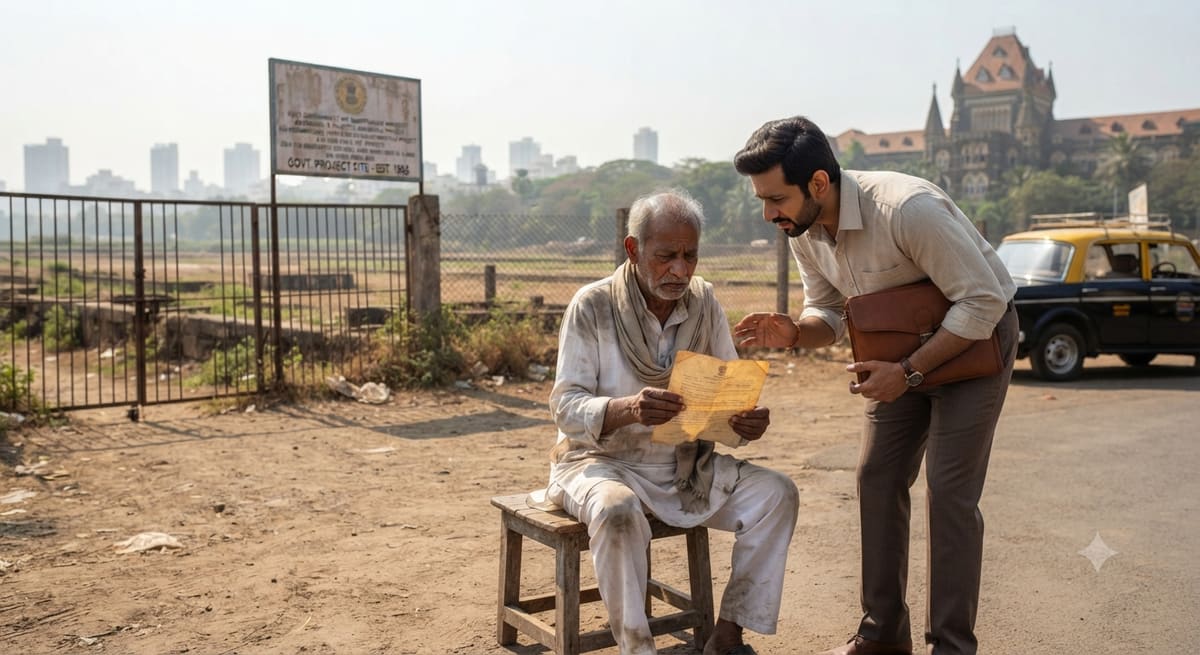
The petitioners, Vimal Babu Lande and another, sought to challenge the 1982 land acquisition award for land in Survey Nos. 61/1 and 61/3, Mauje-Nigadi, Pune. They alleged that although compensation was paid for only a portion of the land, the entire survey area was taken without adequate payment. The acquisition award was passed on 16.08.1982, and possession was handed over and compensation collected at that time.
Key Facts
- Land acquisition award dated 16.08.1982 was issued and accepted by the landowners
- Compensation was received and possession surrendered in 1982
- No grievance was raised until 2012, nearly 30 years later
- On 08.09.2023, the Collector, Pune, issued a reasoned order rejecting the petitioners’ claim, finding no substance in the allegation of under-compensation or unauthorized acquisition
- The writ petition was filed on 2025, over 42 years after the award
- The petition was filed by Constituted Attorney Sanjay Shamgir Gosavi
- A Power of Attorney dated 14.10.2015 was produced, authorizing Gosavi only to represent owners of Survey No. 61, Hissa No. 3/1 (80 Ares), not Survey Nos. 61/1 and 61/3
Procedural History
- 16.08.1982: Land acquisition award passed; compensation paid; possession surrendered
- 2012: First time grievance raised before authorities
- 08.09.2023: Collector’s order rejecting claim issued
- 2025: Writ Petition No. 15847 of 2025 filed before Bombay High Court
- 07.03.2026: Court issued notice, directed filing of award copy and cautioned against costs if claim lacked substance
- 2026: Interim Application No. 3104 of 2026 filed by purported landowners seeking withdrawal
The Parties' Positions
The petitioners, through their attorney, claimed that the acquisition covered more land than compensated. The State, through the Collector’s order dated 08.09.2023, had already rejected this claim as unsubstantiated. The petitioners did not file the petition themselves; it was filed by Sanjay Shamgir Gosavi, who claimed authority under a Power of Attorney.
Relief Sought
The petitioners sought quashing of the acquisition award or additional compensation for allegedly acquired but uncompensated land in Survey Nos. 61/1 and 61/3.
The Legal Issue
The central question was whether a writ petition can be maintained when filed by an attorney acting without any authority under the Power of Attorney, and whether the Court should impose costs for such abuse of process, particularly when the underlying claim is both time-barred and unsubstantiated.
Arguments Presented
For the Petitioner
The petitioners’ attorney, Siddhartha Ronghe, did not contest the lack of authority. The petition was filed on the basis of the claim that the acquisition was incomplete, relying on the constitutional right to property under Article 300-A. No argument was made to justify the 40-year delay.
For the Respondent
The State, through Additional Government Pleader B.V. Samant, argued that the petition was not only time-barred but also filed by an attorney who had no authority to represent the petitioners in respect of the lands in question. The State highlighted the defective Power of Attorney and the misleading nature of the vakalatnama, which bore a signature inconsistent with the thumb impression used in official records.
The Court's Analysis
The Court observed that the petitioners had accepted compensation and surrendered possession in 1982, yet waited until 2012 to raise any grievance - a delay of three decades. The Collector’s 2023 order had already examined the claim and found it without substance. The Court noted a troubling trend of litigants approaching writ courts decades after land acquisition proceedings concluded.
"We find a tendency on the part of citizens of this country to approach the Writ Court after decades, raking up issues pertaining to land acquisition proceedings that took place 30 to 40 years ago."
The Court then turned to the conduct of the Constituted Attorney, Sanjay Shamgir Gosavi. The Power of Attorney explicitly authorized representation only for Survey No. 61, Hissa No. 3/1 (80 Ares), yet the petition was filed for Survey Nos. 61/1 and 61/3 - entirely different parcels. The Court found this to be a deliberate misrepresentation.
Further, the Court noted a discrepancy between the signature on the vakalatnama and the thumb impression used by the same petitioner in official documents before the Deputy Collector. This raised serious questions about the identity and authenticity of the petitioners themselves.
"The conduct of the said Constituted Attorney to misled this Court by giving an impression that he was authorized to represent the owners... is reprehensible and it cannot be ignored."
The Court held that the Interim Application seeking withdrawal was legally defective because the applicants had not filed the petition - only the attorney had. The proper remedy, if any, would have been to seek dismissal on grounds of lack of authority, not withdrawal.
The Verdict
The Interim Application No. 3104 of 2026 was dismissed. The writ petition was dismissed with costs. The Constituted Attorney, Sanjay Shamgir Gosavi, was directed to deposit Rs. 50,000 within four weeks into the High Court Employees Medical Welfare Fund account. The Court emphasized that such abuse of process, particularly when coupled with fraudulent representation, warrants punitive costs to deter future misconduct.
What This Means For Similar Cases
Unauthorized Representation Will Not Be Tolerated
- Practitioners must verify the scope of authority under Power of Attorney before filing any petition
- Filing a petition beyond the scope of authorization constitutes professional misconduct and may attract costs
- Courts will scrutinize signatures and identification documents where discrepancies arise
Delayed Writ Petitions in Land Acquisition Face High Hurdles
- Writ petitions challenging acquisition awards after 30+ years are viewed with extreme skepticism
- Acceptance of compensation and surrender of possession constitutes acquiescence
- Courts will not entertain belated claims unless there is clear, contemporaneous evidence of fraud or coercion
Costs as a Deterrent for Abuse of Process
- Courts are increasingly willing to impose costs on attorneys who mislead the court
- The Rs. 50,000 cost order sets a precedent for punitive action against unethical conduct
- Legal representatives must ensure factual accuracy and authority before initiating litigation