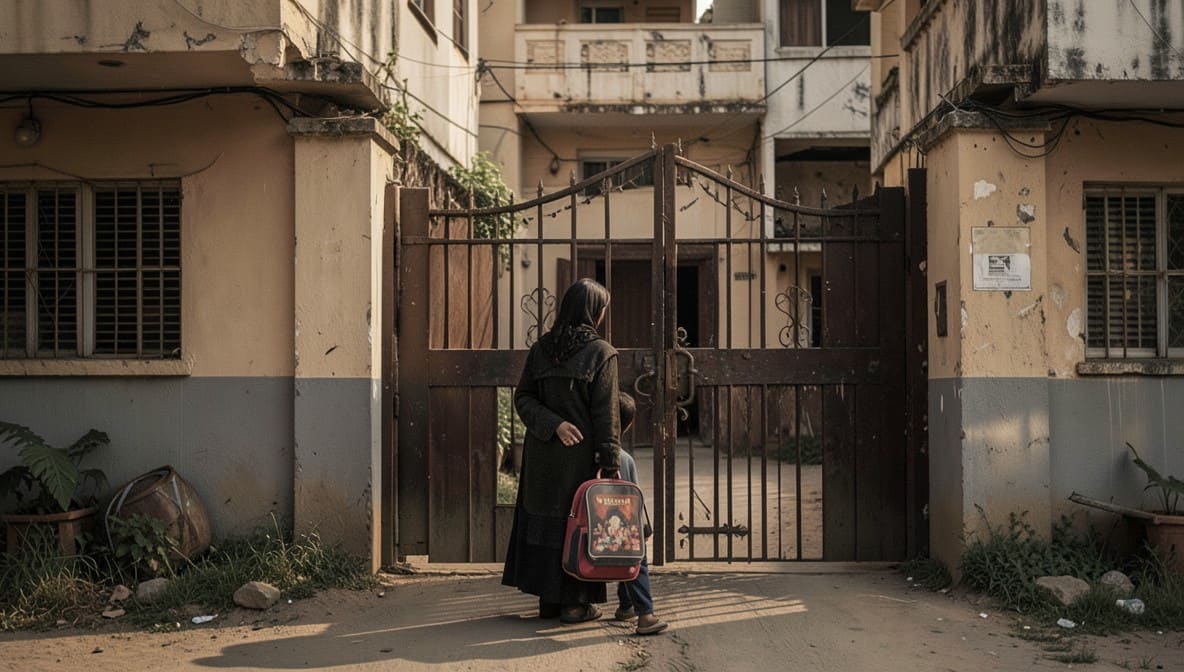
The Delhi High Court dismissed a Regular Second Appeal seeking possession of a suit property, holding that under Mohammedan law a will bequeathing more than one-third of a share requires consent of other legal heirs, the Declaration of Surrender was invalid due to lack of registration, and the defendant-wife was entitled to reside in the property under Section 39 of the Transfer of Property Act.
Background & Facts
The Dispute
The appellant, Sheikh Firozuddin, claimed exclusive ownership of suit property bearing No. G-45-B, East of Kailash, New Delhi, and sought possession of one room on the first floor occupied by the respondent, Farida (ex-wife of his brother), along with damages and injunction to restrain her from using common facilities.
Key Facts
- The plot bearing No. G-45-B, East of Kailash, New Delhi (327.19 sq. m.) was allotted by DDA to the appellant and his mother, Smt. Saeedan Nisa, on 09.10.1989
- Smt. Saeedan Nisa executed a will dated 05.03.2008 (Ex.PW-1/H) allegedly bequeathing her share to the appellant
- Smt. Saeedan Nisa died on 15.07.2008
- Mr. Aftab Ahmad (appellant's brother) married the respondent; this was his second marriage and her third marriage
- Mr. Aftab Ahmad divorced the respondent per Sharia law on 17.10.2008 (disputed in proceedings)
- In June 2010, the respondent forcibly entered and trespassed into one room of the first floor of the suit premises
- The appellant served a legal notice dated 19.10.2010 on the respondent to vacate the suit property and pay Rs. 10,000/- per month for unauthorised use
- The suit was filed for decree of possession of one room, mesne profits/damages at Rs. 10,000/- per month, and permanent injunction
Procedural History
- 12.05.2011: Issues in pleadings framed by trial court
- 16.01.2013: Learned Civil Judge dismissed the suit (Judgment dated 16.01.2013)
- 27.02.2015: Learned Additional District Judge upheld dismissal in First Appeal (RCA No. 65/2013)
- 13.10.2026: Present Regular Second Appeal (RSA 316/2015) decided by High Court
The Parties' Positions
Appellant's Case: He was the absolute owner via mother's will; respondent had no right to reside as divorced wife of brother; Declaration of Surrender dated 15.09.2008 (Ex.PW-1/I) transferred brother's share to him; entitled to possession and injunction.
Respondent's Case: Will not proved; under Mohammedan law mother could only bequeath 1/3 share without heir consent; Agreement dated 23.04.1996 (Mark-A) conferred no ownership rights; Declaration of Surrender invalid; entitled to residence as wife under Section 39 TPA.
Relief Sought
The appellant sought: (1) Decree of possession for one room on first floor; (2) Mesne profits/damages at Rs. 10,000/- per month; (3) Permanent injunction restraining respondent from using common facilities or occupying other portions.
The Legal Issue
The central question was whether the trial and appellate courts were justified in not granting the limited relief prayed for in part (c) of the plaint - namely, to restrain the respondent from entering and occupying any portion of the suit property beyond the one room found to be in her occupation - particularly in view of the findings regarding the validity of the will under Mohammedan law and the Declaration of Surrender under the Registration Act.
Arguments Presented
For the Appellant
The appellant relied on the will dated 05.03.2008 to claim exclusive ownership, asserting that his mother had bequeathed her entire share to him. He contended that the Declaration of Surrender dated 15.09.2008, executed by Mr. Aftab Ahmad in his favour, was a valid relinquishment of share. He argued that as the respondent was divorced per Sharia law on 17.10.2008, she had no right to reside in the suit property, which was not her matrimonial home, and that he had no obligation to provide her residence.
For the Respondent
The respondent challenged the will's validity, noting the attesting witness (PW-5) could not identify signatures on the will and testimony contained inconsistencies. She argued that under Mohammedan law, Mst. Saidul Nisa could not bequeath more than one-third of her share without consent of all legal heirs, and no such consent was proved. She asserted that the Agreement dated 23.04.1996 (Mark-A) was merely an inter-se arrangement for occupation, not transfer of ownership, and the Declaration of Surrender was invalid for lack of stamping and registration under Sections 17 and 49 of the Registration Act, 1908. Crucially, she contended that as the wife of Mr. Aftab Ahmad (a co-owner), she had a right of residence under Section 39 of the Transfer of Property Act, which could not be defeated by the appellant's actions.
The Court's Analysis
The court first examined the validity of the will dated 05.03.2008. It held that the attesting witness (Mr. Shakeel Ahmad) nowhere identified his signatures on the will or those of the executant, Smt. Saidul Nisa, and his testimony showed major discrepancies during cross-examination. The court concluded: "It was thus, concluded that this Will had not been typed in his presence and he was unable to prove the authenticity of the Will. Therefore, it was held that the Will was not proved in accordance with law."
Turning to Mohammedan law principles, the court observed: "It was further observed that parties to the Suit, were Mohammedans (Muslims) and therefore, Plaintiff's mother Mst. Saidul Nisa could not have bequeathed her entire share in the suit property, in favour of the Plaintiff, by virtue of Will dated 05.03.2008 Ex.PW-1/H, unless all her Legal Heirs gave their consent in bequeathing her estate in excess of 1/3rd share in the suit property and such bequest was not valid." The court found no proof of consent from other legal heirs for a bequest exceeding one-third share.
Regarding the Declaration of Surrender dated 15.09.2008, the court held it "was neither stamped nor registered, as per Sections 17 and 49 of the Indian Registration Act" and thus "could not be considered as a valid document for relinquishing the share of Mr. Aftab Ahmad, in favour of the Plaintiff." It further noted that under Mohammedan law, consent of other legal heirs to a bequest must be obtained after the testator's death, and a declaration by one heir alone "cannot be the consent of all the other legal heirs."
On Section 39 of the Transfer of Property Act, the court emphasized: "Section 39 of the Transfer of Property Act provides as under: '39. Transfer where third person is entitled to maintenance. - Where a third person has a right to receive maintenance, or a provision for advancement or marriage, from the profits of immoveable property, and such property is transferred, the right may be enforced against the transferee, if he has notice thereof or if the transfer is gratuitous; but not against a transferee for consideration and without notice of the right, nor against such property in his hands.'" The court held that Mr. Aftab Ahmad (respondent's husband) could not have transferred his share to defeat the respondent's right of maintenance while matrimonial litigation was pending, stating: "In view of Section 39 of the Transfer of Property Act, Mr. Aftab Ahmad (Defendant's husband) could not have transferred his share in favour of the Plaintiff (his brother), while there was matrimonial litigation pending between the Defendant and her husband Mr. Aftab Ahmad, purely to defeat and deprive the Defendant's right of maintenance."
The court concluded that the plaintiff had failed to prove exclusive ownership, remaining only a 50% shareholder in his individual capacity. It found no merit in the limited relief sought for injunction beyond the one room already occupied, noting: "In the absence of evidence establishing a threatened entry into any other portion in the Plaintiff's possession, the limited relief of injunction was rightly declined by both the Courts below."
The Verdict
The Regular Second Appeal was dismissed. The plaintiff failed to prove exclusive ownership under Mohammedan law as the will exceeded the permissible one-third share without heir consent. The Declaration of Surrender was invalid for lack of registration. The defendant-wife was entitled to reside in the suit property under Section 39 of the Transfer of Property Act as the wife of a co-owner. No injunction was granted beyond the one room already occupied by the respondent. Costs of the appeal were awarded to the respondent.
What This Means For Similar Cases
Mohammedan Wills Require Heir Consent for >1/3 Share
Practitioners must verify that under Mohammedan law, a will bequeathing more than one-third of a share requires explicit consent of all legal heirs. Mere execution of a will is insufficient; the burden lies on the beneficiary to prove heir consent for any bequest exceeding the statutory limit. This judgment reinforces that testamentary capacity under Mohammedan law is constrained by the rights of legal heirs.
Section 39 TPA Protects Spousal Maintenance Rights
Section 39 of the Transfer of Property Act creates a substantive right that runs with the property. A spouse's right to maintenance cannot be defeated by a transfer of the property share during pending matrimonial litigation. Lawyers advising clients on property transfers must investigate whether Section 39 TPA applies, as it may invalidate ostensibly valid transfers intended to deprive a spouse of residence rights.
Declaration of Surrender Must Be Registered
Any relinquishment of share via Declaration of Surrender must comply with the Registration Act, 1908 - specifically Sections 17 (compulsory registration) and 49 (effect of non-registration). An unregistered declaration is inadmissible as evidence of title transfer and cannot defeat existing rights under statutes like Section 39 TPA. This serves as a strict compliance reminder for property practitioners.
Limited Injunction Requires Evidence of Threatened Beyond Current Occupation
Courts will not grant injunctions to restrain occupation beyond what is already in possession without concrete evidence of threatened entry into other portions. The burden is on the plaintiff to demonstrate imminent trespass or occupation beyond the current scope; mere allegations or past incidents without present threat are insufficient.