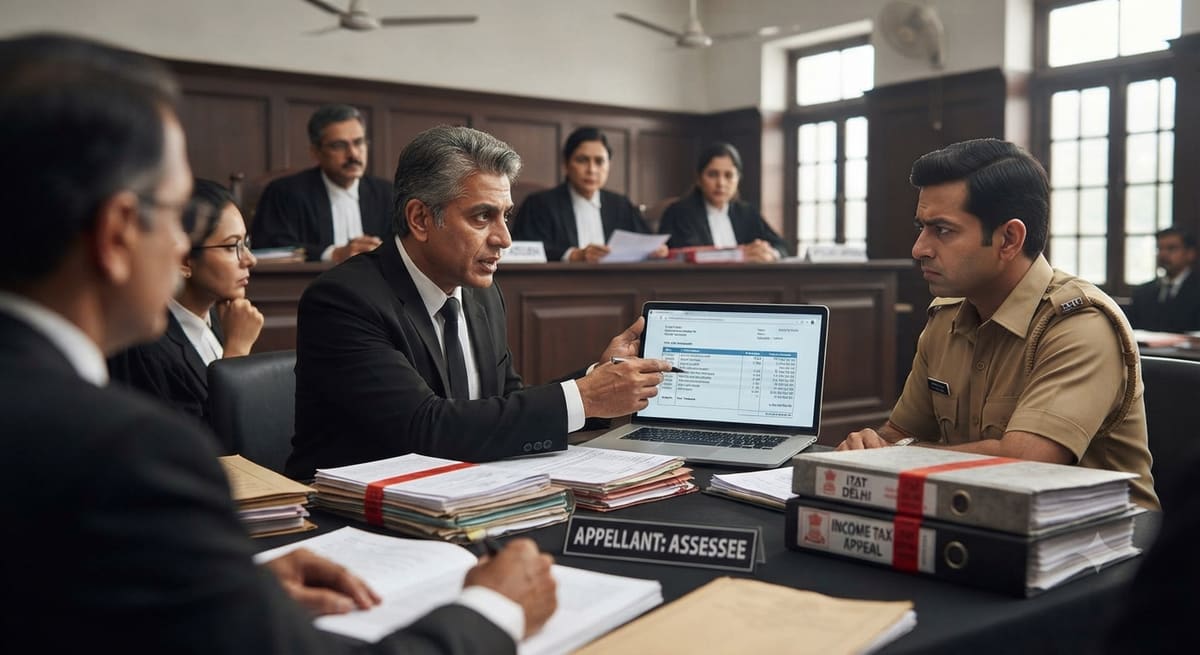
The Income Tax Appellate Tribunal, Kolkata, has reaffirmed a foundational principle in direct tax jurisprudence: when corresponding sales are accepted by tax authorities, disallowance of purchases on speculative grounds is impermissible. The Tribunal also held that WhatsApp chat transcripts, absent independent corroboration, cannot sustain an income addition under Sections 69A or 145(3) of the Income Tax Act.
Background & Facts
The Dispute
The appellant, Balmukund Concast Pvt. Ltd., a manufacturer of steel products, faced reassessment proceedings for Assessment Years (AY) 2019-20 and 2023-24 following a search operation under Section 132 of the Income Tax Act conducted on 30.11.2022. The search targeted the Kanodia Group of companies, of which the appellant was a related entity. The Revenue alleged suppression of income through bogus purchases from shell companies and unaccounted cash transactions via WhatsApp communications.
Key Facts
- AY 2019-20: The assessee filed its return on 30.10.2019 declaring total income of ₹7,62,84,690 and book profit under Section 115JB of ₹7,22,45,510. The return was processed under Section 143(1) on 30.04.2020.
- The assessee purchased raw materials (MS Billet and sponge iron) worth ₹3,11,47,131 from M/s Rajmata Dealers Pvt. Ltd. during AY 2019-20.
- M/s Rajmata Dealers Pvt. Ltd. was identified by the Directorate of Income-Tax (Investigation), Kolkata, as a shell company with no physical assets, no rent payments, and sudden surge in turnover only in AY 2019-20.
- The Assessing Officer (AO) added ₹12,45,885 (4% of ₹3,11,47,131) as suppressed income, alleging the purchases were from a shell entity with no actual movement of goods.
- The assessee submitted invoices, e-way bills, transport documents, audited financials, and confirmation letters from M/s Rajmata Dealers Pvt. Ltd. All documents were seized during the search.
- The statutory audit and tax audit reports, prepared by independent auditors, classified the purchases as genuine raw material inputs.
- AY 2023-24: The assessee filed its return on 29.10.2023 declaring income of ₹16,64,81,050. The AO identified discrepancies between dispatch slips seized during search and actual sales recorded in books, leading to an addition of ₹47,93,460 (12% of ₹3,99,45,500) for suppressed sales.
- The dispatch slips showed higher prices than final invoices due to discounts, payment terms, and unexecuted orders.
- The AO also relied on WhatsApp chats between Shri Rajesh Dhandaria (employee) and Shri Patna Tiwarji/Rajeev Kanodia (third parties) to allege unaccounted cash transactions of ₹1,53,00,000. The CIT(A) sustained ₹20,47,140 of this addition after applying a gross profit (GP) rate of 13.38%.
- No independent evidence linked the WhatsApp chats to the assessee’s business or confirmed receipt of cash.
Procedural History
- 30.11.2022: Search conducted under Section 132 at assessee’s premises and associated entities.
- 30.04.2020: AY 2019-20 return processed under Section 143(1).
- 10.01.2024: AY 2023-24 return processed under Section 143(1).
- 14.04.2025: Order of National Faceless Appeal Centre (CIT(A)) issued.
- 15.04.2025: CIT(A) order dated 14.04.2025 received by parties.
- ITA No. 1892/KOL/2025 (AY 2019-20): Filed by assessee on 15.04.2025 (delayed by 20 days).
- ITA No. 1893/KOL/2025 (AY 2023-24): Cross appeal filed by Revenue on 15.04.2025.
- ITA No. 1380/KOL/2025 (AY 2023-24): Appeal filed by assessee on 15.04.2025.
- 09.02.2026: Hearing held before ITAT Kolkata.
- 15.04.2026: Judgment pronounced.
The Parties' Positions
For the Assessee
- Contended that purchases from M/s Rajmata Dealers Pvt. Ltd. were genuine, supported by invoices, e-way bills, transport records, and audit reports.
- Argued that the AO’s addition of ₹12,45,885 was based on surmises, not evidence, and violated the settled principle that if sales are accepted, corresponding purchases cannot be disallowed.
- Submitted that WhatsApp chats were not corroborated, lacked context (no indication of receipt/payment), and involved third parties not connected to the assessee’s books.
- Relied on DCIT v. Sharp Mint Ltd. and Balmukund Sponge and Iron Pvt. Ltd. v. DCIT to support the position.
For the Revenue
- Argued that M/s Rajmata Dealers Pvt. Ltd. was a shell company with no real business, making purchases from it inherently suspect.
- Claimed that discrepancies between dispatch slips and invoices indicated suppression of sales.
- Contended that WhatsApp chats revealed unaccounted cash transactions and justified addition under Section 69A or as unexplained income.
- Sought restoration of the CIT(A)’s order sustaining ₹20,47,140 addition and reversal of deletion of ₹1,32,52,860.
Relief Sought
- Assessee sought deletion of all additions: ₹12,45,885 (AY 2019-20), ₹47,93,460 (AY 2023-24), and ₹20,47,140 (AY 2023-24).
- Revenue sought restoration of the CIT(A)’s additions totaling ₹1,53,00,000 (₹20,47,140 sustained + ₹1,32,52,860 deleted).
The Legal Issue
The central questions were: (1) Whether the disallowance of purchases is sustainable when corresponding sales have been accepted by the tax authorities, and (2) Whether WhatsApp chat transcripts, without independent corroboration, can form the basis for an income addition under Sections 69A or 145(3) of the Income Tax Act.
Arguments Presented
For the Appellant/Petitioner
The assessee relied on the principle established in DCIT v. Sharp Mint Ltd. [2024] 159 taxmann.com 1381 (Delhi - Trib.), which held that once sales are accepted, disallowance of corresponding purchases on the basis of the supplier being a shell company is legally unsustainable. The assessee further cited Balmukund Sponge and Iron Pvt. Ltd. v. DCIT (order dated 09.12.2025), where the same Bench held that WhatsApp chats lacking corroboration cannot justify any addition, even if a gross profit rate is applied. The assessee emphasized that the documents submitted - invoices, e-way bills, transport records, audit reports, and supplier confirmations - were all seized during the search and formed a complete evidentiary chain. The absence of any proof of cash receipt or benefit to the assessee rendered the WhatsApp chat-based addition legally untenable.
For the Respondent/State
The Revenue contended that the supplier, M/s Rajmata Dealers Pvt. Ltd., was a known shell entity with no assets, no rent, and no prior business history, making the purchases inherently fraudulent. It argued that the 4% addition was a reasonable estimate under Section 145(3). Regarding the WhatsApp chats, the Revenue maintained that the chats were found in the possession of a key employee and reflected unaccounted transactions. It relied on the CIT(A)’s application of GP rate as a valid method to estimate undisclosed income, citing the principle of prima facie suspicion.
The Court's Analysis
The Tribunal undertook a meticulous review of the evidentiary record and applicable precedents. It observed that the AO had not produced any independent evidence to prove that the goods purchased from M/s Rajmata Dealers Pvt. Ltd. were not physically received or utilized in manufacturing. The Tribunal noted that the assessee had submitted all supporting documents - invoices, e-way bills, transport records, and supplier confirmations - which were seized during the search. The statutory audit and tax audit reports, prepared by independent professionals, had not raised any objection to the purchases.
"It is settled law that no addition is permissible on the basis of surmise and conjecture. When corresponding sales have been accepted, disallowance for bogus purchase is not sustainable."
The Tribunal held that the CIT(A)’s deletion of ₹12,45,885 was well-reasoned and aligned with the decision in Sharp Mint Ltd. The Tribunal emphasized that the burden to prove the purchases were bogus lay with the Revenue, which failed to discharge it.
Regarding the AY 2023-24 sales suppression addition of ₹47,93,460, the Tribunal accepted the assessee’s explanation that dispatch slips recorded maximum prices inclusive of GST, while final invoices reflected discounts, payment terms, and unexecuted orders. The Tribunal examined the dispatch slips and corresponding invoices (pages 196-280) and found that the discrepancies were explainable and not indicative of suppression.
"The authorities below have not brought any material on record to show that the assessee has received the differential cash or in kind."
On the WhatsApp chat issue, the Tribunal squarely applied its own decision in Balmukund Sponge and Iron Pvt. Ltd. v. DCIT. It held that WhatsApp chats, even if found in the possession of an employee, cannot be treated as evidence against the company unless corroborated by independent material. The chats did not specify whether amounts were receipts or payments, nor did they link the transactions to the assessee’s books. The Tribunal rejected the application of Section 69A, noting that no unexplained money was found. It also clarified that the presumption under Section 292C is rebuttable, and the assessee had successfully rebutted it.
The Verdict
The assessee succeeded on all grounds. The Tribunal dismissed the Revenue’s appeals and allowed the assessee’s appeals. The addition of ₹12,45,885 for AY 2019-20, ₹47,93,460 for AY 2023-24, and ₹20,47,140 for AY 2023-24 were all deleted. The Revenue’s cross-appeal challenging the deletion of ₹1,32,52,860 was dismissed as infructuous. The Tribunal directed the Assessing Officer to delete the additions and pass a fresh order consistent with this judgment.
What This Means For Similar Cases
Sales Acceptance Bars Purchase Disallowance
- Practitioners must argue that if the Revenue accepts the sales side of a transaction, disallowing the corresponding purchases on the basis of the supplier’s alleged shell status is legally untenable.
- The burden shifts to the Revenue to prove the absence of actual goods movement or benefit - mere financial analysis of the supplier is insufficient.
- Tax audit reports and independent auditor confirmations carry significant evidentiary weight and must be addressed by the AO.
WhatsApp Chats Require Corroboration
- WhatsApp chats alone, even if seized during a search, cannot form the basis for an income addition under Sections 69A, 69B, or 145(3).
- The chats must be linked to the assessee’s business through independent evidence - bank records, invoices, or witness testimony.
- The presumption under Section 292C is rebuttable; the assessee can successfully rebut it by showing the chats relate to third parties or non-business matters.
- Applying a gross profit rate on uncorroborated WhatsApp chats is legally invalid.
Procedural Rigor in Search-Based Assessments
- Assessing Officers must avoid speculative additions based on group company data or association.
- All documents seized must be examined holistically; selective reliance on suspicious patterns without proof of benefit to the assessee is impermissible.
- Tribunals will scrutinize whether the Revenue has discharged its burden of proof, especially in cases involving shell companies and digital communications.