The Chhattisgarh High Court has affirmed that a conviction for rape under Section 376 IPC may stand even in the absence of DNA evidence, provided the victim’s testimony inspires complete confidence. In a significant ruling, the Court set aside convictions under the Scheduled Castes and Scheduled Tribes (Prevention of Atrocities) Act, 1989, due to failure to prove the victim’s caste status, while upholding the core rape conviction.
Background & Facts
The Dispute
The case arose from a brutal sexual assault committed against a married woman belonging to a Scheduled Caste community in Village Dhodhapur, Police Station Pathariya, District Mungeli, Chhattisgarh, during the night of 27-28.12.2017. The accused, Karan Singh Rajput (A-1), along with two co-accused - Kuleshwar Rajput (A-2) and Jitendra Rajput (A-3) - allegedly surrounded the victim as she went to answer the call of nature, held her limbs and mouth, and Karan Singh Rajput committed sexual intercourse with her. The victim reported the incident to the police the next day.
Key Facts
- The incident occurred on 27-28.12.2017 at approximately 11:00 PM.
- The victim, aged 29 years, is a deserted married woman.
- FIR (Ex.P/4) was registered on 28.12.2017 at 7:00 PM.
- Medical examination of the victim was conducted by Dr. S. Praveen; MLC report (Ex.P/23) recorded four injuries.
- Vaginal swabs were collected and sent for forensic analysis; FSL report (Ex.C-1) confirmed presence of human sperm/semen on the slides.
- Four orange-colored bangles were recovered from the spot on 29.12.2017 (Ex.P/13).
- Spot map (Ex.P/05) and panchnama (Ex.P/02, Ex.P/03) were prepared on 29.12.2017.
- Victim’s statements under Section 161 CrPC were recorded on 28.12.2017 and 29.12.2017 (Ex.P/9, Ex.P/10).
- Victim’s statement under Section 164 CrPC was recorded on 03.01.2018 (Ex.P/07).
- Caste certificate (Ex.P/17) was issued on 28.01.2012 by the Tehsildar, Pathariya.
- The accused were arrested on 01.01.2018 (Ex.P/21, Ex.P/26, Ex.P/27).
- Charge sheet was filed on 15.03.2018.
- Trial commenced before the Special Judge (SC/ST Act), Mungeli.
Procedural History
- 15.03.2018: Charge sheet filed.
- 24.11.2021: Special Judge convicted Karan Singh Rajput (A-1) under Sections 376, 294, 506, 323, 342 IPC and Sections 3(2)(v), 3(1)(r), 3(1)(s) of the SC/ST Act; acquitted co-accused.
- 24.11.2021: Sentences imposed: 10 years RI under Section 376 IPC; life imprisonment under Section 3(2)(v) of the SC/ST Act; 4 years RI under Sections 3(1)(r) and 3(1)(s); all sentences to run concurrently.
- 12.06.2021: Criminal Appeal No. 1057 of 2021 filed by Karan Singh Rajput challenging conviction.
- 12.06.2021: Criminal Appeal No. 1418 of 2021 filed by the victim seeking enhancement to Section 376D IPC and 20 years RI.
- 21.04.2022: Acquittal Appeal No. 229/2021 filed by the victim against acquittal of co-accused dismissed by this Court.
- 24.03.2026: Judgment delivered by Division Bench of Chhattisgarh High Court.
The Parties' Positions
For the Accused (Appellant in CRA-1057/2021):
- Argued that absence of DNA matching renders FSL report unreliable under Krishan Kumar Malik v. State of Haryana.
- Contended that MLC report (Ex.P/23) is inadmissible as the examining doctor was not examined.
- Challenged the validity of caste certificate (Ex.P/17) as it was issued by Tehsildar, who was not the competent authority under the Chhattisgarh Rules, 2013.
- Asserted that the prosecution failed to prove the victim belonged to a Scheduled Caste on the date of offence.
For the State and Victim (Respondents in CRA-1057/2021; Appellant in CRA-1418/2021):
- Submitted that the victim’s testimony is consistent, credible, and unshaken in cross-examination.
- Relied on State of MP v. Dayal Sahu to argue that non-examination of doctor and absence of DNA evidence are not fatal if the victim’s statement inspires confidence.
- Argued that the charge under Section 376D IPC was not framed, and thus cannot be substituted at appellate stage.
- Highlighted that acquittal of co-accused has attained finality, making Section 376D inapplicable.
Relief Sought
Appellant (Karan Singh Rajput):
- Acquittal on all charges.
Appellant (Victim, PW-02):
- Conversion of conviction from Section 376 IPC to Section 376D IPC.
- Enhancement of sentence from 10 years RI to minimum 20 years RI.
The Legal Issue
The central questions were: (1) Whether conviction under Section 376 IPC can be sustained without DNA evidence or medical testimony, if the victim’s statement inspires confidence? (2) Whether the conviction under Sections 3(2)(v), 3(1)(r), and 3(1)(s) of the SC/ST Act, 1989 can stand when the victim’s caste certificate is unproved and issued by an incompetent authority? (3) Whether the conviction under Section 376D IPC can be substituted at the appellate stage when no charge was framed and co-accused were acquitted?
Arguments Presented
For the Appellant/Petitioner
The appellant’s counsel relied on Krishan Kumar Malik v. State of Haryana to argue that the prosecution’s failure to conduct DNA profiling of the semen found on the victim’s slides renders the forensic evidence inconclusive and legally insufficient. He further contended that the MLC report (Ex.P/23) could not be relied upon because the examining doctor, Dr. S. Praveen, was not examined, and the prosecution offered no explanation for this omission. Regarding the caste certificate (Ex.P/17), he emphasized that under Rule 9 of the Chhattisgarh Scheduled Castes, Scheduled Tribes and Other Backward Classes (Regulation of Social Status Certification) Rules, 2013, only the Sub-Divisional Officer (Revenue) was competent to issue such certificates after a formal inquiry. The Tehsildar, who issued the certificate on 28.01.2012, was not the competent authority under the 2013 Rules, and the witness who testified about the certificate (PW-08) admitted he neither issued it nor knew the issuer. Thus, the prosecution failed to prove the victim’s caste status on the date of offence.
For the Respondent/State
The State counsel argued that the victim’s testimony was clear, consistent, and corroborated by prompt FIR registration, recovery of bangles, and the FSL report confirming semen. Citing State of MP v. Dayal Sahu, the State maintained that the non-examination of the doctor and absence of DNA matching are not fatal if the prosecutrix’s testimony inspires confidence. The prosecution also submitted that the victim’s statement under Section 164 CrPC was recorded without coercion and remained unshaken in cross-examination. Regarding Section 376D, the State supported the trial court’s position that no charge was framed under that section, and the acquittal of co-accused rendered the ingredients of Section 376D inapplicable. The Amicus Curiae reinforced this, citing Chintambaramma v. State of Karnataka, to argue that substitution of charges at appellate stage without opportunity of defence violates the accused’s right to a fair trial.
The Court's Analysis
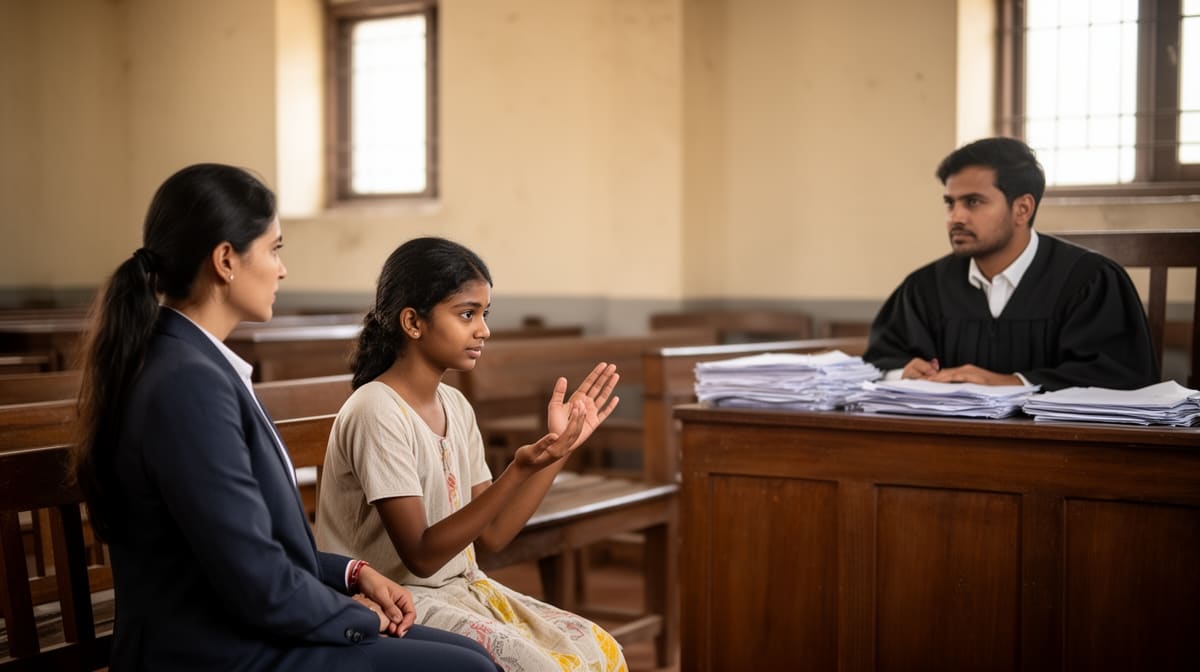
The Court undertook a meticulous review of the evidence and legal precedents. It acknowledged the prosecution’s failure to conduct DNA profiling of the semen found on the victim’s slides, noting that Krishan Kumar Malik v. State of Haryana had established that such testing is now a necessary step to ensure a foolproof case. However, the Court distinguished this case by emphasizing that the Supreme Court in State of MP v. Dayal Sahu had held that the non-examination of the doctor and absence of DNA evidence are not fatal if the victim’s testimony inspires confidence. The Court found that the victim’s account was detailed, consistent, and unshaken during prolonged cross-examination. She clearly identified Karan Singh Rajput as the sole perpetrator of sexual intercourse, while stating that the other two accused only held her limbs and mouth. The prompt filing of FIR and recovery of physical evidence (bangles) further supported her version.
"The testimony of victim (PW-02) is of sterling quality and, therefore, it is held that the learned trial Court has rightly convicted the appellant for offences under Sections 376, 294, 506, 323, 342 of IPC."
Regarding the SC/ST Act charges, the Court held that the caste certificate (Ex.P/17) was issued on 28.01.2012, prior to the 2013 Rules, but the State had issued a circular on 22.08.2013 clarifying that only the Sub-Divisional Officer (Revenue) was competent to issue caste certificates after that date. The witness who testified about the certificate (PW-08) admitted he was not the issuing officer and did not know who was. The Court concluded that the prosecution failed to prove the victim’s caste status on the date of offence beyond reasonable doubt. Consequently, the convictions under Sections 3(2)(v), 3(1)(r), and 3(1)(s) of the SC/ST Act were set aside.
On the issue of Section 376D IPC, the Court held that the charge was never framed by the trial court, and the accused was not given an opportunity to defend against it. The acquittal of co-accused on the same charge had attained finality. Citing Chintambaramma v. State of Karnataka, the Court emphasized that substitution of charges at the appellate stage without opportunity of defence is impermissible and violates the principles of natural justice. The Court observed that the accused was tried and convicted only under Section 376 IPC, and the prosecution did not seek to amend the charge during trial.
The Verdict
The appellant, Karan Singh Rajput, succeeded in part. The Chhattisgarh High Court affirmed his conviction under Sections 376, 294, 506, 323, and 342 IPC, with the original sentence of 10 years rigorous imprisonment under Section 376 IPC, 1 month under Section 294 IPC, 3 months under Sections 323 and 342 IPC, and 6 months under Section 506 IPC - all to run concurrently. The Court set aside his convictions under Sections 3(2)(v), 3(1)(r), and 3(1)(s) of the SC/ST Act, 1989, and acquitted him of those charges. The victim’s appeal for enhancement to Section 376D IPC and 20 years RI was dismissed. The Court directed the trial court to transmit the judgment to the jail authorities for necessary action.
What This Means For Similar Cases
Victim Testimony Can Sustain Rape Conviction Without DNA Evidence
- Practitioners must now argue that non-examination of the doctor and absence of DNA matching are not fatal if the victim’s testimony is credible, consistent, and unshaken in cross-examination.
- The State of MP v. Dayal Sahu principle is now firmly entrenched in Chhattisgarh jurisprudence: confidence in the prosecutrix’s account overrides technical gaps.
- In rural or under-resourced jurisdictions, prosecutors should focus on documenting the victim’s narrative in detail, including time, location, physical resistance, and immediate reporting.
Caste Certificate Must Be Proved by Competent Authority
- Prosecutions under the SC/ST Act must now prove not only the victim’s caste status but also the validity of the certificate’s issuance under applicable state rules.
- If a certificate was issued before state rules were amended, the prosecution must establish that the issuing authority was competent under the law prevailing at the time.
- Merely producing a certificate is insufficient; the chain of issuance and authority must be proven through documentary evidence and witness testimony.
Substitution of Charges Is Impermissible Without Opportunity of Defence
- Courts will not allow substitution of a more serious charge (e.g., Section 376D for Section 376) at the appellate stage if the original charge was not framed.
- The right to fair trial under Article 21 requires that the accused be informed of the exact nature of the charge and given a chance to meet it.
- Where co-accused are acquitted on the same charge, appellate courts will not infer joint liability to sustain a higher charge against the sole convict.