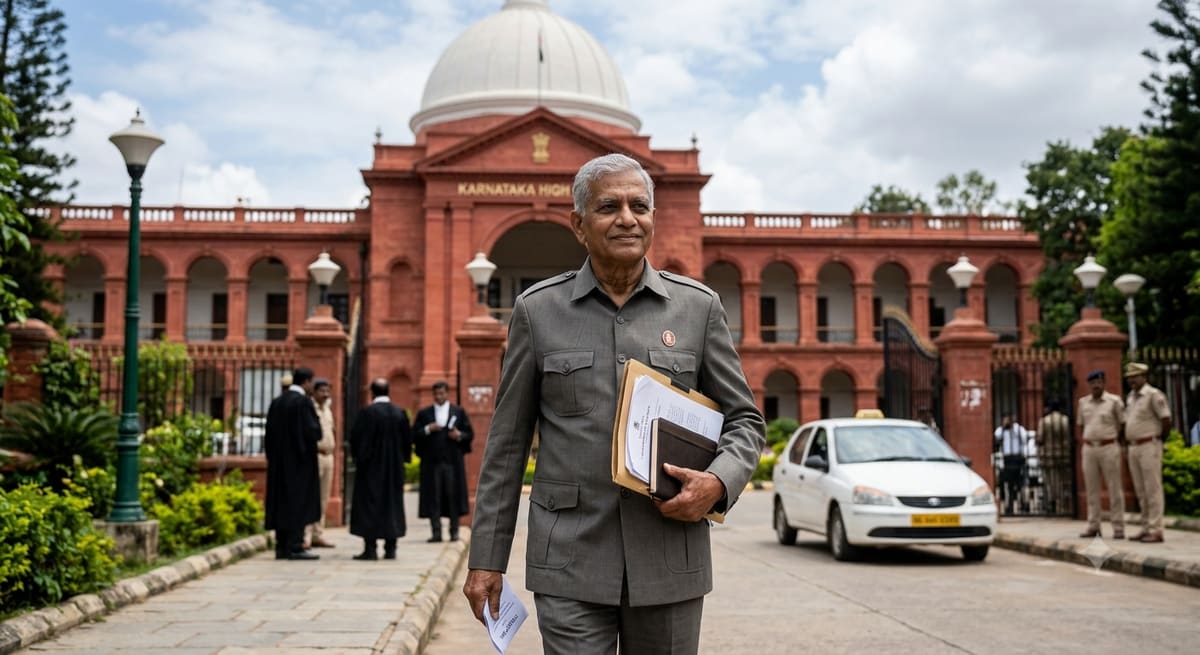
The Kerala High Court has affirmed the availability of transit bail as a constitutional safeguard when an accused faces inter-state arrest in a jurisdiction where they cannot immediately seek anticipatory bail. This order clarifies the limits of territorial jurisdiction in bail matters under the new Bharatiya Nagarik Suraksha Sanhita, 2023, and reinforces the judiciary’s role in preventing arbitrary detention.
Background & Facts
The Dispute
The petitioner, Fawaz Mon K, aged 30, is named as an accused in Crime No. 132/2026 registered at Govindpuri Police Station, South East District, New Delhi. The alleged offences fall under Sections 318(4), 95, and 61(2) of the Bharatiya Nyaya Sanhita, 2023. The petitioner, a resident of Malappuram, Kerala, fears imminent arrest by authorities in Delhi and seeks protection from coercive action pending his ability to approach the appropriate jurisdictional court.
Key Facts
- The petitioner is a resident of Muthiraparamba, Valluvambram, Malappuram, Kerala, with no known residence or business presence in Delhi.
- The FIR was registered in New Delhi, placing the jurisdictional court outside the territorial authority of the Kerala High Court.
- The petitioner has submitted annexures including a notice under Section 35(3) of the Bharatiya Nagarik Suraksha Sanhita dated 07.06.2026, corporate incorporation certificate, GST registration, and a bank lien notice.
- The petitioner filed a writ petition (WP No. 10402/2026) before the Kerala High Court on an urgent basis, seeking protection from arrest.
- The petitioner has no prior criminal record and has cooperated with authorities through legal representation.
Procedural History
- 07.06.2026: Notice issued under Section 35(3) of BNSS, 2023, intimating the petitioner of potential arrest.
- 19.06.2026: Bail application filed under Section 482 of BNSS, 2023, before the Kerala High Court.
- 19.06.2026: Hearing conducted before Dr. Justice Kauser Edappagath.
The Parties' Positions
For the Petitioner
The petitioner’s counsel argued that:
- The petitioner cannot approach the Delhi court immediately due to geographical and logistical constraints.
- The threat of arrest without prior opportunity to seek bail violates Article 21 of the Constitution.
- The petitioner has no connection to Delhi and is not a flight risk.
- The Supreme Court in Priya Indoria v. State of Karnataka recognized the power of non-jurisdictional courts to grant transit bail.
For the Respondent
The Public Prosecutor did not oppose the grant of transit bail but emphasized that the petitioner must approach the jurisdictional court in Delhi within a reasonable time.
Relief Sought
The petitioner sought interim protection from arrest until he can approach the court in Delhi with territorial jurisdiction to entertain an application for anticipatory bail.
The Legal Issue
Can a High Court, lacking territorial jurisdiction over the place where the FIR is registered, grant interim protection from arrest to an accused who cannot immediately approach the jurisdictional court, and if so, under what legal mechanism?
Arguments Presented
For the Petitioner
The petitioner relied on the Supreme Court’s decision in Priya Indoria v. State of Karnataka (2023 KHC OnLine 6997), which held that while a High Court cannot grant anticipatory bail in cases outside its territorial jurisdiction, it retains the power to issue transit bail to prevent arbitrary detention. The counsel argued that the petitioner’s inability to travel to Delhi immediately, coupled with the seriousness of the allegations, justified interim protection under Article 21. The annexures submitted demonstrated the petitioner’s legitimate business presence in Kerala and absence of any nexus with Delhi.
For the Respondent
The Public Prosecutor did not contest the grant of transit bail but stressed that such relief must be time-bound and conditional upon the petitioner approaching the jurisdictional court. The State acknowledged the constitutional imperative to protect personal liberty but maintained that the ultimate authority to grant anticipatory bail rests solely with the court having jurisdiction over the offence.
The Court's Analysis
The Court examined the evolving jurisprudence on transit bail under the Bharatiya Nagarik Suraksha Sanhita, 2023, and reaffirmed the principle that the right to personal liberty under Article 21 cannot be suspended merely due to jurisdictional boundaries. The Court noted that while Section 482 of BNSS does not explicitly mention transit bail, the inherent powers of the High Court under Article 226 of the Constitution permit such relief to prevent abuse of process and protect fundamental rights.
"Though this Court is not in a position to grant pre-arrest bail in cases where crimes have been registered outside the territorial jurisdiction, this Court is empowered to pass an order of transit bail."
The Court found the petitioner’s apprehension of arrest to be well-founded, particularly given the notice issued under Section 35(3) of BNSS and the absence of any indication that the Delhi authorities would permit remote application for bail. The Court emphasized that transit bail is not a substitute for anticipatory bail but a temporary measure to ensure access to justice. The three-week window was deemed sufficient for the petitioner to arrange legal representation and file an application before the appropriate court in Delhi.
The Verdict
The bail application was disposed of with liberty to the petitioner to approach the jurisdictional court in Delhi to seek anticipatory bail within three weeks from the date of this order. The respondent No. 2, the Station House Officer, Govindpuri Police Station, is directed not to arrest the petitioner until the expiry of the three-week period. The petitioner shall be entitled to remain at liberty during this time, subject to compliance with any conditions imposed by the jurisdictional court.
What This Means For Similar Cases
Transit Bail Is a Constitutional Safeguard
- Practitioners may now invoke transit bail as a procedural right under Article 21 when clients face inter-state arrest threats.
- The three-week window set by the Kerala HC provides a clear, enforceable timeframe for approaching jurisdictional courts.
Jurisdictional Barriers Do Not Override Liberty
- Courts outside the territorial jurisdiction of the FIR are not powerless - they can and must act to prevent arbitrary detention.
- The burden is on the state to demonstrate why immediate arrest is necessary; mere registration of an FIR does not justify detention without access to judicial remedy.
Procedural Compliance Must Be Practical
- Notices under Section 35(3) of BNSS trigger the right to seek transit bail.
- Annexures proving residence, business ties, and lack of connection to the offence jurisdiction strengthen the application.
- Courts should not require physical presence in the FIR jurisdiction before granting interim protection.